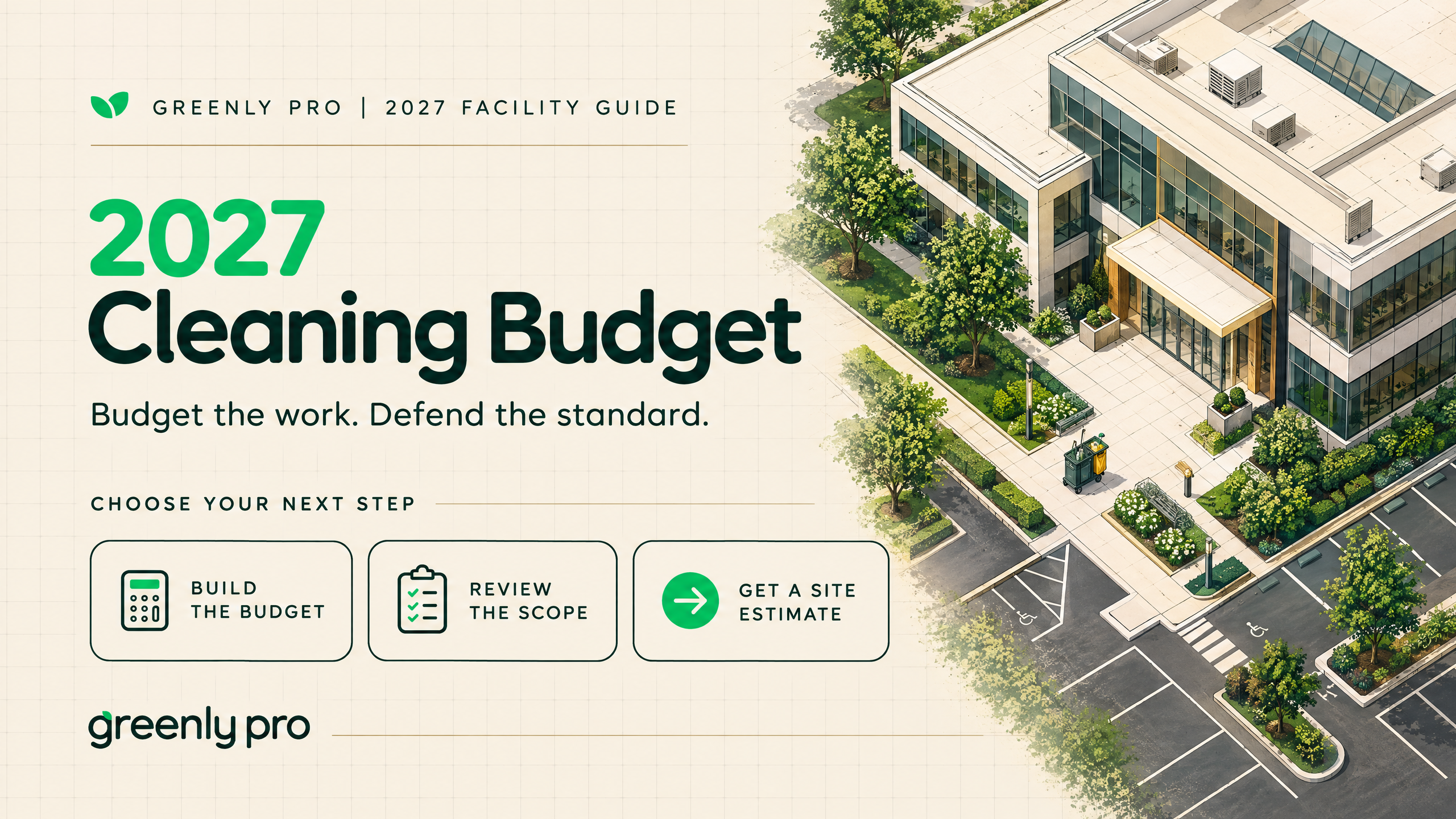
When a facility manager is asked for a commercial cleaning budget (2027), the usual instinct is to open last year’s contract, add a percentage, and call it planning. It is understandable. It is also how a budget becomes hard to defend the moment someone asks what changed.
A better budget starts with the work the building actually needs: the cleanable space, the people using it, the task frequencies, the service standard, the periodic projects, and the risk of leaving something out. That does not make budgeting slower. It makes the conversation simpler.
You can point to the reason a number moved. Maybe occupancy rose. Maybe a fifth day of service returned. Maybe restrooms, shared kitchens, or high-touch areas need more attention. Maybe carpet extraction and floor care were never part of the monthly contract in the first place.
The planning principle: Do not forecast one mysterious percentage. Build a 2027 budget that separates baseline cleaning, scope changes, periodic work, and a visible reserve.
This planner is designed for office, medical-office, flex, retail, and multifamily common-area teams in Greater Boston. It is not a promise of a future price. It is a way to prepare a realistic request before the provider renewal or RFP process begins.
The four lines every commercial cleaning budget 2027 should show
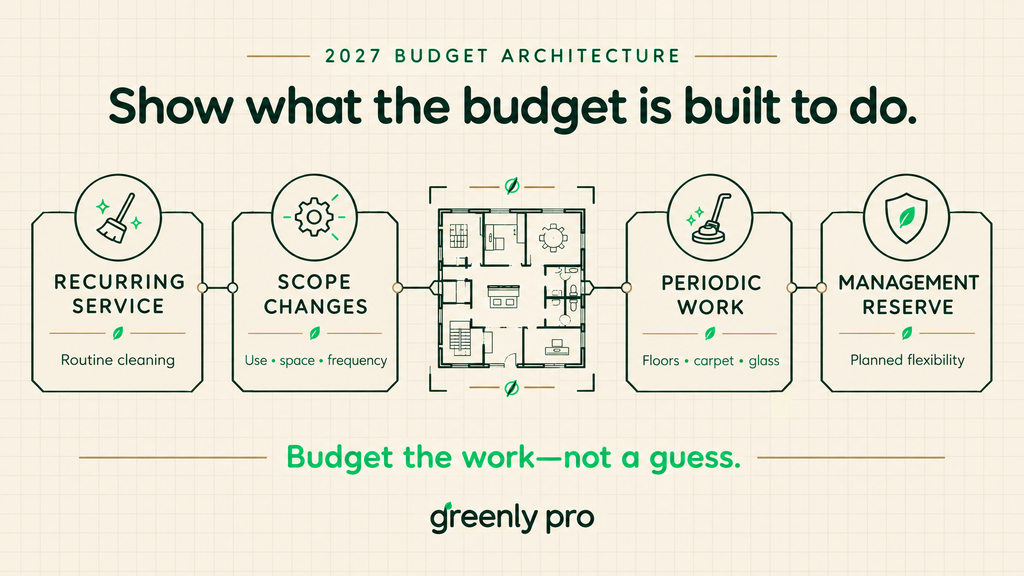
A useful cleaning budget does not hide every cost inside one monthly number. Use four lines, even if your final presentation condenses them later.
| Budget line | What belongs here | What it prevents |
| 1. Recurring service | Contracted routine cleaning: restrooms, trash, vacuuming, mopping, touchpoints and common areas at the agreed frequency | Assuming the base program covers every task |
| 2. Scope changes | Added square footage, occupancy shifts, new schedules, revised frequencies, new tenant areas or changes in building use | Calling an operational change “inflation” |
| 3. Periodic work | Carpet extraction, hard-floor care, interior glass, high dusting, upholstery, post-event recovery and other planned projects | Funding projects from an already-stretched monthly line |
| 4. Management reserve | A deliberate allowance for unplanned cleanups, access changes, small resets or approved contingencies | Treating every exception as an emergency request |
The first three lines describe the work. The fourth protects the plan from normal operating variation.
If your current contract has one flat number, begin by asking the provider to separate it. You do not need to expose every internal cost detail. You do need a scope map that lets your team understand what the budget buys.
Build the baseline from cleanable space and tasks
Gross square footage is a useful real estate measure. It is not the same as cleanable square footage.
A lobby, office suite, restroom, breakroom, stairwell, loading area, and mechanical room can occupy the same total footprint while requiring completely different amounts of labor. The building’s function and usage pattern matter more than the number on a lease plan.
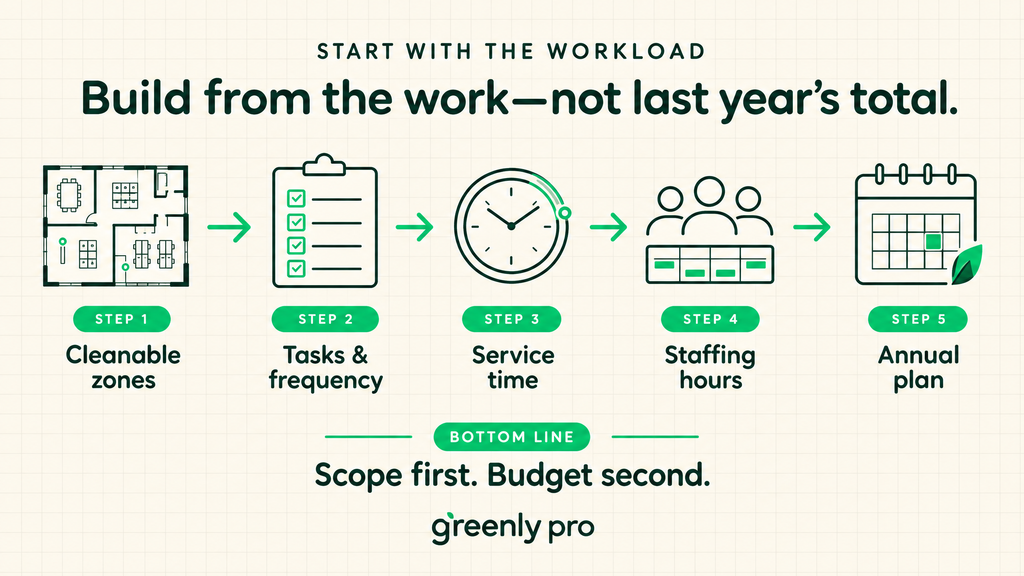
ISSA’s workloading guidance recommends beginning with an inventory of cleanable space, then defining tasks and annual frequencies before calculating time and labor. That sequence is worth adopting even when cleaning is outsourced. It gives facility managers a shared language for evaluating a proposal.
Build your baseline in five steps:
1. Inventory the spaces people actually use
Segment the property into practical zones: general office, restrooms, kitchens, conference rooms, reception, corridors, elevator cabs, storage, fitness or amenity areas, loading areas and tenant-specific spaces.
Do not forget the surfaces that square footage alone misses: workstations, doors, fixtures, glass, touchpoints, waste stations and entry mats. The goal is not an engineering exercise. It is a truthful picture of what the crew is responsible for.
2. Set the service standard before setting frequency
“Clean three nights per week” is a schedule, not a standard.
A useful standard says what clean looks like in the spaces that matter: restrooms stocked and sanitary, entries free of visible debris, floors maintained to the appropriate condition, waste removed, touchpoints addressed and issues reported. The standard should also distinguish routine service from project work.
3. Assign task frequency by use, not habit
A low-occupancy office floor may not need the same frequency as a shared kitchen, high-use restroom or public lobby. Review what changed during the year: onsite attendance, visitor patterns, tenant mix, opening hours, events and building access.
A frequency adjustment can save money when it reflects actual use. It can also create rework when it is made only to reach a target number. The point is to make the trade-off explicit.
4. Convert the scope into labor hours or an equivalent service plan
For an in-house operation, the underlying logic is straightforward:
Annual labor hours = task time × frequency. Annual labor cost = annual labor hours × loaded hourly cost
“Loaded” means more than the wage rate. It can include payroll taxes, benefits, workers’ compensation, supervision, uniforms, training, equipment, supplies, administration, and other operating costs.
For an outsourced program, you may not receive every internal labor assumption. You can still ask the provider to demonstrate how staffing, scope, quality control, and service windows support the result being sold.
5. Record the baseline in one place
Create a simple one-page scope summary with cleanable zones, task categories, frequencies, service nights, project work, and exclusions. That document becomes the reference point for the renewal discussion.
Use price benchmarks carefully, then return to your building
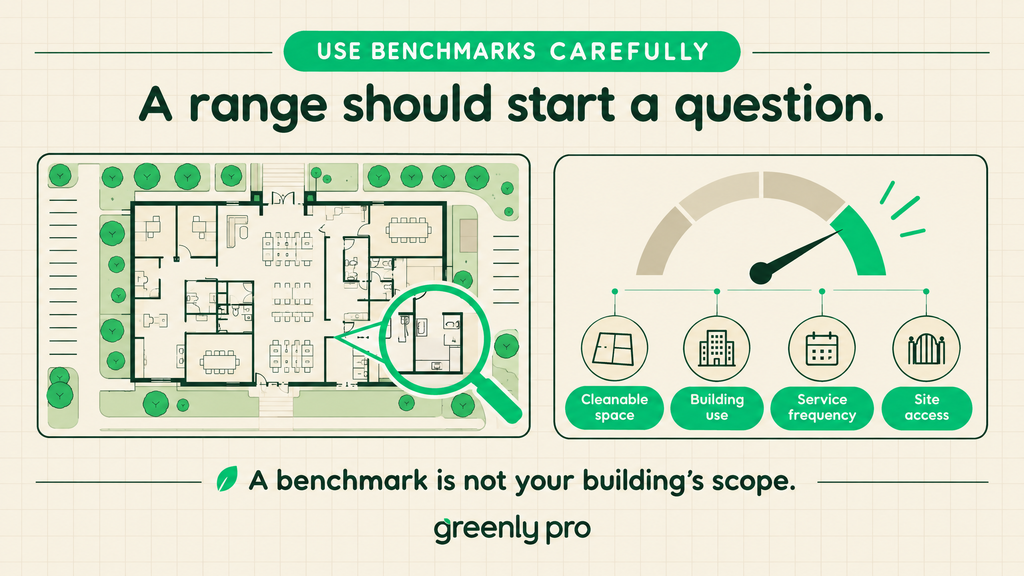
National benchmarks help detect a quote that deserves another question. They are not a substitute for a walkthrough.
ISSA’s current industry guide lists broad national monthly rate ranges of roughly $0.09–$0.17 per square foot for general office cleaning, $0.14–$0.29 for medical and healthcare, $0.08–$0.20 for industrial or manufacturing, $0.07–$0.15 for retail, and $0.07–$0.14 for schools. Those are guidance ranges, not a Massachusetts price list.
Use this calculation as a diagnostic:
Monthly contract cost ÷ cleanable square footage = monthly cost per cleanable square foot
Then ask the right question: What explains our position inside, above or below the range?
The answer may be reasonable. Greater Boston labor conditions, evening access, a public-facing lobby, detailed restroom service, a medical or regulated environment, site security, supplies, a smaller floor plate or a long travel distance can all affect the number.
The warning sign is not a higher rate. It is a rate without a clear operating explanation.
Plan 2027 labor exposure with scenarios, not a prediction
No credible guide can tell a facility manager exactly what every 2027 cleaning contract will cost. A local labor market, a building’s schedule, and a provider’s workforce model are too specific.
What you can do is avoid pretending those inputs do not exist.
As a current reference point, Massachusetts’ general minimum wage is $15.00 per hour and the state’s published guidance says the 2023 increase was the final scheduled increase under that legislation. That is a legal floor, not a realistic all-in budget rate for a staffed commercial-cleaning program.
The broader direction is also clear: the U.S. Bureau of Labor Statistics reported that, through June 2026, private-industry compensation rose 3.3% year over year, with wages and salaries up 3.1% and benefits up 3.8%. That is not a forecast for 2027 or a local janitorial index. It is a reminder to keep labor and benefit exposure visible when a renewal is being planned.
Instead of using one universal uplift, prepare three internal views:
| Planning view | Use when | Budget action |
| Baseline case | Occupancy, hours, scope and provider structure are stable | Carry the documented current program; challenge only unexplained changes |
| Operating-change case | Service frequency, occupied area, traffic or quality requirements will change | Price the scope change separately from the existing program |
| Contingency case | You expect uncertainty around access, events, turnovers, staffing availability or project demand | Hold a visible reserve rather than quietly cutting the base scope |
This is more defensible than adding a percentage to every line. It lets leadership choose the service level rather than accidentally accepting a lower one.
Do not let periodic work disappear from the annual plan
Routine janitorial service keeps the building operating. It does not automatically restore carpet, maintain hard-floor finish, clean interior glass, reach high dust or recover from every event, move-in or tenant turnover.
Those jobs need their own calendar and budget line.
Start with the last 12 months. Pull work orders, extra invoices, tenant requests and any complaint that led to a rush project. Group the work into three buckets:
- Planned preservation: carpet care, hard-floor maintenance, upholstery, interior glass and high dusting.
- Demand-driven work: event recovery, turnover cleaning, move-in or move-out support, spill response and temporary use changes.
- Specialist work: restoration, elevated work, post-construction cleaning and tasks that need a specific qualification or access plan.
Then decide which projects should become planned annual or quarterly work and which should remain reserve-funded exceptions.
This is often the easiest budget correction to make. It does not require a surprise increase. It requires moving predictable work out of the emergency column.
Include supplies, equipment and sustainability requirements deliberately
Supplies are rarely the largest line in a commercial-cleaning budget. They are often the most invisible one.
Clarify whether the provider supplies consumables, chemicals, paper goods, liners, equipment, batteries, pads, dispensers, or replacement items. If ownership is shared, name the handoff point. A low monthly contract can look less compelling once your team begins purchasing the omitted items separately.
If your organization has an environmental procurement standard, put it in the scope—not a verbal preference. The EPA’s Safer Choice product search allows purchasers to filter products for business use and by product type, including all-purpose, carpet, floor, glass, and restroom categories.
The goal is not to ask for a logo on every bottle. It is to specify performance, product requirements, storage, dilution controls, and any reporting needed by the property or tenant.
A worked example: turn a monthly contract into a 2027 request
The following is a planning illustration, not a Greenly PRO quote and not a market-rate recommendation.
Imagine a facility with a documented recurring program of $4,500 per month. The team expects a new occupied suite and higher kitchen use, plus planned carpet and floor work that was previously requested ad hoc.
| Line | Planning input | Annual budget |
| Recurring program | $4,500 × 12 months | $54,000 |
| Scope change | Added service for occupied suite and higher-use areas | $5,400 |
| Periodic plan | Carpet and floor-care projects scheduled in advance | $7,000 |
| Subtotal | Recurring + scope change + periodic plan | $66,400 |
| Management reserve | 5% planning reserve on subtotal | $3,320 |
| 2027 budget request | Subtotal + reserve | $69,720 |
The useful part is not the $69,720. Your building will be different.
The useful part is the explanation:
- $54,000 keeps the current program in place.
- $5,400 buys a specific operating change.
- $7,000 stops predictable projects from becoming emergency approvals.
- $3,320 gives the manager a modest, visible buffer instead of reducing the scope when reality changes.
That is a budget request a non-facilities stakeholder can understand.
Four questions to ask before approving a commercial cleaning budget (2027) proposal
- What changed from the current scope? Ask for a concise change log. New service frequency, added areas, revised timing, labor-market adjustments, supplies, or quality controls should not be blended into one unexplained increase.
- What is included in routine service, and what is not? The answer should cover restrooms, waste, floors, touchpoints, common areas, consumables, quality checks, and exclusions.
- Which periodic services are planned, and which are billed only when requested? This is where many annual plans fail. A line that looks economical every month can become expensive if it ignores recurring project demand.
- How will quality be observed and corrected? A proposal is stronger when it identifies the site contact, inspection rhythm, issue escalation process, and response expectation. The goal is predictable operations, not more paperwork.
A simple renewal timeline for facility managers
- 90–120 days before renewal: Review building use, current scope, extra invoices, complaints and planned tenant or occupancy changes.
- 60–90 days before renewal: Update the cleanable-space inventory, confirm task frequency and identify periodic projects. Schedule a walkthrough with the current provider or prospective bidders.
- 30–60 days before renewal: Compare like-for-like scopes, not totals. Choose the baseline, operating-change, and contingency views you want leadership to see.
Before approval: Record the final scope, project calendar, quality-control process, escalation path and owner for reviewing the reserve.
The operating benefit is simple: nobody has to rediscover the agreement when the first unusual request comes in.
Commercial cleaning budget is a service decision
A commercial cleaning budget is not simply a procurement number. It is the operating standard your tenants, visitors, and employees experience every day.
The strongest 2027 plans do not promise that costs will never move. They show what the building needs, what changed, what is planned, and where the team has chosen to hold flexibility.
For properties in Boston, Waltham, Burlington, Woburn, and Braintree, Greenly PRO can help translate your building’s needs into a scope-based cleaning estimate. Start at greenlypro.com/estimate. You will have a service plan to evaluate, not just a monthly total.