Greenly Pro Logotipo

Our Blog

Learn more about the world of cleaning here on our blog.

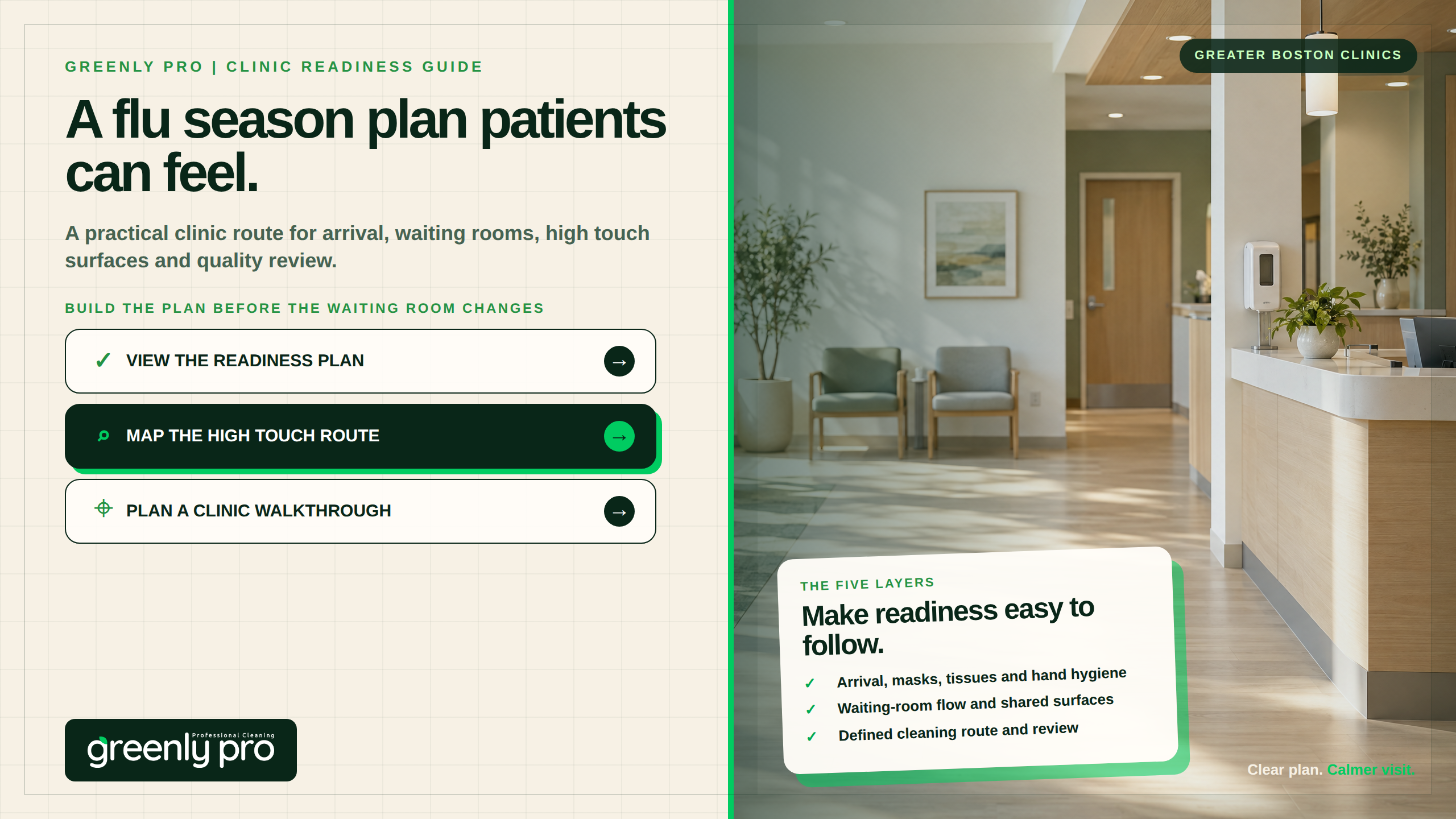
A flu season clinic cleaning plan patients can feel: Greenly Pro clinic readiness guide for Greater Boston covering arrival, waiting rooms, high touch surfaces and quality review

Flu Season Clinic Cleaning: Smart Safety Plan

Flu season clinic cleaning should run as part of a layered respiratory-virus plan, not as a separate disinfection project. Start with the patient arrival path. Make it easy to report respiratory symptoms, find a mask, dispose of a tissue, and clean hands. Then use a written route for waiting rooms and other shared spaces, with clear ownership, approved products, label-directed contact time and a documented quality check.

That plan matters because a waiting room can become busy before anyone notices it has changed. A few more coughing patients, a later running schedule, an empty tissue dispenser or a missed reception counter can create friction for staff and patients quickly.
Read More »
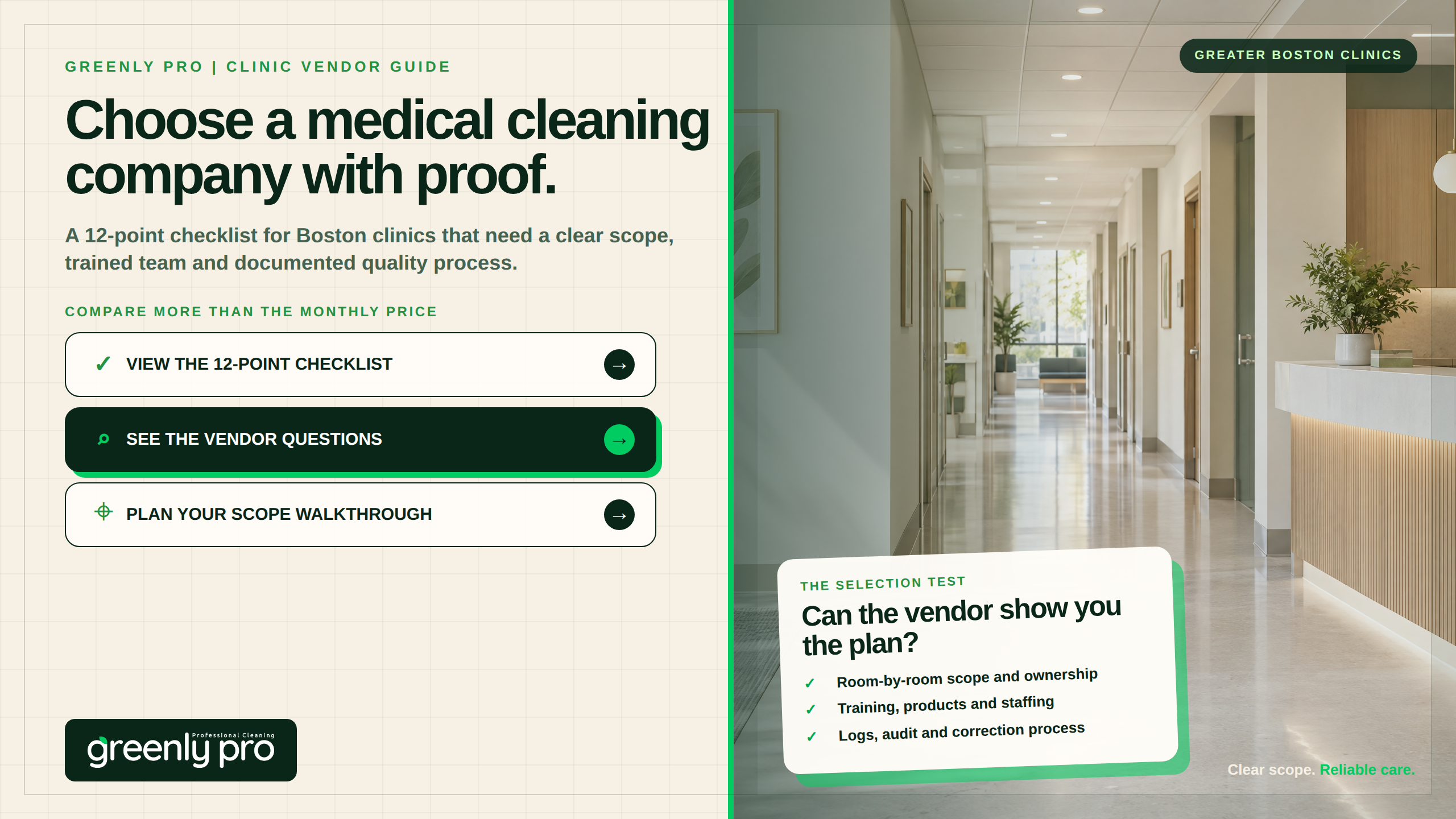
Choose a medical cleaning company with proof: Greenly Pro 12-point checklist for Boston clinics that need a clear scope, trained team and documented quality process.

Medical Cleaning Company in Boston: How to Choose One With a 12-Point Checklist

Medical cleaning company Boston searches should lead to a vendor your clinic can verify in the real world. The company should be able to map the rooms it will clean, identify who owns each task, show how its team is trained, name the products and methods used, document the work, and escalate anything outside its scope.

That standard is more useful than a long list of generalized healthcare claims. A strong vendor does not ask you to trust a brochure. It makes the cleaning plan visible enough for your facility leader to inspect.

Read More »
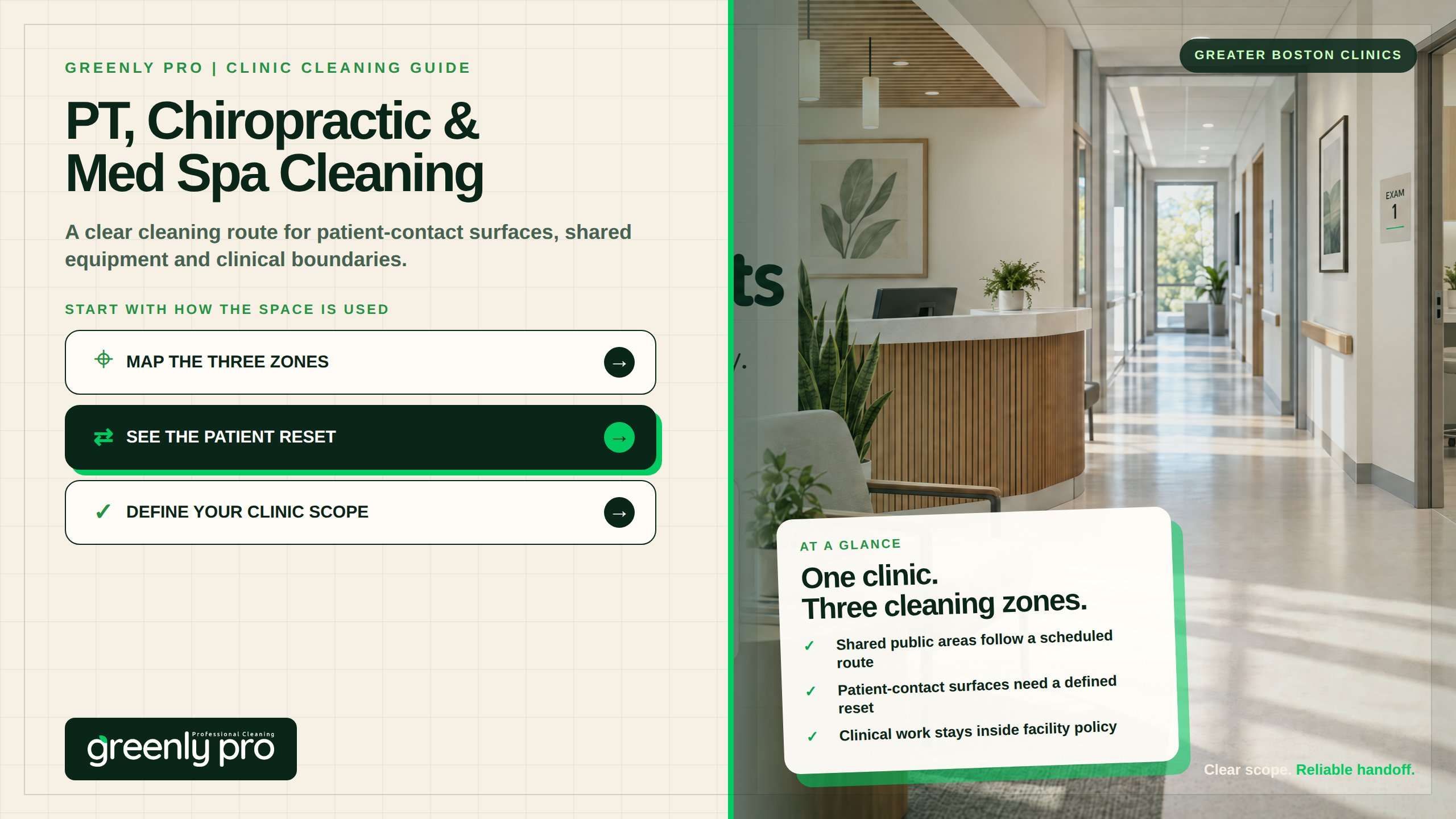
PT, chiropractic and med spa cleaning: Greenly Pro Greater Boston guide to a clear route for patient-contact surfaces, shared equipment and clinical boundaries

Physical Therapy Clinic Cleaning: How Should a PT Clinic Be Cleaned?

Physical therapy clinic cleaning should follow a written route based on patient contact, shared equipment, visible soil and the procedures performed in each room. In practice, that means defining the between-patient reset for treatment tables and shared rehab equipment, then expanding the route at close to cover lower-touch surfaces and floors. The facility’s policy, equipment instructions and product labels set the exact method.

Read More »
Procedure room cleaning, turnover vs terminal: Greenly Pro guide for Greater Boston clinics to the patient-zone reset, the end-of-day route, and the handoff between them.

Procedure Room Cleaning Protocol: What changes between Patients and End of Day?

A procedure room cleaning protocol should not give the same instructions for every reset. The room that is ready for the next patient and the room that is being closed for the day have different jobs to accomplish.

Between patients, the priority is to reset the patient zone safely and predictably. At the end of the day, the work expands across the room. That is the practical difference between room turnover cleaning and terminal cleaning outpatient teams need to understand.

Read More »
Who cleans what in an urgent care center? Greenly Pro Boston clinic guide to an outpatient cleaning scope for patient care, public areas and after hours handoffs

Urgent Care Cleaning in Boston: Who cleans what in an Outpatient Clinic?

Urgent care cleaning in Boston works best when a clinic stops treating every surface as one cleaning problem. An urgent care center has patient care rooms, public waiting areas, restrooms, staff spaces, medical equipment and moments when normal work must pause. Those spaces do not have the same risk, owner or cleaning method.

The useful question is not, “Who cleans the urgent care center?” It is, “Who owns this task, at this moment, under which procedure?”

Read More »
What should be cleaned every night in a dental office? Greenly Pro printable dental office checklist for clinical close, sterilization handoff and after hours facility care

Dental Office Cleaning Checklist: Smart Nightly Close

A dental office cleaning checklist works when it separates the work by owner. The clinical team closes and verifies patient care areas under the practice’s infection prevention plan. Trained dental health care personnel handle instruments and the sterilization area. The after-hours cleaning route covers the approved nonclinical spaces, such as reception, restrooms, staff areas, administrative offices, corridors, and floors.

That may sound like an administrative detail. It is not. Most missed work in a dental office starts with an unclear handoff. The clinical team assumes a cleaner will take care of a surface. The cleaning team assumes it was part of patient turnover. The next morning begins with a question nobody should have to answer under pressure.

Read More »
What does dental office cleaning cost? Greenly Pro Boston guide to budgeting by route, frequency and scope rather than a vague price per square foot

Dental Office Cleaning Cost: Smart Boston Pricing Guide

Dental office cleaning cost in Boston is usually a monthly scope decision, not a simple price per square foot. For 2026 planning, an active small practice with a defined nonclinical after-hours route can budget roughly $750 to $1,450 per month. A mid-sized practice often falls around $1,350 to $2,800 per month. A larger or near-daily program can reach $4,000 to $7,000 or more each month.

Read More »
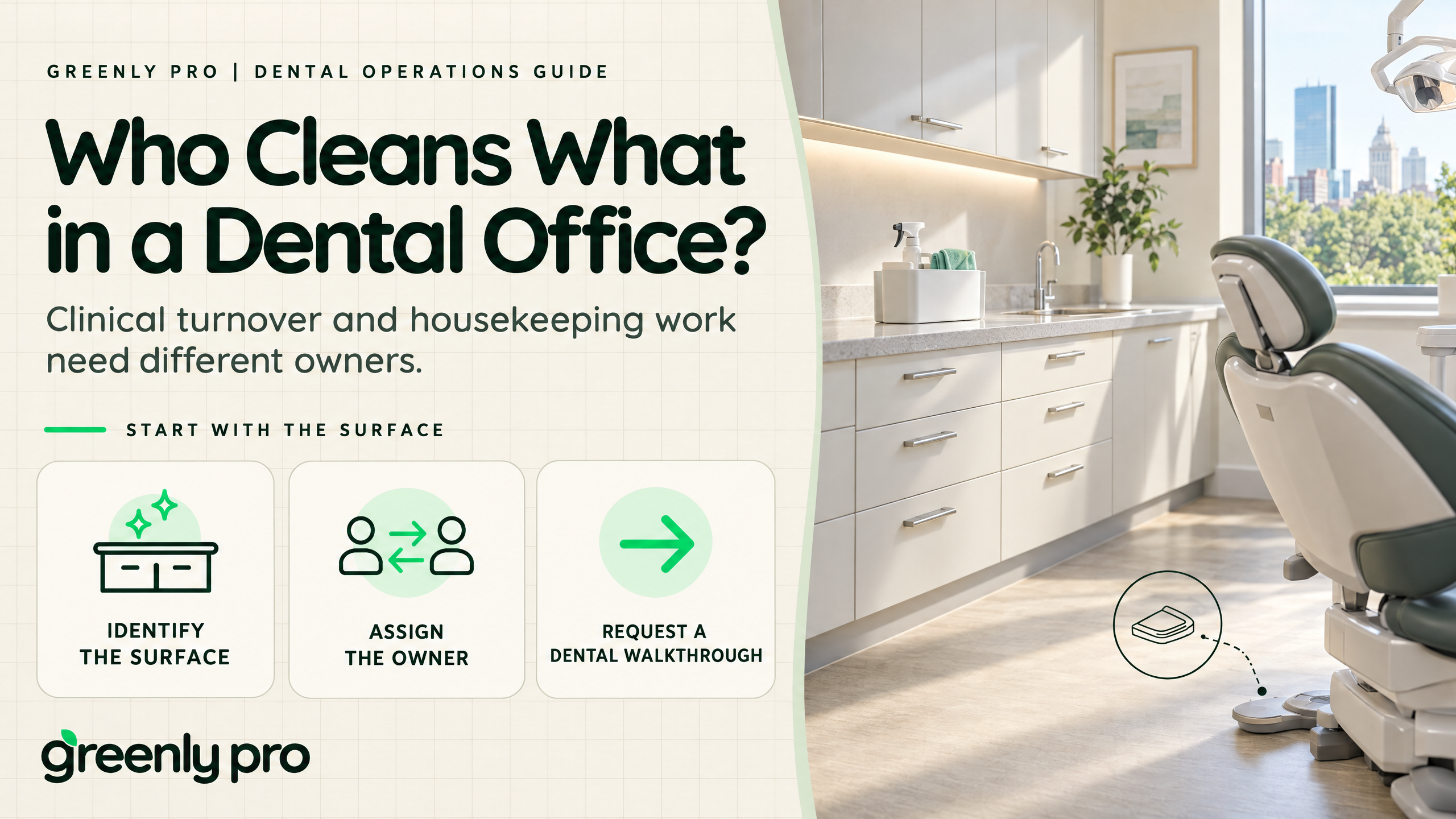
Who cleans what in a dental office cleaning? Greenly Pro operations guide to assigning clinical turnover and housekeeping work to different owners, starting with the surface.

Dental Office Cleaning Responsibilities: Safety Essentials

Dental office cleaning responsibilities do not give a cleaning company automatic ownership of dental chair disinfection. A cleaning company can support the office, but it should not assume control of that work simply because it cleans the facility after hours.

Dental office cleaning responsibilities begin with a more specific question: which part of the chair, which type of contamination, which time in the patient flow, and which trained person owns the task? The CDC specifically names switches on dental chairs as clinical contact surfaces that are difficult to clean and therefore good candidates for barriers. Clinical contact surfaces should be barrier-protected or cleaned and disinfected between patients.

Read More »
Dental office cleaning in Boston: Greenly Pro guide to Massachusetts requirements, scope boundaries, and how a clear written scope supports a clean practice

Dental Office Cleaning in Boston: Safe Essential Guide

Dental office cleaning in Boston practices is built around a division of work, not a generic evening clean. A dental office has patient care spaces, clinical contact surfaces, instruments, administrative rooms, restrooms, and waiting areas. They do not all carry the same risk, and they should not be treated the same way.

The practical question is not, “Who wipes the room down?” It is, “Who owns each task, under which written instruction, and how do we know the process is followed?” For anyone comparing dental office cleaning Boston providers, that is the question that reveals whether a scope is built for a clinical setting or copied from a standard office contract.

Read More »
Parvo and ringworm disinfection for veterinary clinics: Greenly Pro guide to choosing a product by the organism claim on the label, not the product category.

Parvovirus Disinfectant Veterinary Clinic: Proven Guide

A parvovirus disinfectant veterinary clinic protocol has to do more than make surfaces look clean. It has to remove organic matter, match the product to the organism, keep the surface wet for the correct time, and prevent people or equipment from carrying contamination back into clean areas.

That matters because parvovirus and ringworm create different cleaning problems. Canine parvovirus is a nonenveloped virus that can resist many common detergents and disinfectants. Ringworm is caused by dermatophyte fungi, and its spores can move with hair, dust, fabrics, tools and hands. A parvovirus disinfectant veterinary clinic plan needs to address both risks without treating them as interchangeable.

Read More »