The kennel cleaning protocol veterinary teams need is not a longer chore list. It is a clear decision about what kind of room this is, what happened in it, and what has to occur before the next animal enters.
A boarding kennel with an occupied, healthy animal needs a different routine from a kennel being turned between animals. In a kennel cleaning protocol in a veterinary setting, an isolation room needs a different route, supplies and release decision again. When all three are handled as “clean the cage,” the risk moves from the room to the people, tools and surfaces around it.
The AAHA sample environmental-cleaning protocol makes the sequence practical: remove bedding and organic material, clean with detergent, rinse, dry as needed, apply the disinfectant at the required concentration and maintain the label-directed wet contact time. It also calls for signage so a room is not used before cleaning and disinfection are complete.
This guide is for Boston-area veterinary practices, boarding facilities, animal hospitals, and shelter-adjacent operations that need an operational environmental-cleaning standard. It does not replace veterinary judgment, an infection-control plan, product labels, animal-welfare requirements or any applicable Massachusetts regulation.
Kennel Cleaning Protocol Veterinary: Start by Naming the Room State
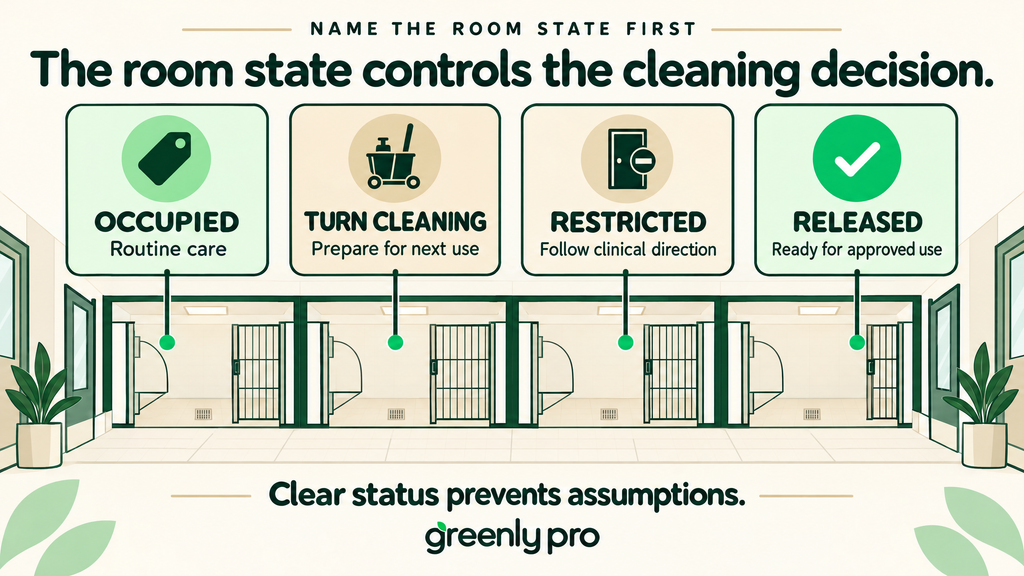
The easiest way to create a dependable protocol is to stop treating every kennel as the same job. Use visible room states that staff, veterinary teams and cleaning partners can recognize immediately:
| Room state | What it means | Cleaning decision |
| Occupied: routine care | A stable animal remains in the kennel. | Use the facility’s approved spot-cleaning routine; avoid unnecessary disruption. |
| Vacant: turn cleaning | The animal has left and the kennel is being prepared for another occupant. | Remove contents, clean, disinfect as directed, dry and inspect before release. |
| Restricted: clinical or infection-control review | The room, animal route or equipment needs a veterinary-led decision. | Restrict access and follow the facility’s written isolation or exposure protocol. |
| Released | The approved cleaning and release process is complete. | Return the kennel to service under the facility’s policy. |
A visible status board keeps an empty kennel from being treated as a ready kennel.
For kennel cleaning protocol, veterinary teams, that is the first control point not an administrative extra.
Routine spot cleaning and terminal cleaning solve different problems
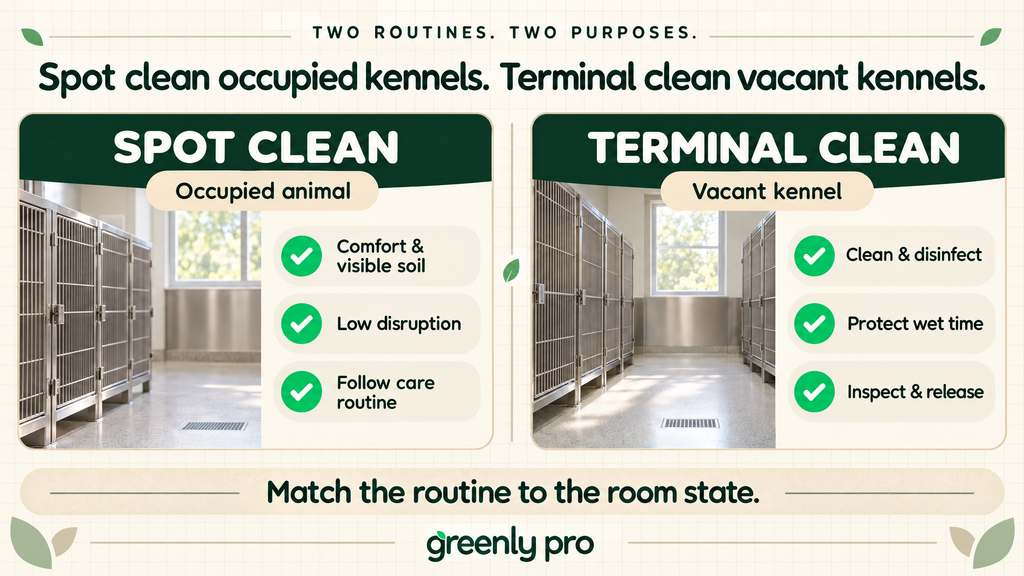
A kennel cleaning protocol veterinary team needs two distinct pathways.
Routine spot cleaning is for an animal that remains in place. It handles soiled bedding, waste, water bowls, visible debris and the immediate comfort of the animal under the clinic or boarding facility’s approved care routine. The goal is safe, low-disruption care not turning the space as if a new animal were arriving.
Terminal cleaning is for a vacant kennel or room being prepared for the next use. It is the fuller process: remove contents, remove organic material, clean, rinse when required, apply the approved disinfectant, protect the contact time, rinse or dry as directed, then inspect and release.
The University of Wisconsin Shelter Medicine Program notes that daily full cleaning and chemical disinfection of an occupied animal’s enclosure may not always be necessary and can create stress. It recommends directing the most thorough cleaning and disinfection work to the transition between animals, while using an appropriate spot-cleaning routine during occupancy.
Run the terminal-cleaning sequence in the same order every time
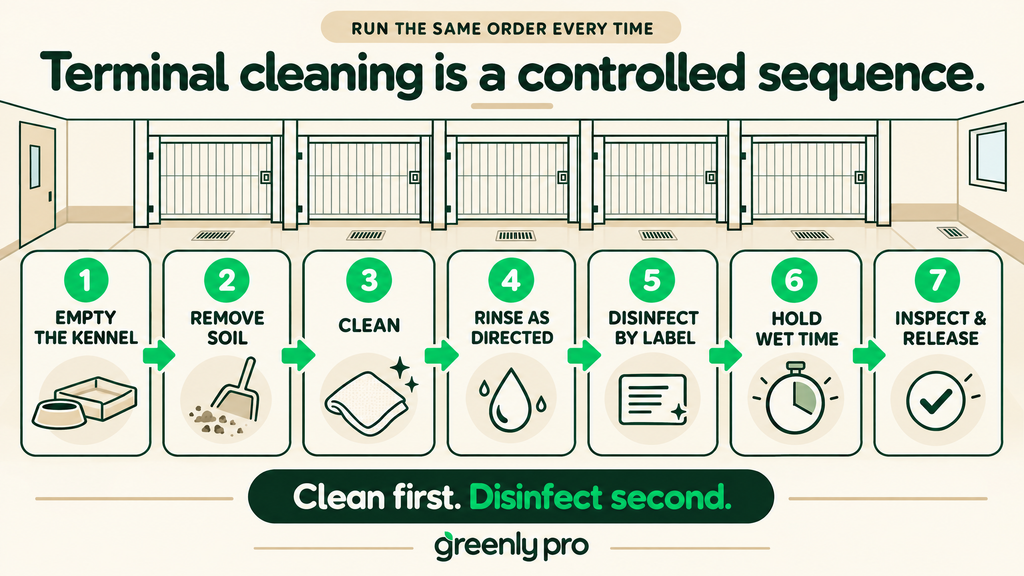
A kennel cleaning protocol for veterinary terminal clean must be simple enough to be followed at the end of a long shift and specific enough to be checked later.
A usable sequence is:
- Confirm the room status and access boundary. Follow the facility’s clinical direction before entering a restricted area.
- Remove movable contents. Bedding, bowls, toys, enrichment items and reusable equipment each need the approved laundering, cleaning or handling route.
- Remove organic material. Use the facility’s PPE and waste process. Do not apply disinfectant over visible soil and assume the work is finished.
- Clean with the approved detergent or method. Scrub where soil, biofilm or debris needs physical removal.
- Rinse and manage excess water as directed. AAHA cautions against high-pressure washing because it can aerosolize or drive organisms into crevices and porous materials.
- Apply the selected disinfectant at the label-directed concentration.
- Keep the surface visibly wet for the required contact time.
- Rinse or dry as the label and facility policy require.
- Inspect, record completion and obtain the appropriate release signal.
Choose the product from the claim and the surface, not the shelf
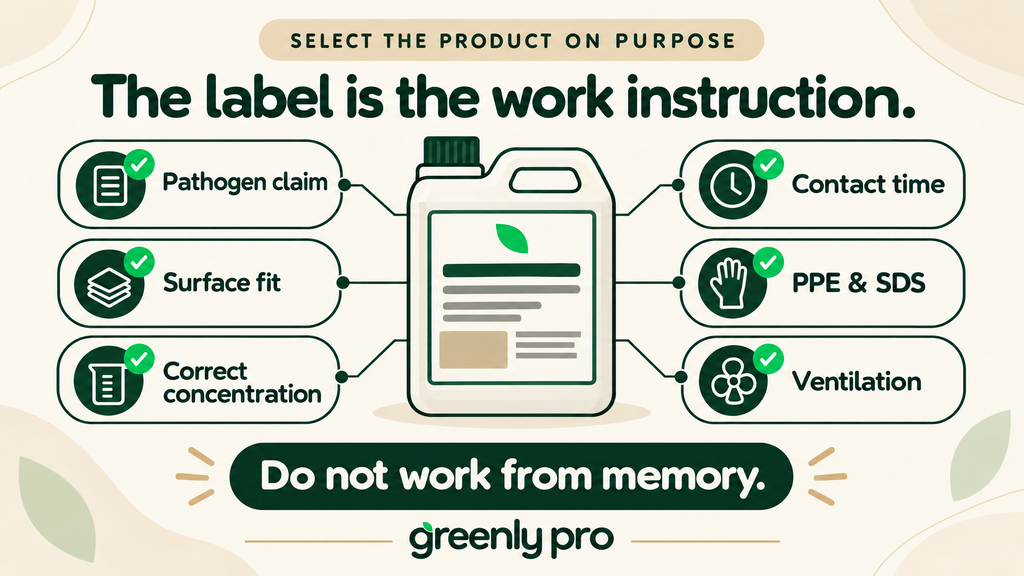
The disinfectant has to match the facility’s approved use, the likely organism risk, the material, and the way the room can actually be turned. That product discipline belongs in every kennel cleaning protocol in veterinary scope.
The EPA’s disinfectant-label guidance explains that the label identifies where a product can be used, how it must be applied and how long it must remain wet. The EPA registration number is the most reliable way to identify a formulation when it is sold under different names.
Before the product is staged in a kennel area, the protocol should specify:
- the approved product and its relevant pathogen claim;
- the correct concentration and how it is measured;
- surfaces it can be used on, including metal, sealed flooring, plastic, grout, bedding or equipment exteriors;
- PPE, ventilation, safety-data-sheet and storage requirements;
- the wet contact time and whether a rinse is required before reuse;
- what to do when a surface is damaged, porous or incompatible.
For parvovirus or feline panleukopenia concerns, the Massachusetts cleaning guidance emphasizes cleaning first, then following the selected product label. It identifies accelerated hydrogen peroxide and bleach-family products as potential options when correctly used, while warning that bleach can be corrosive, irritating and ineffective when organic material remains. It also advises against relying on quaternary ammonium compounds for parvovirus control.
Contact time belongs on the room-status board
Disinfectant contact time is often lost in a fast turnover. A kennel cleaning protocol veterinary system makes that time visible rather than leaving it to memory.
The product may be applied, but bedding is reloaded, a bowl is returned or the next animal is brought in before the required time is complete. That is not a completed disinfecting step.
The AAHA protocol describes contact time as the period the disinfectant remains wet on the surface to act against the pathogens of concern. It notes that this is generally five to ten minutes but depends on the product, concentration and target organism. The label controls the actual requirement.
A room-status workflow turns that instruction into behavior:
- Pending clean —> do not enter for routine use.
- Disinfecting until [time] —> contact time is in progress.
- Pending release —> the room is dry or rinsed as directed and awaits inspection or approval.
- Released —> available for its next approved use.
The status answers whether the kennel is ready.
Isolation rooms need a controlled entry, exit and cleaning route
Isolation cleaning is not a standard kennel clean with more disinfectant. A kennel cleaning protocol for veterinary scope needs a separate route for this room state.
It is a controlled workflow for people, tools, equipment and room surfaces. The AAHA’s sample isolation entry and exit protocol directs personnel to stage needed supplies before donning PPE, avoid bringing personal equipment into the room, clean and disinfect used equipment, remove disposable PPE before exit, then perform hand hygiene and address any contaminated exit touchpoints.
For an operational cleaning scope, write the route down:
- Prepare outside the room. Confirm access, stage approved supplies and identify the clean-to-dirty path.
- Enter under the facility’s PPE protocol. The veterinary team sets the clinical direction and isolation requirements.
- Use dedicated or controlled tools. Do not roll a shared cart through isolation and then into routine boarding or treatment spaces without the approved handling process.
- Complete the room sequence. Work from the cleaner area toward the dirtier area, follow the product label and protect contact time.
- Doff, dispose or decontaminate as directed. Clean exit touchpoints and perform hand hygiene before returning to the general workflow.
- Document the status and escalate exceptions. A damaged surface, unclear exposure boundary or unanswered release question belongs with the designated veterinary or infection-control lead.
Facility design must support controlled separation and cleanable surfaces; follow the requirements that apply to your site.
The cleaning route should run from lower risk to higher risk
The route a person takes can matter as much as the product in the bucket. Kennel cleaning protocol: veterinary teams need that route to be as clear as the product label.
The University of Wisconsin Shelter Medicine Program recommends cleaning healthy-animal areas before isolation areas and avoiding backtracking. The program also points out that pathogens move beyond kennel walls on hands, door handles, carriers, clothing, equipment and traffic routes.
For a kennel, boarding or hospital team, that means defining a practical order for the specific site:
| Start | Then | End |
| Healthy or lower-risk areas | Routine boarding and treatment-adjacent support areas | Restricted or isolation areas under the approved process |
This does not replace clinical triage. It gives the environmental-cleaning team a default route that does not undo the rest of the protocol.
Tool control and a no-backtracking rule matter even more when staffing is limited.
Build the facility around cleanable surfaces and visible boundaries
A protocol cannot compensate forever for a room that cannot be cleaned reliably.
Cracked floors, chipped wall coating, damaged plastic kennel fronts, unsealed edges, difficult drains and storage piled into a quarantine room create hidden points where soil and moisture can persist. Massachusetts guidance for animal shelters and rescues explains why impervious surfaces matter: cracks and holes can trap organic material, allowing pathogens to survive the cleaning and disinfection process.
During a site walk, look for:
- intact, cleanable floor and wall finishes;
- kennel seams, latches and door tracks that can be reached and inspected;
- drain condition and water-control practices;
- adequate space to stage clean supplies outside restricted zones;
- separation between clean storage, used tools, laundry and waste;
- room signage that shows occupancy, cleaning status and escalation contacts.
Release the kennel with a short record, not an assumption
The last step is not “looks good.” It is a usable record. For kennel cleaning protocol veterinary teams, this is the evidence that a room moved from turn cleaning to released.
A kennel turnover or isolation-room log can be simple:
| Record | Why it helps |
| Kennel or room ID | Connects the work to a specific space. |
| Room state and time | Shows whether the space was occupied, turned, restricted or released. |
| Method and product | Confirms the approved routine was used. |
| Contact-time completion | Makes the key label instruction visible. |
| Exception or escalation | Captures damaged surfaces, unclear routes or clinical follow-up. |
| Release owner | Shows who authorized return to service. |
Training and periodic checks reveal failures before the next turn.
For a broader look at how routine contracts can leave critical work undefined, see Greenly PRO’s guide to the janitorial scope gap in Massachusetts. For a vendor review, its commercial cleaning selection guide also outlines questions about technical competence, accountability and documented scope.
A better protocol reduces the number of decisions a shift has to make
A boarding kennel or isolation room does not need a dramatic response. It needs a standard the team can follow when the room is occupied, when it turns, and when it becomes restricted.
For kennel cleaning protocol veterinary teams, that standard is clear room states, a clean-before-disinfecting sequence, product-label discipline, controlled tools and traffic, a visible contact-time status, and a documented release decision.
Greenly PRO helps Boston-area animal-care facilities convert those requirements into site-specific environmental-cleaning scopes, training-ready checklists and practical handoffs. To review your boarding, kennel or support-space workflow, begin at greenlypro.com/estimate.