A parvovirus disinfectant veterinary clinic protocol has to do more than make surfaces look clean. It has to remove organic matter, match the product to the organism, keep the surface wet for the correct time, and prevent people or equipment from carrying contamination back into clean areas.
That matters because parvovirus and ringworm create different cleaning problems. Canine parvovirus is a nonenveloped virus that can resist many common detergents and disinfectants. Ringworm is caused by dermatophyte fungi, and its spores can move with hair, dust, fabrics, tools and hands. A parvovirus disinfectant veterinary clinic plan needs to address both risks without treating them as interchangeable.
The uncomfortable part is simple. A cleaner can have a fungicidal claim for ringworm and still be a poor choice when parvovirus is the risk. A product cannot be judged by its category, brand familiarity or fresh scent. It must be judged by its exact label claim and the clinic workflow around it.
This guide explains what kills parvovirus on clinic surfaces, where accelerated hydrogen peroxide fits, why quat-only routines create a gap, and how to build a written environmental cleaning scope around the veterinary team’s protocol.
What Kills Parvovirus on Clinic Surfaces?
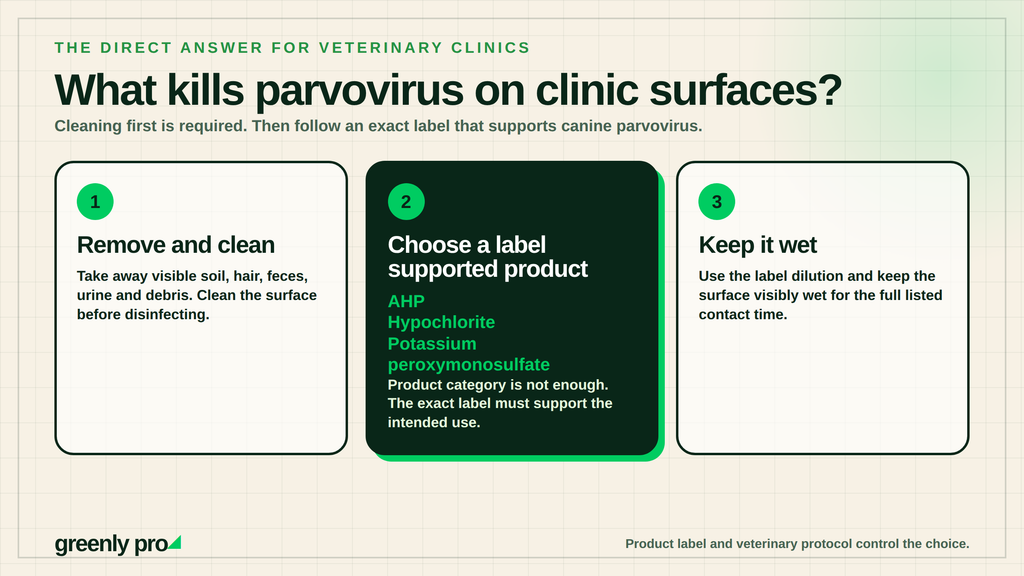
For a veterinary clinic, the short answer is this: remove visible contamination, clean the surface, then use an EPA registered disinfectant whose label supports canine parvovirus for that use site, at the stated dilution and wet contact time. That is the core of a dependable parvovirus disinfectant veterinary clinic routine.
The Massachusetts parvovirus cleaning guidance names accelerated hydrogen peroxide, also known as AHP, and bleach family products as options that can inactivate canine parvovirus and feline panleukopenia. It says AHP is the preferred recommendation when available. The Merck Veterinary Manual also identifies diluted bleach, peroxygen products, potassium peroxymonosulfate and accelerated hydrogen peroxide after gross organic material has been removed.
That does not mean every product containing hydrogen peroxide, bleach, or an oxidizing agent has the same claim. It means those chemical families include products that may be appropriate when the exact label, use site and procedure support the intended job.
A useful parvovirus disinfectant veterinary clinic decision begins with a narrow question: Does this exact product label name canine parvovirus or an accepted equivalent claim, and can the team use it correctly on this surface? If the answer is unclear, the clinic should not treat the product as a canine parvovirus disinfectant
Why Quats Do Not Cover Both Risks
“Quats” refers to quaternary ammonium compounds. They are common in cleaning programs because many formulations are practical for routine use. The problem begins when that familiarity becomes a universal claim.
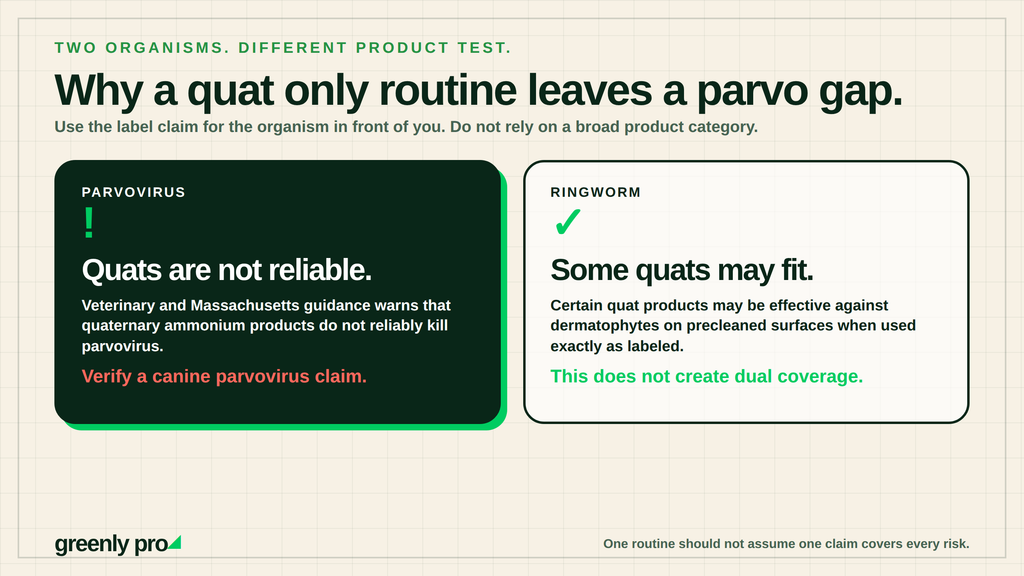
For parvovirus, the evidence is direct. Massachusetts guidance says to avoid quaternary ammonium compounds because repeated studies show they are not as effective against parvoviruses. The University of Wisconsin Shelter Medicine program is equally clear: independent studies have found that quats do not reliably kill parvovirus, even after reformulation and label claims.
Ringworm requires more nuance. The same university’s ringworm disinfection guidance lists certain 0.3 percent quat products as effective against dermatophytes on precleaned surfaces where organic material has been removed. That does not make them a dependable dual-purpose answer for a clinic handling parvovirus risk. The source specifically warns that products with dermatophyte claims may not cover nonenveloped viruses.
So the accurate message is not “all quats fail.” It is this: a quat-only routine can leave a critical parvovirus gap, even if the same product is suitable for ringworm disinfection on a properly cleaned surface. Any parvovirus disinfectant veterinary clinic scope should state that distinction plainly.
Clean First, Then Disinfect in the Right Order
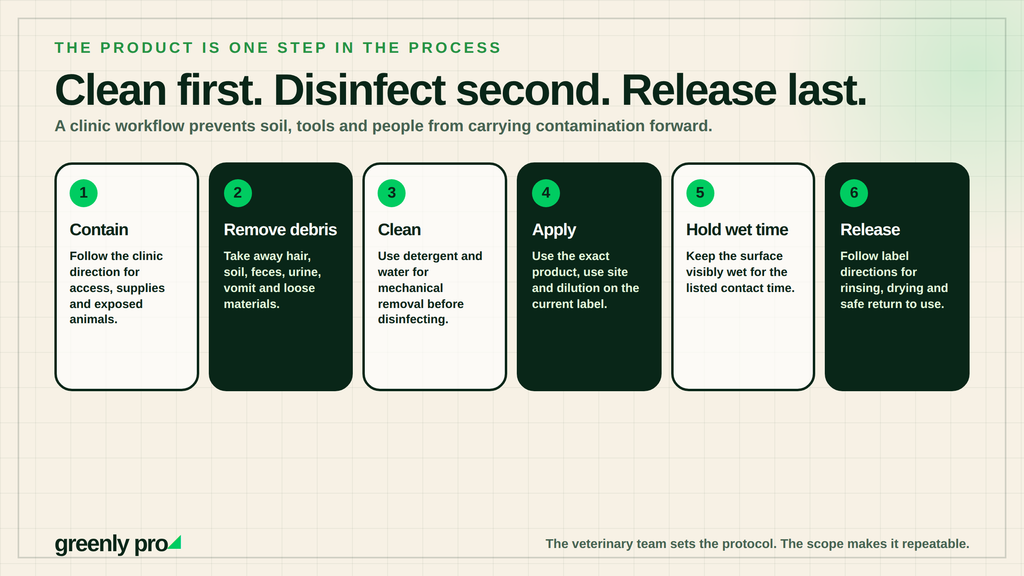
Disinfectant does not work through a layer of hair, feces, vomit, dust or bedding debris. That is why the cleaning sequence matters as much as the product.
First, contain the room and remove exposed animals, supplies and movable equipment according to the clinic’s direction. Do not move loose items into a clean corridor simply to clear the room. That turns cleaning into transport.
Second, remove the visible contamination. For parvovirus, that includes feces, urine, vomit, hair and debris. For ringworm, hair and dust are part of the problem because fungal material can move with them. Use the clinic’s designated waste and laundry routes.
Third, clean with detergent and water. This is mechanical removal. It lowers the soil load that can interfere with a disinfectant, especially on textured or damaged surfaces.
Fourth, apply the selected disinfectant at the label-directed dilution. The EPA explains that a label identifies the organisms a product has been reviewed to address, the appropriate use sites, the application method and the contact time.
Fifth, keep the surface visibly wet for the full stated contact time. If it dries early, the product must be reapplied. Then follow the label’s instructions for rinsing, drying and safe return to use.
The clinical team sets the infection control standard. The cleaning scope should show who cleans, which product is used, how the team confirms the contact time, and who releases the room. That clarity protects both care standards and the people doing the work. It also gives a parvovirus disinfectant veterinary clinic team a process that can be trained, inspected and repeated.
Where Accelerated Hydrogen Peroxide Fits
If you are researching accelerated hydrogen peroxide vet products, start with the product label instead of the marketing category. This is the right starting point for a parvovirus disinfectant veterinary clinic purchase decision.
AHP is often a practical choice for veterinary environments because the product family can combine cleaning properties with broad disinfecting performance. Massachusetts guidance says AHP is effective on nonporous surfaces such as metal and sealed floors, and it may also be used on porous materials such as scratched plastic, unsealed concrete, carpet and bedding when the label allows. The same guidance notes better activity in the presence of residual organic material than bleach family products.
That does not remove the need to clean first. It does mean the clinic may have a more workable option for rooms where organic material, porous surfaces or repeated turnover make bleach a poor operational fit. Bleach can be effective on clean, hard surfaces, but it can be corrosive, irritating and less useful where organic material remains or the surface is porous.
Before approving any AHP product, verify five details on the current label:
- The organism claim includes canine parvovirus or the clinic’s required nonenveloped virus claim.
- The product has a fungicidal or dermatophyte claim appropriate for the clinic’s ringworm protocol.
- The intended use site includes the surface or equipment in question.
- The required dilution and contact time are operationally realistic.
- The safety instructions, ventilation, rinsing and personal protective equipment requirements fit the clinic’s use plan.
Ringworm Disinfection Is Not a Shortcut
Ringworm disinfection begins with removal, not chemical selection. A surface that looks clean may still hold hairs or dust carrying dermatophyte material. In a treatment or isolation space, the work includes the room, transport carriers, counters, cages, reusable equipment, laundry routes and the tools used to clean them.
The University of Wisconsin guidance recommends thorough detergent cleaning before disinfection and emphasizes that products work on precleaned surfaces with organic matter removed. It also calls for regular deep cleaning in treatment areas, daily spot cleaning and clear personal protective equipment routines that limit contamination moving between spaces.
A clinic does not need to turn every room into an isolation unit. It does need a room by room plan. The veterinary lead decides which cases, areas and materials require isolation. The cleaning team needs a written route that identifies tools, laundry, waste, products and handoffs for that plan.
Read the Label Like a Work Instruction
A product label is not packaging detail. It is the work instruction.
The EPA says that if a label does not include directions for a particular pathogen, it has not reviewed data showing the product is safe and effective for that use. The agency also notes that an EPA registration number is the reliable way to identify a product, since the same formulation can be sold under different names.
At the supply closet, the team should be able to answer six questions without guessing:
- What is the EPA registration number?
- Is the product labeled for canine parvovirus, the required nonenveloped virus claim or both?
- Is it labeled for the fungus or dermatophyte risk in the clinic’s ringworm plan?
- Can it be used on this hard or porous surface?
- What dilution and wet contact time are required?
- What does the label require for personal protection, ventilation, rinsing and storage?
If those answers are scattered across supplier emails, a laminated dilution chart and memory, the process is vulnerable. Put the current answer at the point of use and make the escalation path obvious.
Build a Parvovirus Disinfectant Veterinary Clinic Scope That Does Not Ask a Cleaner to Practice Medicine
A professional cleaning partner can make a veterinary clinic easier to manage. The partner should not decide the infection control standard. A parvovirus disinfectant veterinary clinic scope should translate clinical direction into operational tasks, not replace it.
The veterinary team owns the clinical protocol, isolation rules, patient handling, and product approvals. The cleaning scope translates that direction into recurring work: which rooms are cleaned, what happens after a suspected case, which tools remain in the area, who handles laundry and waste, and how the team documents correction when the routine is missed.
For clinics with boarding, cages or isolation spaces, Greenly PRO’s kennel cleaning protocol guide is a useful companion. For the wider environmental cleaning system, see the veterinary clinic cleaning guide for Boston. Both are designed to help a facility turn a clinical direction into a visible operational standard.
The Right Question Before You Reorder
Do not ask only, “Is this product a disinfectant?” Ask, “Does this exact product, on this exact surface, in this exact workflow, cover the organisms we are trying to control?”
That question exposes the gap in a quick-and-dirty routine. It also makes the next step straightforward: document the clinical requirements, verify the product labels, train the sequence, and inspect the handoff.
If you need a cleaning scope that follows your veterinary team’s written protocol without adding ambiguity, request a walkthrough at greenlypro.com/estimate.