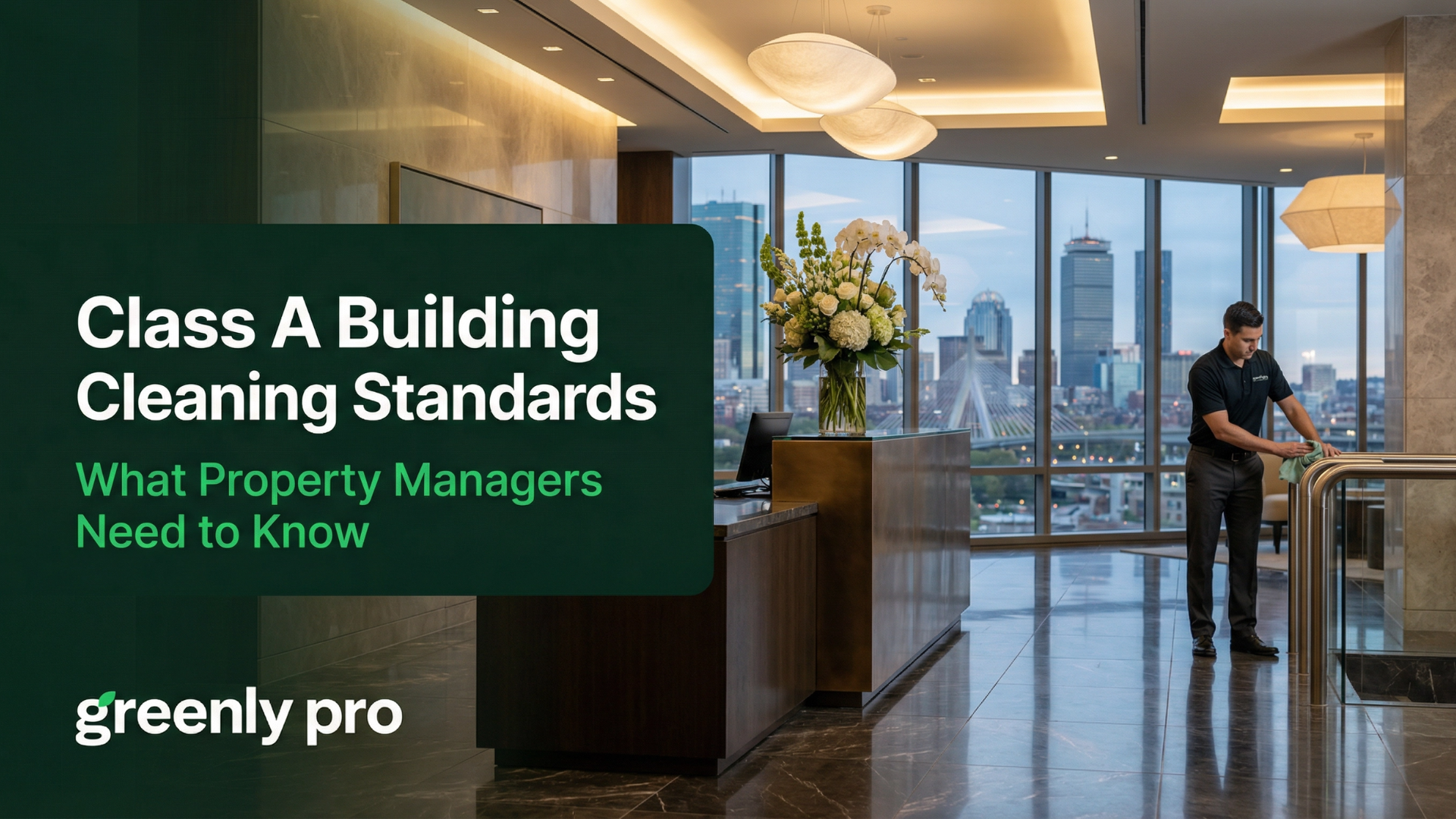
The Class A building cleaning standards you uphold are a direct reflection of this prestige. Every detail, from the polish on the brass fixtures to the air quality in the boardroom, is a testament to the premium environment you cultivate.
As a property manager for a Class A building in Greater Boston, you operate under a unique kind of pressure. Your tenants aren’t just renting space; they’re investing in an image.
You know that “cleanliness” is paramount. But what does that word actually mean when the stakes are this high? The standards are subjective, vendors all promise “quality,” and the risk of choosing a partner from the myriad of commercial cleaning services in Boston who doesn’t understand the nuances of a Class A environment is significant.
This guide is designed to make the Class A building cleaning standards visible, citable, and clear; for you, for your tenants, and for anyone evaluating what premium commercial cleaning truly requires.
What Differentiates Class A Property Management Cleaning?
The Building Owners and Managers Association (BOMA) classifies buildings based on factors like location, quality of finishes, and amenities. While there are no official BOMA cleaning standards published as a separate document, the classification itself implies a standard of care that separates Class A from the rest of the market. The difference is not just in the tasks performed, but in the philosophy behind the service, which is a critical part of asset preservation and facility planning.
The following table outlines the fundamental shift in expectations for any top-tier commercial cleaning service in Boston:
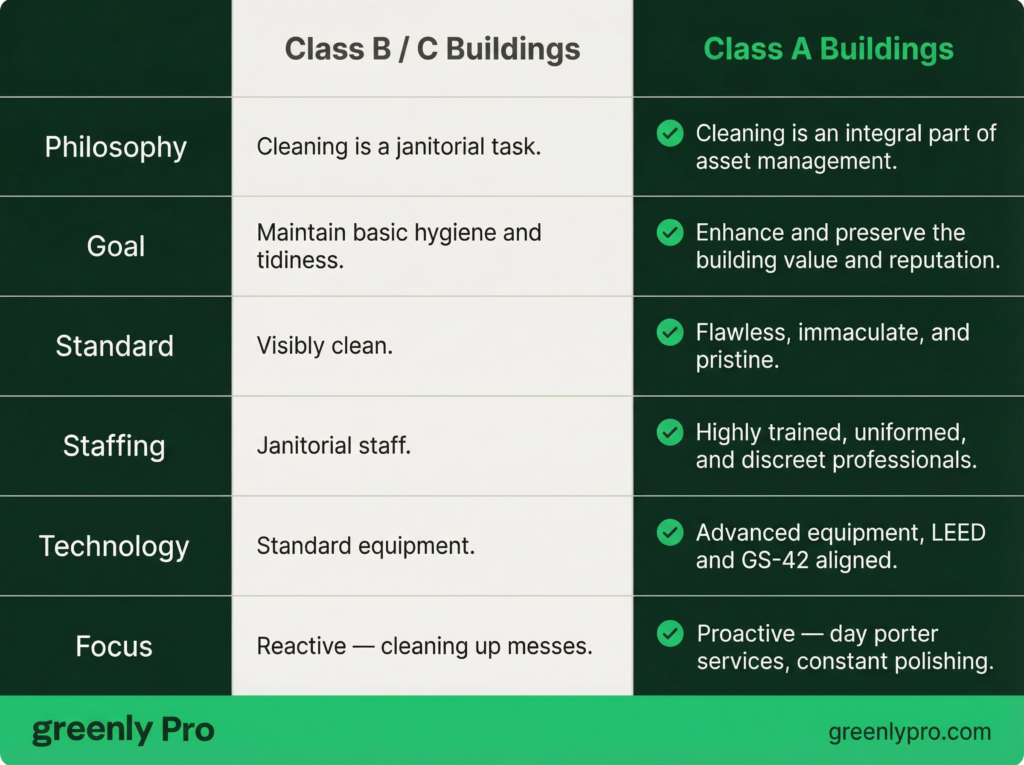
For a Class A property, cleaning is not a cost center; it is a critical component of the tenant experience and a direct contributor to the building’s prestigious brand.
The Four Pillars of Class A Cleaning Excellence
To translate the philosophy into execution, a true Class A cleaning program is built on four pillars. These are the non-negotiable principles that define property management cleaning at the highest level.
Pillar 1: Uncompromising Attention to Detail
This is the most critical and most frequently cited principle. In a Class A environment, first impressions are everything. This means every surface must be flawless. It’s about ensuring streak-free windows, perfectly polished floors, and dust-free corners that go unnoticed by the casual observer but contribute to an overall sense of quality. The standard is perfection.
Pillar 2: Customized, Tenant-Centric Plans
A one-size-fits-all approach is the hallmark of a Class B provider. Class A buildings house a diverse range of tenants, each with unique workflows and expectations. A premier cleaning service provides a customized plan tailored to the specific layout, materials, and tenant needs of the building, including flexible scheduling and specialized protocols for sensitive areas.
Pillar 3: Invisible Professionalism
The cleaning team in a Class A building should be felt but rarely seen. Operations must be seamless and unobtrusive, performed by uniformed, badged professionals who are trained in discretion and clear communication. The cleaning staff are an extension of the building’s management and must reflect the premium nature of the property at all times, boosting both impressions and employee productivity.
Pillar 4: Sustainable & Tech-Forward Operations
Modern Class A properties are leaders in sustainability and technology. The cleaning program must align with these values. This includes the use of state-of-the-art, quiet equipment and a commitment to environmentally friendly practices and non-toxic solutions that meet Green Seal (GS-42) and LEED certification standards. This isn’t just a preference; it’s a core requirement for attracting and retaining high-value tenants.
The Class A Office Cleaning Checklist
Specificity is the language of expertise. A detailed office cleaning checklist provides a clear, structured, and citable framework that defines a baseline for Class A service.
Daily Cleaning Protocol
- Lobbies & Entrances: All entrance glass and doors cleaned and disinfected. High-touch surfaces (door handles, push bars) disinfected. Hard surface floors detailed, including corners. Welcome mats cleaned and positioned.
- Restrooms: All fixtures cleaned and disinfected. All dispensers refilled. Mirrors polished. Floors disinfected. Trash and sanitary receptacles emptied.
- Offices & Workstations: Trash emptied. Accessible surfaces dusted. High-touch points (light switches, door handles) disinfected.
- Common Areas (Hallways, Elevators, Break Rooms): Floors vacuumed/mopped. Elevator buttons and handrails disinfected. Break room surfaces cleaned and disinfected.
Weekly Cleaning Protocol
Thorough high and low dusting of all surfaces. Polishing of all metal (brass, stainless steel) and wood surfaces. Cleaning of all interior glass and partitions. Buffing of hard floors in high-traffic areas. Detail vacuuming of all carpeted areas, including edges and corners.
Monthly & Quarterly Protocol (Deep Cleaning)
Deep cleaning of carpets using hot water extraction. Stripping and refinishing of hard floors. High dusting of vents, light fixtures, and other hard-to-reach areas. Deep cleaning and sanitization of kitchen and break room appliances.
This level of detail separates a true deep cleaning service from a regular one, a core component of upholding Class A building cleaning standards year-round.
The Critical Role of Day Porter Services
Perhaps the most visible differentiator for a Class A building is the presence of day porter services. This is not just a daytime janitor. A Day Porter is a proactive service professional responsible for maintaining the building’s pristine condition throughout business hours. Their role is to ensure the lobby is always perfect, to respond instantly to spills, to keep restrooms fully stocked and immaculate, and to be a visible sign of the building’s commitment to quality.
The presence of a day porter is a strong signal to tenants that the building operates at a higher standard.
Choosing a Partner Who Understands Boston’s Class A Standards
Choosing a cleaning partner is not just about keeping your building clean. It’s about preserving your asset’s value and reputation.
When you choose a commercial cleaning service in Massachusetts, vetting their understanding of these nuances is paramount. The cleaning company you partner with should not only be able to perform to these standards but also be able to articulate them with the clarity and expertise that both you and your tenants can trust.
At Greenly Pro, we’ve built our 37-year, BBB A+ accredited reputation on this principle. We believe that transparency of process is the ultimate proof of quality. If you’re managing a Class A property in the Greater Boston area and find that your current provider’s standards don’t align with the level of detail outlined here, we should talk.