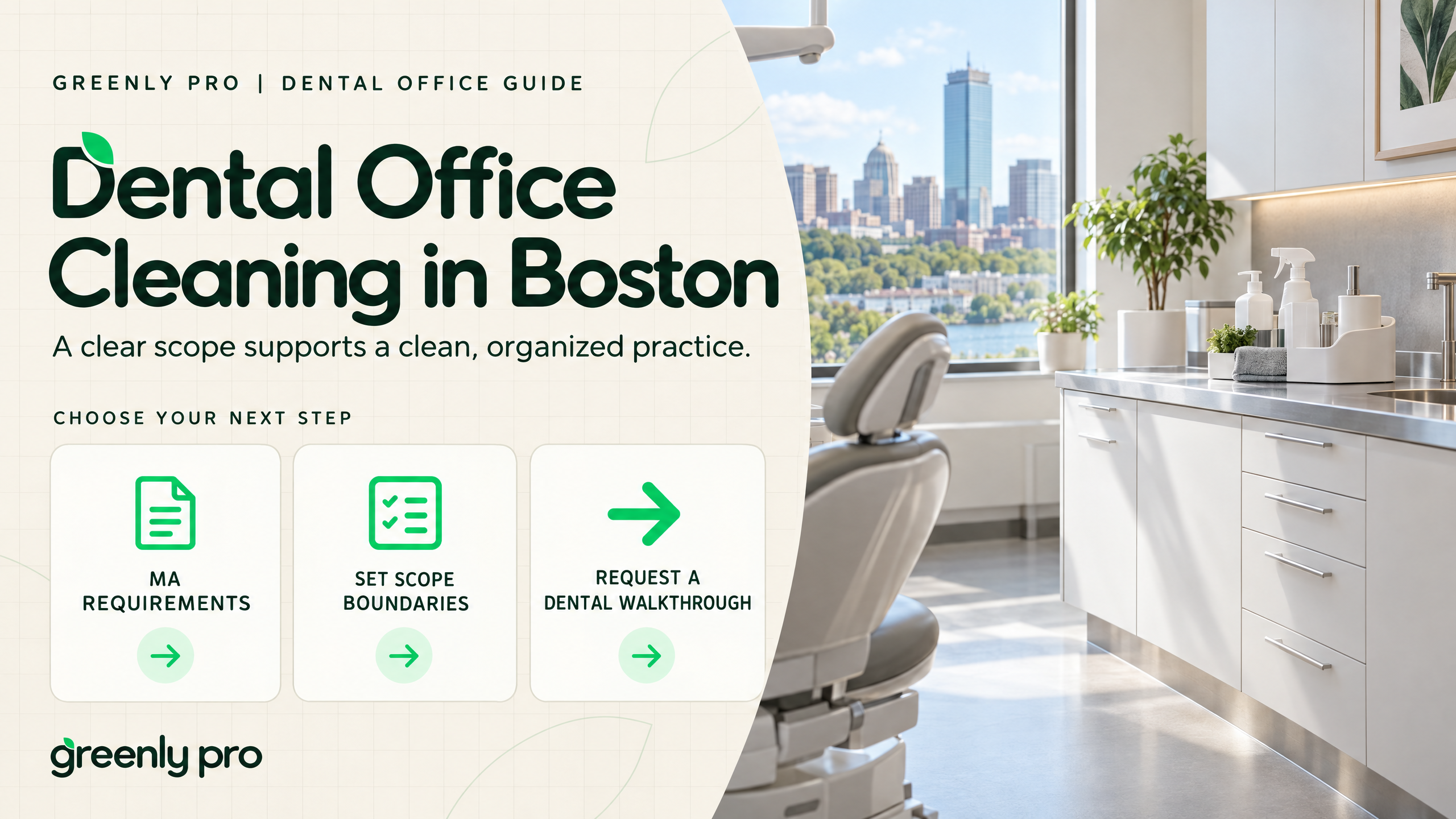
Dental office cleaning in Boston practices is built around a division of work, not a generic evening clean. A dental office has patient care spaces, clinical contact surfaces, instruments, administrative rooms, restrooms, and waiting areas. They do not all carry the same risk, and they should not be treated the same way.
The practical question is not, “Who wipes the room down?” It is, “Who owns each task, under which written instruction, and how do we know the process is followed?” For anyone comparing dental office cleaning Boston providers, that is the question that reveals whether a scope is built for a clinical setting or copied from a standard office contract.
Massachusetts dental practices operate under 234 CMR 5.05, which requires people licensed by the Board of Registration in Dentistry, known as BORID, and practices that provide dental services to comply with CDC infection control guidance and OSHA standards. The Massachusetts Dental Society explains the Board expectation as conformity with the most recent CDC infection control recommendations.
That makes cleaning more than a cosmetic standard. It is part of a written infection prevention system. The practice owns that system. A dental practice janitorial partner supports it through a defined scope that respects clinical boundaries. That is the practical standard a dental office cleaning Boston agreement should support.
What Are Dental Office Cleaning Requirements in MA?
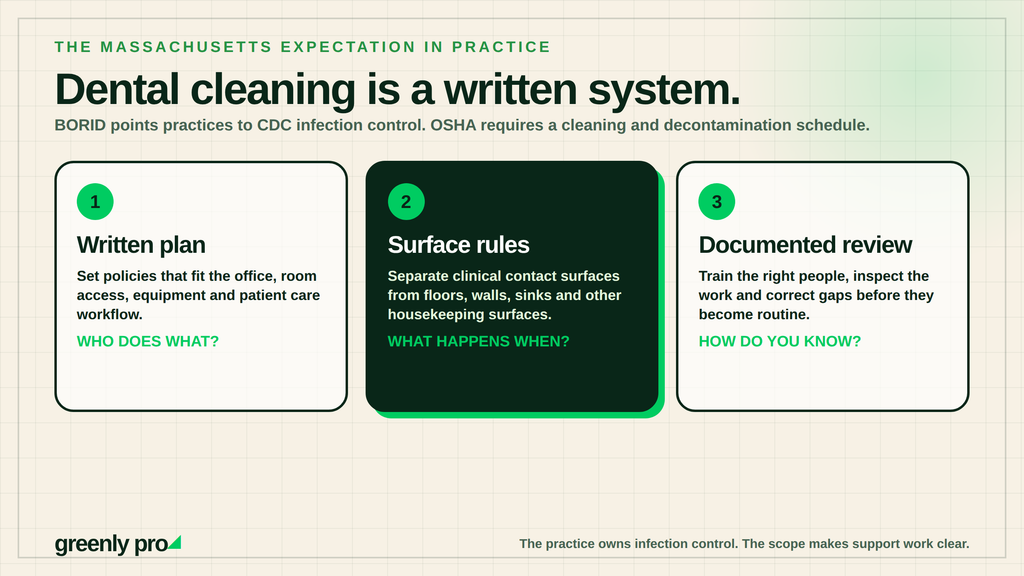
The short answer is that Massachusetts dental offices must operate within a structured infection prevention program. The state regulation references the CDC’s dental infection control standard, while OSHA requires a written cleaning and decontamination schedule tailored to the location, surface, soil and work performed in the area.
That does not mean one universal cleaning list will satisfy every office. A pediatric practice with several operatories, a specialty surgical office and a small general dentistry practice may have different traffic patterns, equipment, room turnover and product requirements. The common expectation is a documented system that staff can follow, inspect and correct.
The CDC’s current dental infection prevention summary says its 2003 guideline, though archived, remains the standard of practice for clinical dentistry alongside CDC recommendations issued since. 234 CMR 5.05 also requires dental practices to comply with OSHA standards.
A useful dental office cleaning Boston plan therefore answers five questions:
- Which surfaces are clinical contact surfaces and which are housekeeping surfaces?
- Who handles clinical turnover, instrument reprocessing and blood or saliva contamination?
- Which nonclinical areas does the janitorial team own?
- What product, use site, contact time and safety instructions apply to each task?
- Who checks the work, documents exceptions and updates the scope when the practice changes?
BORID Infection Control Is a System, Not a Supply Closet
When people search for BORID infection control, they often expect a list of products. The regulation points to a broader operating system.
The CDC recommends that a dental setting designate at least one trained infection prevention coordinator. That person develops written policies that fit the services provided, keeps supplies and guidance available, supports staff training and reassesses the program regularly. The CDC administrative guidance also recommends evaluation of adherence, corrective action when a gap is found and training records.
For a practice manager, the important distinction is accountability. A janitorial partner can carry out recurring tasks in the agreement. It cannot decide which clinical surfaces need to be disinfected between patients, substitute its own product directions for the office protocol, or take responsibility for patient care reprocessing.
The Massachusetts Dental Society’s BORID overview identifies infection control failures among the leading nonclinical violations found following complaint-triggered inspections. Its examples include weekly spore testing, internal indicators in sterilization pouches, sterilization of handpieces and proper storage of sterilized handpieces and equipment. Those tasks belong in the clinic’s clinical infection prevention program, not an after-hours janitorial checklist.
Clinical Contact Surfaces and Housekeeping Surfaces Need Different Rules
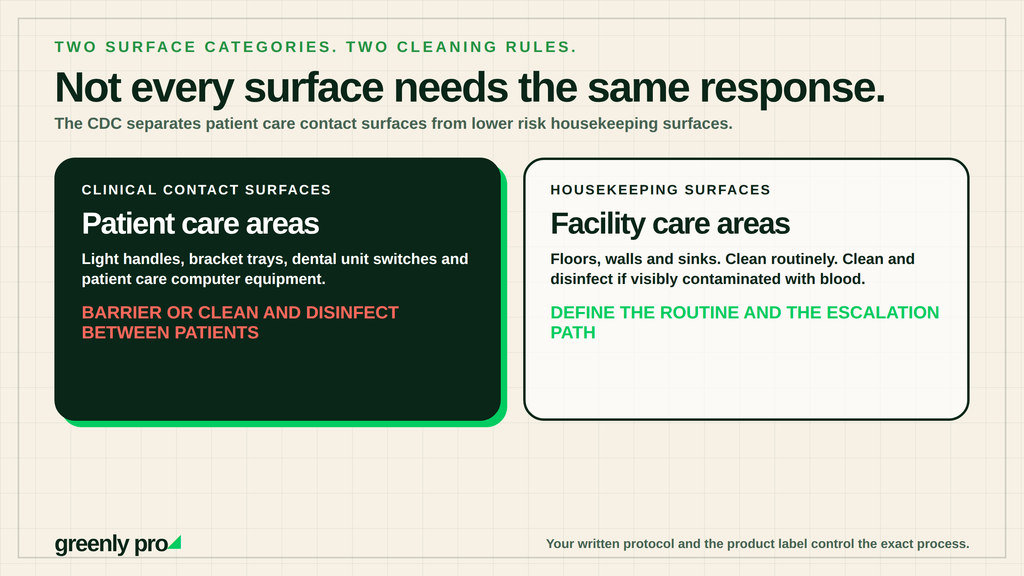
The CDC makes a useful separation between clinical contact surfaces and housekeeping surfaces.
Clinical contact surfaces are the high-touch surfaces in the patient care area. Examples include light handles, bracket trays, dental unit switches and computer equipment used during care. The CDC says these surfaces should be protected by barriers or cleaned and disinfected between patients. If a clinical contact surface is visibly contaminated with blood, the CDC calls for an EPA-registered intermediate-level hospital disinfectant with a tuberculocidal claim.
Housekeeping surfaces include floors, walls and sinks. They generally present a lower risk of disease transmission. The CDC says they may be cleaned with soap and water or cleaned and disinfected when visibly contaminated with blood.
That distinction gives a dental practice janitorial scope its backbone. A cleaning team may own detailed work in reception, corridors, offices, staff rooms, restrooms, floor care and general dust control. It may also support nonclinical cleaning in defined areas. Clinical patient turnover, instruments, handpieces and the release of an operatory should remain with trained dental health care personnel under the office’s current protocol. In a dental office cleaning Boston scope, those boundaries should be written before the team begins work.
No one benefits when a scope blurs those lines. The cleaning crew is left to guess. The dental team assumes a task was done. The patient care area becomes the place where an unclear handoff shows up.
A Dental Practice Janitorial Scope Needs a Handoff Map
The strongest scope is not the longest one. It makes ownership visible.
The dental team should own the tasks that require clinical training, direct knowledge of patient care or authority to release an operatory. This includes patient turnover, clinical contact surfaces, instrument reprocessing, sterilization monitoring, dental unit equipment, barriers, regulated waste procedures and response to clinical contamination under the practice protocol.
The dental practice janitorial team should own the recurring tasks that keep the facility clean, orderly and ready for the next day. Depending on the written agreement, that can include reception and administrative spaces, staff rooms, restrooms, general floors, office surfaces, glass, trash from approved locations, dusting and scheduled deep cleaning.
The practice manager or infection prevention coordinator should own the bridge between those areas. That means approving products and use sites, defining access, identifying restricted rooms, explaining spill escalation, setting the inspection routine and updating the scope when a renovation, new operatory or workflow change creates a new risk.
For broader medical environments, Greenly PRO’s healthcare facility cleaning service shows how a scope can support a facility’s operating requirements without overstepping clinical authority. For contract language that avoids missed tasks, see what a standard janitorial scope can miss.
Product Label Is Part of the Cleaning Requirement
A product can be appropriate for a restroom floor and inappropriate for a clinical contact surface. It may have a health care claim but not be intended to clean a surface before disinfection. It may need to remain wet longer than the routine allows.
The CDC’s dental disinfection guidance requires EPA-registered hospital disinfectants or detergent disinfectants with health care use claims for clinical contact surfaces. It also says to follow the manufacturer’s instructions for amount, dilution, contact time, safe use and disposal.
That is why a written product map matters. The map should identify the product, the room or surface, the application method, the contact time and who is authorized to use it. It should also make clear when the cleaning crew pauses work and contacts the practice rather than improvising.
Product control does not need to be complicated. It needs to be current, visible and consistent with the clinic’s infection prevention plan.
OSHA Requires a Written Housekeeping Schedule
OSHA’s Bloodborne Pathogens Standard requires employers to maintain a clean and sanitary workplace. It also requires an appropriate written schedule for cleaning and decontamination based on the area, surface, type of soil and tasks performed there.
The OSHA standard states that contaminated work surfaces must be decontaminated after procedures, as soon as feasible after visible contamination or a spill, and at the end of a shift if they may have become contaminated since the last cleaning.
For a dental office, a usable schedule is more valuable than a vague promise to clean “as needed.” It identifies the room, task, frequency, owner, product category, access limitation, and escalation path. It also tells a nonclinical cleaning professional when the right action is to stop and call the practice manager. A dental office cleaning Boston schedule is useful only when the people working the shift can understand it.
That protects staff and prevents a vendor from being asked to make a clinical decision without the information or authority to make it.
Use Inspection as a Feedback Loop, Not a Gotcha
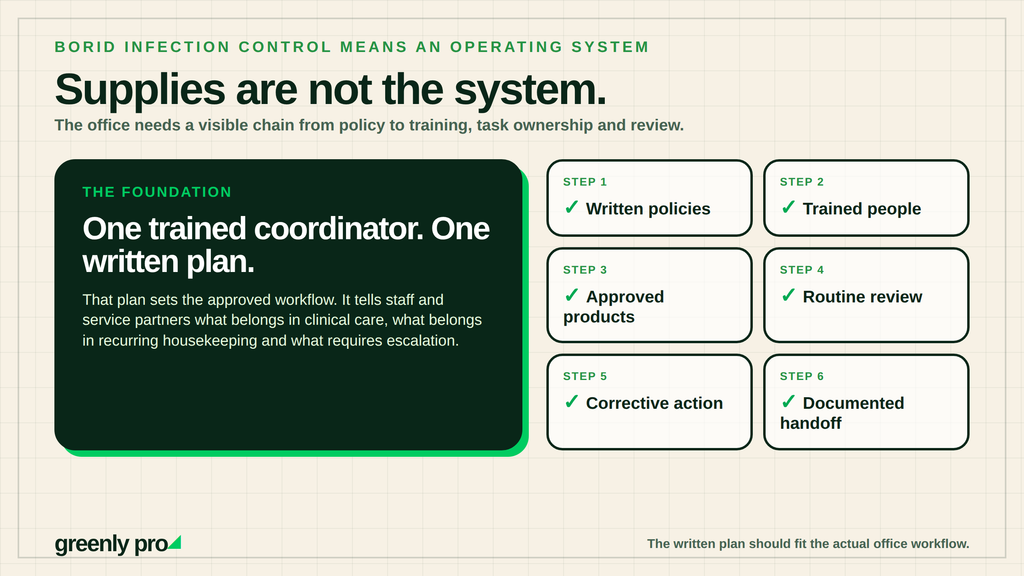
The CDC recommends routine evaluation of infection prevention practices. Its Dental Infection Prevention Checklist can help a practice assess policy, compliance, supplies and corrective action.
A practical monthly review can be short. Walk the reception area, restrooms, staff areas, floors, waste staging points and the transition areas around clinical spaces. Compare the work against the written scope. Note exceptions. Resolve them before they become part of the routine.
This is also the right moment to ask whether the scope still matches the office. New equipment, an added provider, a change in hours or a construction project can change the route and access requirements. A stable cleaning relationship responds to that change with a clearer written plan, not with assumptions.
The Right Next Step for a Boston Dental Practice
A clean office matters to every patient. A documented, role-specific cleaning system matters to the practice. That is why dental office cleaning Boston services should begin with the practice’s actual workflow rather than a generic after-hours checklist.
Start with the clinic’s infection prevention plan. Separate clinical and nonclinical work. Confirm the labels and access rules. Then build a dental office cleaning Boston scope that gives every task an owner.
Greenly PRO can help your practice create a recurring nonclinical cleaning scope around the instructions your clinical team already uses. Request a walkthrough at greenlypro.com/estimate.