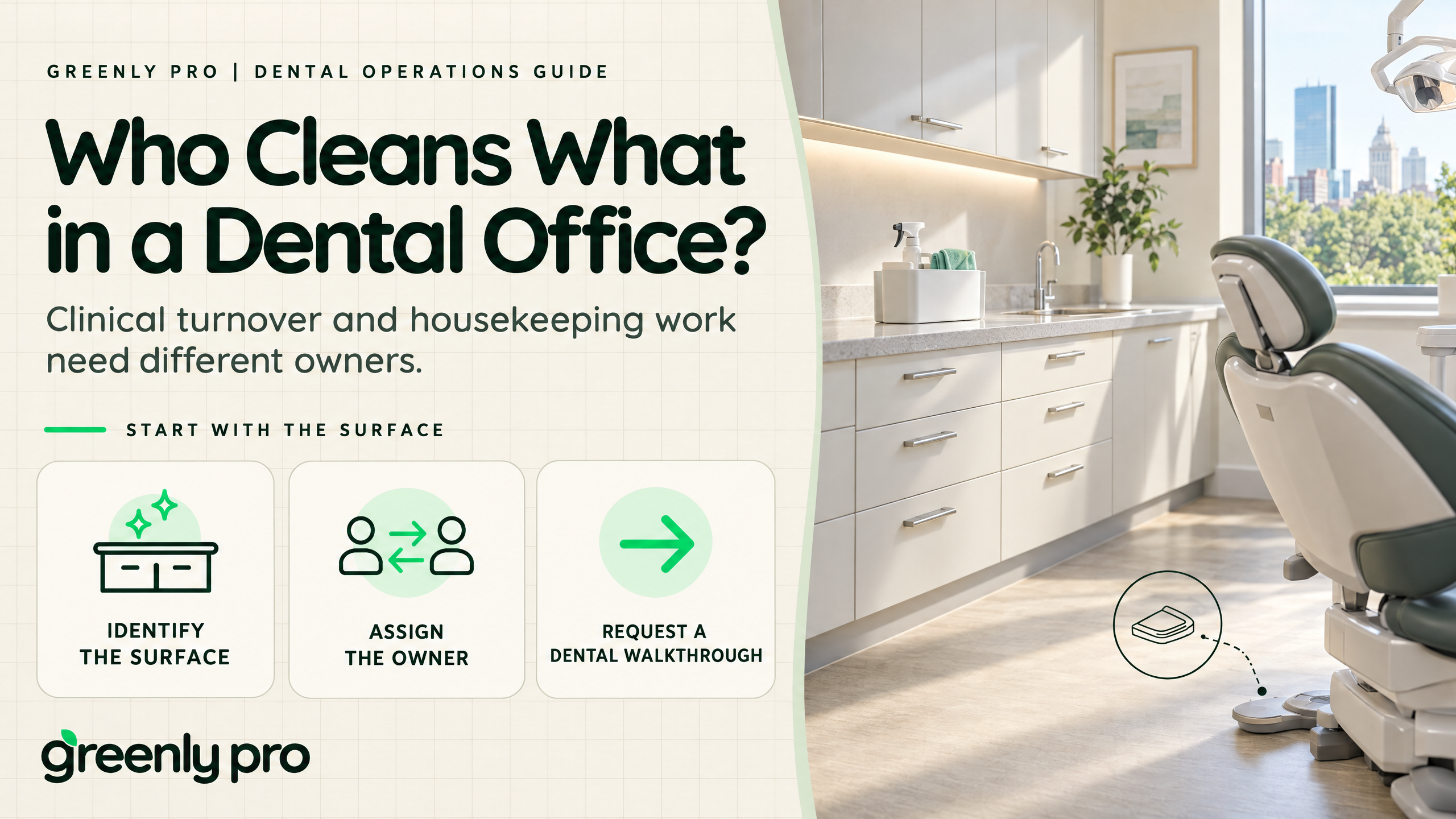
Dental office cleaning responsibilities do not give a cleaning company automatic ownership of dental chair disinfection. A cleaning company can support the office, but it should not assume control of that work simply because it cleans the facility after hours.
Dental office cleaning responsibilities begin with a more specific question: which part of the chair, which type of contamination, which time in the patient flow, and which trained person owns the task? The CDC specifically names switches on dental chairs as clinical contact surfaces that are difficult to clean and therefore good candidates for barriers. Barrier-protect clinical contact surfaces or clean and disinfect them between patients. That is part of the practice’s infection prevention program, not a generic janitorial assumption.
A dental chair is also not one single category. Switches and controls used during care may be clinical contact surfaces. The practice’s written protocol should classify upholstery, bases, foot controls, arms, and nearby equipment based on how they are used, whether they may receive spray or spatter, and what the equipment manufacturer permits.
That distinction is the foundation of clear dental office cleaning responsibilities. It protects patients, keeps the dental team in control of clinical work, and gives a commercial cleaning partner a scope it can carry out without guessing.
Dental Office Cleaning Responsibilities
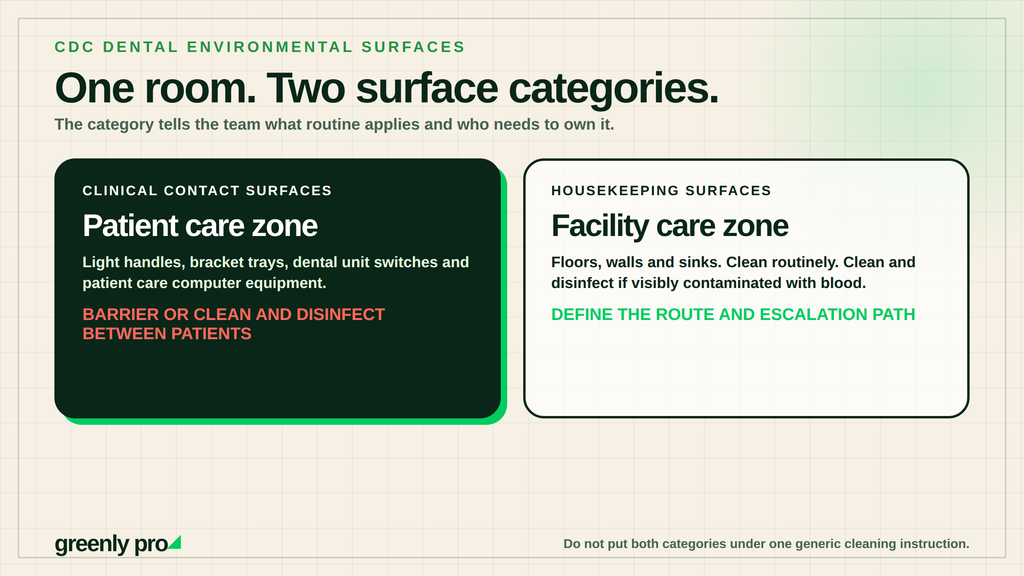
The CDC divides environmental surfaces in a dental setting into two practical groups. The groups may be next to each other in the same room, but they do not carry the same instructions.
Clinical contact surfaces are surfaces in the patient care area that may be touched during procedures or contaminated by spray, spatter or contaminated gloves. The CDC’s dental environmental surface guidance lists light handles, bracket trays, switches on dental units and computer equipment as examples. Its broader dental summary specifically points to switches on dental chairs as surfaces that may be hard to clean.
Housekeeping surfaces include floors, walls and sinks. The CDC says they do not contact patients or devices used in dental procedures and carry less risk of disease transmission. They can be cleaned with soap and water, or cleaned and disinfected if visibly contaminated with blood.
The difference is operational. Clinical contact surfaces are part of patient turnover. Housekeeping surfaces are part of facility care. Combining both under one line item called “clean and disinfect” leaves too much room for assumptions. A useful dental office cleaning responsibilities chart makes the classification visible before a shift begins.
CDC Dental Environmental Surfaces: What Happens Between Patients?
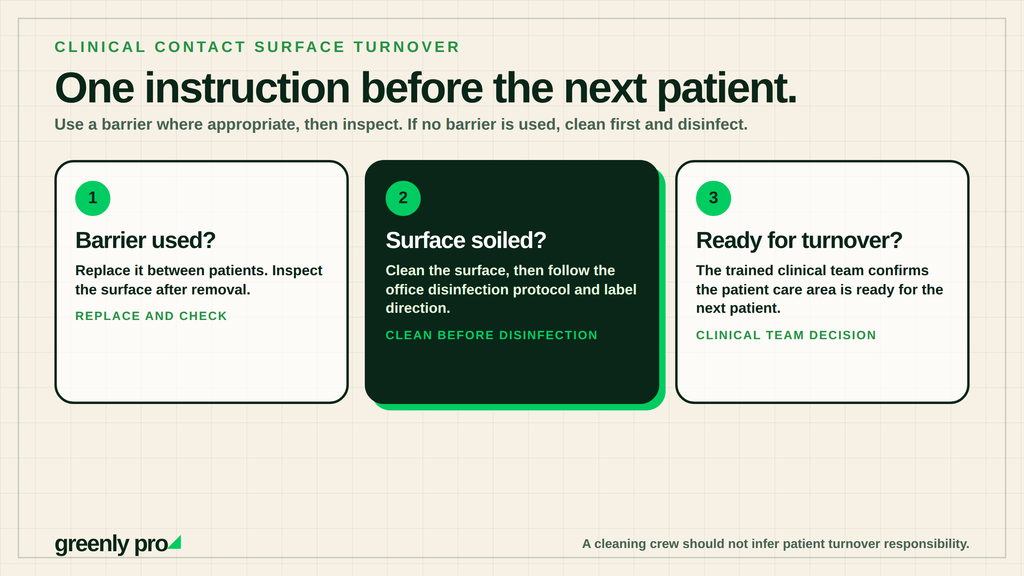
For clinical contact surfaces, the CDC’s instruction is direct. Use a surface barrier where appropriate, replace it between patients and inspect the surface after the barrier is removed. If it is contaminated, clean and disinfect it before the next patient.
Where a barrier cannot be used, the clinical contact surface should be cleaned and then disinfected with an EPA-registered hospital disinfectant. If visibly contaminated with blood or other potentially infectious material, CDC calls for an EPA-registered intermediate-level hospital disinfectant with a tuberculocidal claim. The practice must follow the product label for amount, dilution, contact time, safe use and disposal.
That work belongs inside the patient turnover routine. It should be performed by the dental team or by personnel the practice has explicitly trained, authorized and supervised within its infection prevention program.
The CDC’s sterilization and disinfection guidance makes another boundary clear: cleaning, disinfection and sterilization of dental equipment should be assigned to dental health care personnel with training in the required reprocessing steps. An evening cleaning crew should not be expected to decide how to handle instruments, handpieces, or patient care equipment.
Why “Clean the Dental Chair” Is Too Vague
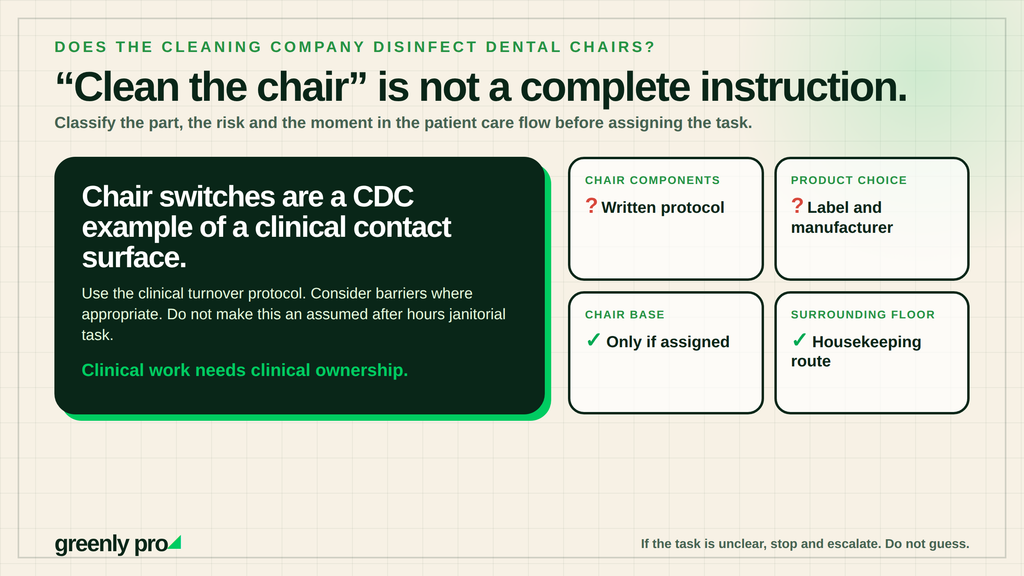
“Clean the dental chair” sounds simple until it reaches a real shift. It can mean wiping the chair base after hours. It can mean changing a barrier on a switch. It can mean responding to visible contamination. It can mean a trained team member turning an operatory over between patients. Those are not interchangeable tasks.
Dental office cleaning responsibilities should state the task at a useful level of detail. For example:
- Chair switches and clinical controls: treat according to the clinical turnover protocol. The CDC identifies switches on dental chairs as a barrier appropriate clinical contact surface.
- Chair surfaces within the patient care zone: follow the practice’s written classification, product instructions and manufacturer guidance.
- Chair base and surrounding floor: include only if the written scope identifies the access conditions, product limits and escalation rule.
- Visible blood or potentially infectious material: do not leave the decision to an untrained after hours team. The practice’s contamination response procedure controls.
This is not a call for more paperwork. It is a call for fewer ambiguous handoffs. A trained dental team should never assume a cleaning crew completed patient turnover. A cleaning crew should never be asked to infer whether a chair surface is approved for a product or ready for the next patient.
What a Commercial Cleaning Partner Can Own
A defined dental practice janitorial scope is valuable precisely because it does not pretend to be a clinical protocol. For a cleaning vendor, dental office cleaning responsibilities begin with the written nonclinical route, not a promise to handle every surface in the suite.
The commercial cleaning partner can own repeatable nonclinical facility work that is named in the agreement. That may include reception and waiting areas, administrative offices, staff rooms, restrooms, corridors, approved floors, dust control, exterior touchpoints, trash from approved locations and scheduled deep cleaning of nonclinical spaces.
The dental practice retains clinical work. It owns patient turnover, clinical contact surfaces, instruments, handpieces, barriers, equipment reprocessing, clinical contamination response and the decision that an operatory is ready for another patient.
The manager or infection prevention coordinator owns the bridge between those roles. That person sets access rules, approves products and use sites, explains what is restricted, defines the escalation contact and updates the scope when the practice adds equipment, changes a room or changes its hours.
For a broader view of scope boundaries in medical settings, see Greenly PRO’s healthcare facility cleaning service. For the contracting problem behind missed tasks, read about the janitorial scope gap.
Write the Scope Like the Work Actually Happens
A reliable scope names the room, surface, task, frequency, owner, approved product or product category, access condition, and escalation contact. It does not have to be long. It needs to be specific enough that a new team member can tell the difference between routine floor care and a patient care task. That is the level of detail dental office cleaning responsibilities need in a live operating plan.
Consider how this works after hours. The practice may close at 6:00 p.m., and the cleaning team may arrive at 8:00 p.m. That does not mean every surface in an operatory becomes part of the evening route. It means the practice decides which rooms are accessible and which tasks are safe and appropriate for the service team to perform.
The scope should also say what happens when the team finds an exception. An overflowing regular trash bin is one instruction. A puncture-resistant sharps container, an unknown spill or material that appears to be contaminated is another. The right answer for the cleaning partner is not to improvise. It is to secure the area if safe to do so and follow the stated escalation path.
OSHA Requires a Schedule That Matches the Surface and Task
OSHA requires employers to maintain a clean and sanitary worksite. Its Bloodborne Pathogens Standard also requires a written cleaning and decontamination schedule based on the location in the facility, type of surface, type of soil and tasks or procedures performed in that area. OSHA’s housekeeping requirement further requires contaminated work surfaces to be decontaminated after procedures, as soon as feasible when visibly contaminated or after a spill, and at the end of shift if they may have become contaminated.
That language supports the same practical point: not every room, surface or event needs the same instruction. Dental office cleaning responsibilities are clearer when the schedule distinguishes clinical procedures from routine facility maintenance. This is also how an office can explain the difference to a new cleaning team without relying on memory.
Massachusetts dental practices also operate under 234 CMR 5.05, which requires practices to operate in compliance with CDC dental infection control guidance and OSHA standards. The Massachusetts Dental Society’s BORID overview identifies infection control matters among commonly identified nonclinical violations after complaint-triggered inspections.
Give the Infection Prevention Coordinator the Final Say
CDC recommends that each dental setting appoint at least one trained infection prevention coordinator who is responsible for written policies that fit the setting. The same CDC administrative guidance calls for job or task-specific education and training. It notes that this includes dental health care personnel working through outside agencies or contracts.
That does not mean a practice manager must personally inspect every floor at night. It means the office has a responsible person who can define the work, train the right people and correct a gap before it becomes routine.
For a dental practice, a simple monthly review works well. Check that the cleaning scope still matches the floor plan. Confirm restricted rooms and products. Look for recurring misses in restrooms, reception or staff areas. Ask the clinical team whether the evening route is affecting the next day’s setup. Update the written scope when the answer is yes.
This is where dental office cleaning responsibilities become a system rather than a promise.
A Clear Scope Supports Both Teams
The goal is not to move clinical work onto a cleaning vendor. It is to remove uncertainty from the work that belongs to each team.
Start by marking clinical contact surfaces, housekeeping surfaces and restricted areas on the office plan. Write the patient turnover tasks separately. Give the cleaning partner a clear recurring route for nonclinical facility care. Then define the exception path so nobody is expected to make a clinical decision after hours.
For a Greater Boston dental office walkthrough and a clearly defined nonclinical cleaning scope, request an estimate at greenlypro.com/estimate.