
When people search for fall cleanup cost in Massachusetts, they usually want a simple number.
Property managers need something more useful: a budget that accounts for the actual site, the leaf volume, the disposal plan, the drainage risks, and the work that has to happen before snow and ice arrive. A light leaf pass at a small, well-maintained property is not the same job as a full commercial cleanup across landscaped beds, parking edges, entrances, catch basins, and loading areas. Treating both as “leaf removal” is how scope gaps end up in the contract.
For a local benchmark, Boston yard-cleanup data published by Angi places general cleanup at roughly $0.02–$0.12 per square foot, with fall work commonly estimated at $230–$690 and local landscaper labor at $50–$80 per hour. Those figures are primarily residential-market data, not a commercial rate card. They are still useful as a checkpoint: a commercial property with a similar quantity of maintainable grounds, clear access, and light debris may begin near the lower end; complex sites will not.
The practical answer: Budget a commercial fall cleanup from the scope outward, not from the gross acreage inward. Confirm the maintainable areas, number of visits, leaf density, access, haul-away plan, and winter handoff before comparing totals.
This guide explains how to build a credible 2026 fall-cleanup budget for Massachusetts offices, multifamily communities, medical properties, retail sites, and flex buildings. It also gives you the checklist that should be attached to the proposal.
A sensible starting point for your 2026 budget
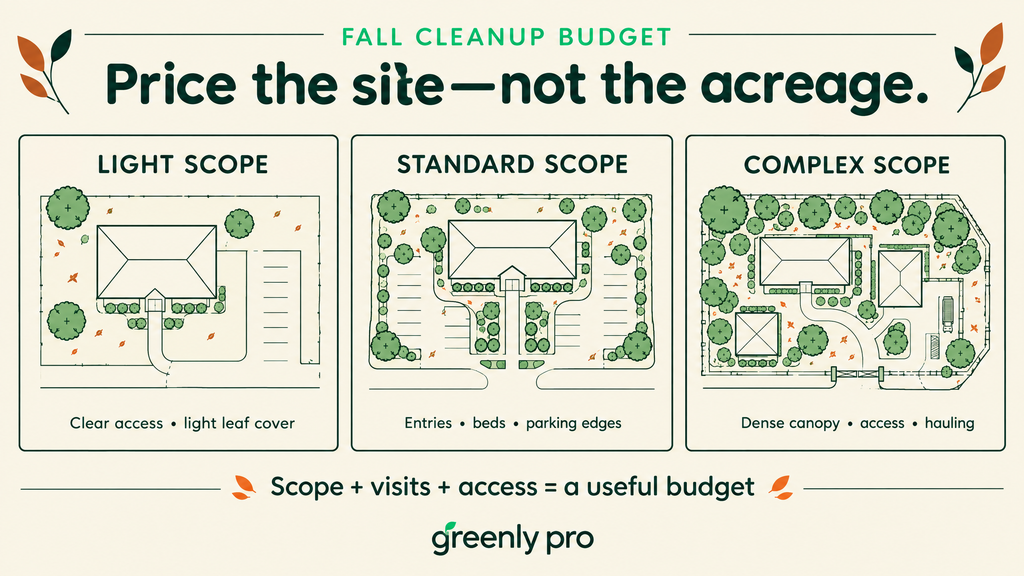
Published Boston benchmarks can help establish the first conversation, but they do not define the final price for a commercial site. Use the following ranges as planning context for maintainable grounds, then request a documented site-specific scope.
| Site condition | Budget signal | What the quote should clarify |
| Light leaf cover; simple lawn and walkway areas; easy crew access | Often closer to the lower end of the $0.02–$0.12 per sq. ft. benchmark | Number of service passes, bagging or mulching method, and whether haul-away is included |
| Typical office, multifamily, or retail grounds; beds, entry paths, parking edges, and several mature trees | Usually falls in the middle of the local planning range | Which surfaces are included, how leaves are managed around drains, and the final-visit trigger |
| Dense tree canopy, multiple buildings, steep or fenced areas, roof/drain issues, restricted access or heavy hauling | Can reach the upper end or require a custom crew-hour / haul-load estimate | Labor plan, disposal destination, access restrictions, specialty subcontractors and exclusions |
The unit matters as much as the rate. Is the vendor pricing only landscaped areas? Every paved surface? The whole parcel? A 60,000-square-foot office site can contain a small amount of turf, a large parking lot, and several drainage points. A square-foot rate without a map tells you very little.
For that reason, a good proposal commonly combines one of three models:
- Per-visit pricing for repeat leaf passes during peak drop.
- Crew-hour pricing for a recovery cleanup, an uncertain amount of debris, or difficult access.
- A defined seasonal program that identifies the number of visits, the final cleanup, and the exception process.
The third option is usually easiest to manage for a portfolio because the expected outcome is visible before the leaves begin falling.
What changes the cost on a Massachusetts property
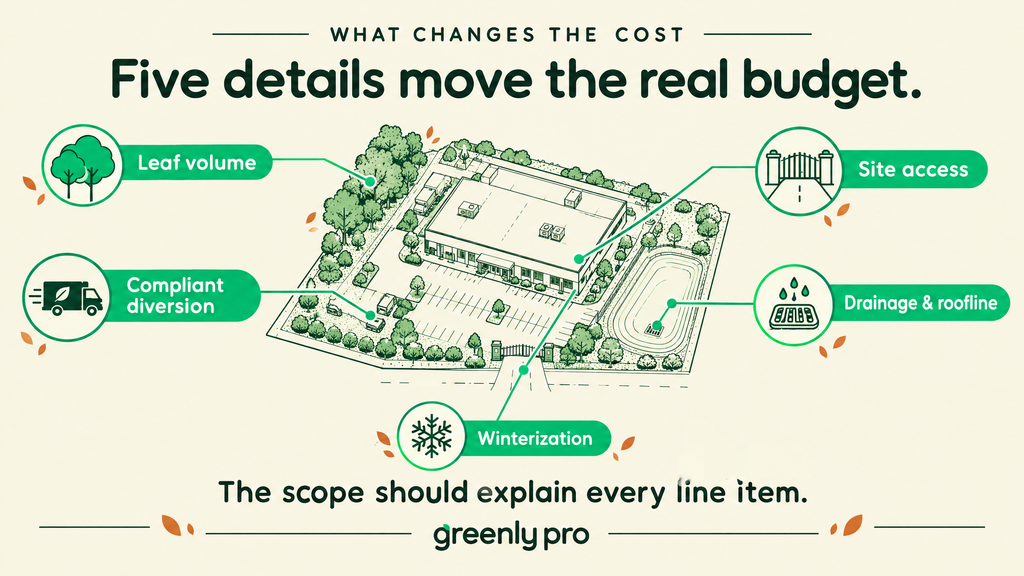
Leaf volume is not the same as property size
A compact property with mature oaks can generate more work than a much larger site with a sparse canopy. The estimator should walk the tree line, beds, parking edges, and wind-collection zones, not just pull an acreage figure from a map.
Ask whether the proposal assumes one final cleanup or several passes. Waiting until every leaf has dropped can appear cheaper at first, but it may leave entrances, walkways and drainage grates covered during the weeks when the site needs them clear.
Access and staging change crew time
Loading-dock rules, tenant traffic, narrow gates, limited parking, noise restrictions and after-hours access all affect the time required. So do distance-to-truck and whether crews can stage bags or equipment safely. These are reasonable factors when they are documented. A generic “commercial surcharge” is not.
Disposal is an operating requirement, not an afterthought
Massachusetts prohibits leaves and yard waste from disposal or transfer for disposal. The MassDEP waste-ban guidance specifically lists leaves and yard waste, and notes that businesses and property managers share responsibility for proper compliance.
That means a complete proposal should say where organic material is going: onsite mulching where appropriate, a permitted composting/recycling outlet, or a hauler’s approved facility. Do not assume a municipal curbside program will take a commercial property’s material. Boston, for example, says its curbside collection does not serve buildings with more than six units, and its drop-off events do not accept waste from businesses.
This detail is often why two otherwise similar proposals are far apart. One may include pickup and compliant diversion; another may only move leaves to a pile or leave haul-away unpriced.
Drainage and roofline work deserve their own line items
Leaves around catch basins, curbs, and sidewalk drains are part of grounds cleanup. Roof drains, scuppers, gutters and elevated work are different: they can require specialized access, safety procedures and a qualified contractor.
A fall walkthrough should identify both, but the proposal should not blur them together. You need to know whether the vendor is clearing accessible ground-level drainage or taking responsibility for roof and gutter work as well.
Plant care, turf work and winterization expand the scope
A final mow, bed cleanup and selective cutbacks can be part of seasonal grounds care. Aeration, overseeding, fertilization, irrigation shutdown, large-branch removal and tree pruning are often separate services. A clear proposal lists each item and its timing.
That is not about making a scope longer. It is about giving the property team a clean decision: maintain it now, defer it deliberately, or approve it as an add-on.
The commercial fall cleanup checklist
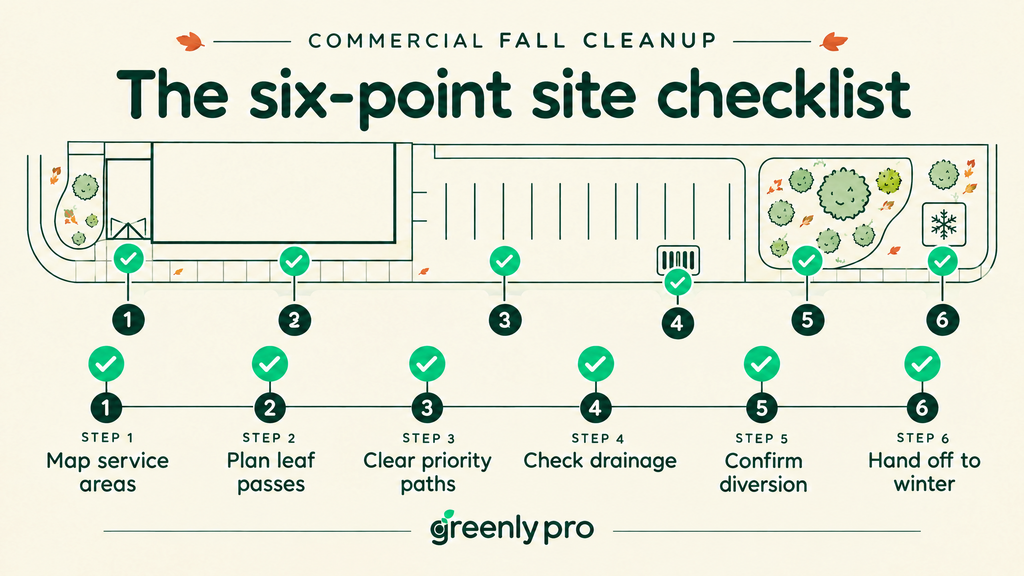
Use this as the scope sheet for your own walkthrough or as an attachment to a vendor proposal.
1. Map the areas that actually need service
Mark lawns, beds, sidewalks, entrance zones, loading areas, parking edges, dumpster enclosures, curbs, catch basins and drainage swales. Note tree canopy, wind pockets and any area where debris regularly collects.
A useful scope names locations. “Remove leaves from grounds” is vague. “Clear the north entry, visitor walk, west parking edge, dumpster path and three catch basins on each service visit” is manageable.
2. Separate recurring passes from the final cleanup
The best time for a final cleanup depends on the trees and the property, not a calendar promise. Set the expected number of recurring visits, then define the trigger for the final pass: a specified date range, canopy drop level, or manager approval after a site walk.
This prevents the familiar problem of a “one-time fall cleanup” that happens early and leaves the property covered again two weeks later.
3. Clear the pathways people use first
Prioritize accessible routes, main entries, curb ramps, fire exits, loading routes and waste areas. Leaves can hide broken pavement, hold moisture, and become slippery once rain or frost arrives. The visual standard matters, but safe access matters first.
4. Check drainage paths before freezing weather
Clear leaves and sediment from accessible catch-basin grates, curb openings, swales and the ground around downspout outlets. Note standing-water areas and escalate roof, gutter or drain failures to the right specialist.
A commercial fall-maintenance checklist from Zoro makes the same operational point: inspect landscape beds, pedestrian routes, catch basins, downspout discharge and low spots before winter. Use that as a starting framework, then adapt it to your site.
5. Decide what gets mulched, composted or hauled away
Moderate leaf cover can sometimes be mulched into turf as part of the landscape plan. UMass Extension notes that mulching may be appropriate when leaves are managed regularly and finely shredded; heavy accumulation is a different situation.
For material leaving the site, confirm the destination. UMass also notes that many municipal sites do not accept yard waste from landscapers or commercial sources. The best time to discover that is before a crew fills a truck.
6. Document the handoff to winter operations
End the fall program with a final inspection. Record unresolved pavement or drainage issues, locations that collect ice, access restrictions, sensitive landscaping and the priority order for snow and ice response.
This is where fall cleanup becomes facility management rather than seasonal appearance work. The completed checklist should improve the first winter response—not sit in a vendor file.
Four questions to ask before signing a fall-cleanup proposal
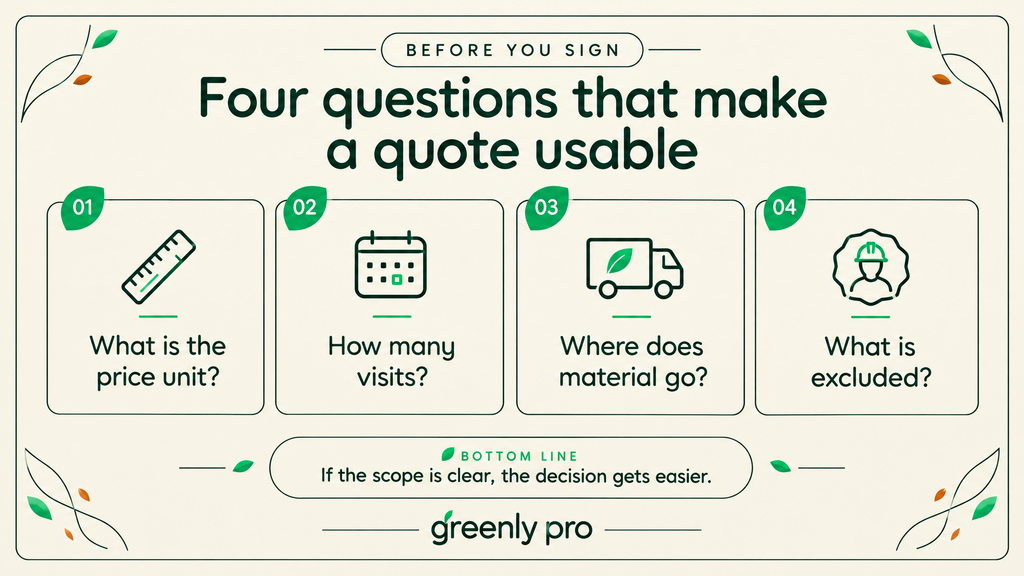
- What is the price unit and what area does it cover? Ask whether the number is per visit, per crew hour, per haul load, per maintained square foot or a seasonal flat fee. Then ask for the areas marked on a site map.
- How many visits are included? A quote for one heavy cleanup and a quote for four scheduled passes can have the same total while producing very different results through October and November.
- Where does the material go? Require the vendor to identify whether leaves are mulched, removed or diverted to a compliant organic-waste outlet. Keep yard waste separate from trash and construction debris.
- What is excluded or needs specialist approval? Roof work, elevated gutter cleaning, tree pruning, irrigation winterization, damaged drainage infrastructure, mulch installation, and large debris should never be left to assumption.
A better way to compare two estimates
Put both proposals into the same checklist and compare the answer to each of these lines:
| Comparison point | What “clear” looks like |
| Covered locations | Named lawns, beds, entries, walks, lots, drainage points and waste areas |
| Visit plan | Number of visits, service window, final-cleanup trigger and weather rescheduling process |
| Debris management | Mulch, bag, haul-away and disposal plan identified |
| Risk items | Ground drainage versus roof/gutter/tree work clearly separated |
| Quality control | Site contact, photo/reporting expectation and correction process stated |
| Winter handoff | Deferred repairs and snow/ice priority areas documented |
The lowest total may still be a sensible choice. It is only a sensible comparison after both vendors are quoting the same operating standard.
The value of planning before the leaf drop
By late October, every landscaper is busy, and every property team is reacting to the same weather. The easiest time to control cost is before that rush, when the scope can still be set, access issues can be solved, and the disposal route can be confirmed.
For Greater Boston properties in Boston, Waltham, Burlington, Woburn, and Braintree, Greenly PRO can help turn a general “fall cleanup” request into a documented plan for your site. Request a scope-based estimate at greenlypro.com/estimate. You will have a defined checklist to compare, not just a number to guess at.
Frequently asked questions
What is the average fall cleanup cost in Massachusetts?
Boston yard-cleanup data published by Angi lists a general range of $0.02–$0.12 per square foot and a fall cleanup range of $230–$690. Those are consumer-market benchmarks. Commercial properties should use them only as a starting point, then request a site-specific scope that accounts for leaf volume, access, repeat visits, and disposal.
Is fall cleanup priced by acre or by visit?
Either can be used, but neither is enough on its own. Commercial vendors often use a seasonal flat program, per-visit pricing, or crew-hour pricing because canopy density, site access, and debris handling can vary dramatically across properties of the same size.
Are leaves and yard waste allowed in the trash in Massachusetts?
Massachusetts lists leaves and yard waste among materials banned from disposal or transfer for disposal. Use an approved organic-waste, composting or recycling pathway instead, and confirm whether a municipal program accepts commercial material before relying on it.
Does a fall cleanup include gutter and roof-drain cleaning?
Not automatically. Ground-level drainage and accessible catch basins may be included in a grounds scope. Gutters, roof drains, scuppers, and elevated work should be clearly listed and performed by appropriately qualified professionals when needed.
How many fall cleanup visits does a commercial property need?
There is no universal number. Properties with mature canopy, public entrances, or busy drainage areas often need recurring passes plus a final cleanup. The right schedule follows leaf drop, site traffic, and winter-readiness needs rather than a generic calendar date.