Healthcare facility cleaning in Massachusetts is not a generic office-cleaning plan with stronger products. It is a documented operating system for the rooms people use, the surfaces they touch, the people who are more vulnerable in those spaces, and the moments when a normal routine must stop and follow the facility’s infection-prevention or exposure-control process.
That is why a waiting room, an administrative office, a patient restroom, and an exam room should not be treated as identical zones. They do not carry the same workflow, contact pattern or escalation path.
A reliable cleaning partner makes those differences visible. The scope identifies what is cleaned, what is disinfected, who owns the task, which product is approved, how the product is used, and what gets reported to the facility rather than handled by the cleaning team.
The operating principle: Match the cleaning method to the room, then document the handoff.
This guide is written for Massachusetts medical-office administrators, outpatient-clinic leaders, dental and specialty-practice managers, healthcare property teams, and long-term-care support teams. It does not replace the facility’s infection-prevention policies, clinical direction, product labels, Massachusetts licensure obligations, or OSHA-required programs.
Why Healthcare Facility Cleaning in Massachusetts starts with risk-based zones
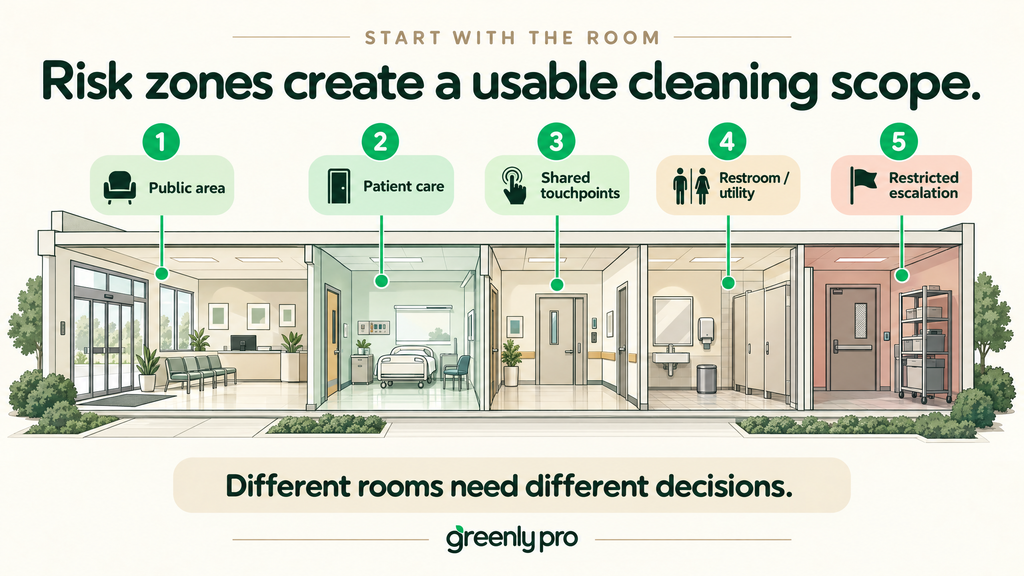
The most common scope problem is also the easiest to spot: one frequency, one product, and one checklist for an entire facility.
The CDC’s environmental-cleaning guidance frames cleaning frequency, method, and process around three questions: How likely is contamination? How vulnerable are the people in the area? How likely is contact with the surface? Those questions are more useful than a generic “daily versus weekly” promise.
Use a zone map before assigning work.
| Zone | Typical examples | Scope decision to make |
| Public/low clinical contact | Lobby, corridors, administrative offices | Determine traffic pattern, touchpoints and presentation standard |
| Patient-facing care area | Exam rooms, treatment rooms, reception counters | Follow the facility-approved turnover, cleaning and disinfection process |
| High-touch shared space | Waiting areas, check-in kiosks, door hardware, shared equipment exteriors | Identify the actual contact points and reset trigger |
| Restroom/utility area | Patient restrooms, staff restrooms, janitor closets | Separate tools and workflow to avoid cross-contamination |
| Restricted clinical or exposure area | Areas involving sharps, regulated waste, blood/body-fluid incidents, isolation or device reprocessing | Define an escalation path owned by the facility’s qualified team and policies |
A cleaning provider can help map rooms, surfaces and traffic. The clinical or infection-prevention lead should determine the patient-care policies, precautions and special procedures that govern the site.
Separate cleaning from disinfection
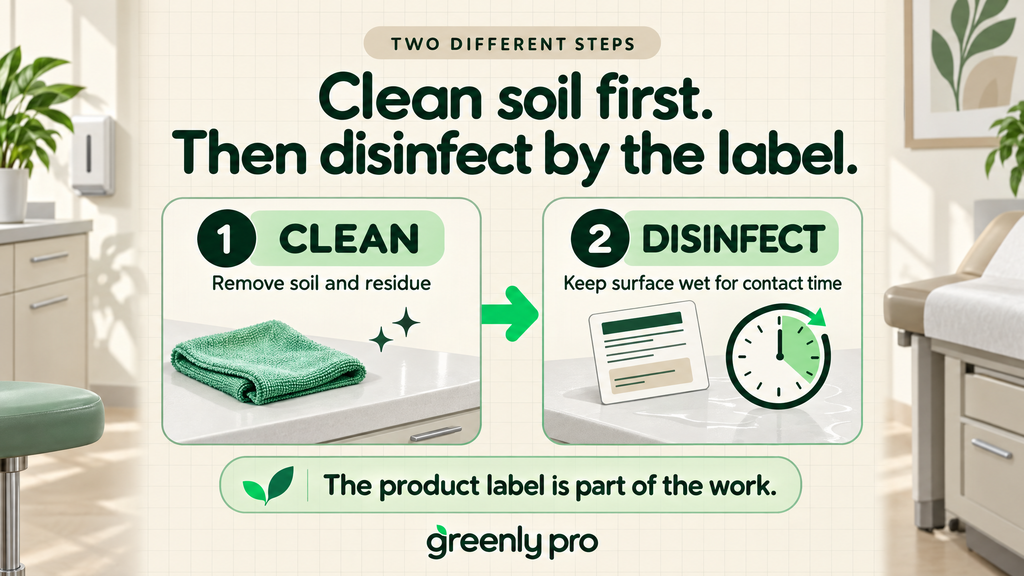
“Disinfect everything” is not a workable instruction. Cleaning physically removes soil and organic material. Disinfection is a separate process that uses a product to act on a surface. In some workflows, a facility-approved product may support both steps; in others, the steps are distinct. The key is not a slogan. It is following the product label and the facility’s process.
The Massachusetts Infection Prevention and Control Resource Hub makes the sequence clear: when a two-step process is used, cleaning comes first because proper disinfection cannot occur on a surface that has not been cleaned. It also emphasizes that the surface must remain wet for the full label contact time before a patient or resident enters, or shared equipment returns to use.
That changes how a team works. A wipe that is applied and immediately buffed dry might look efficient, but it may not meet the label directions. A product used on the wrong surface, at the wrong dilution or without enough wet time creates a paper trail without a dependable process behind it.
Build room-by-room routines around the actual workflow
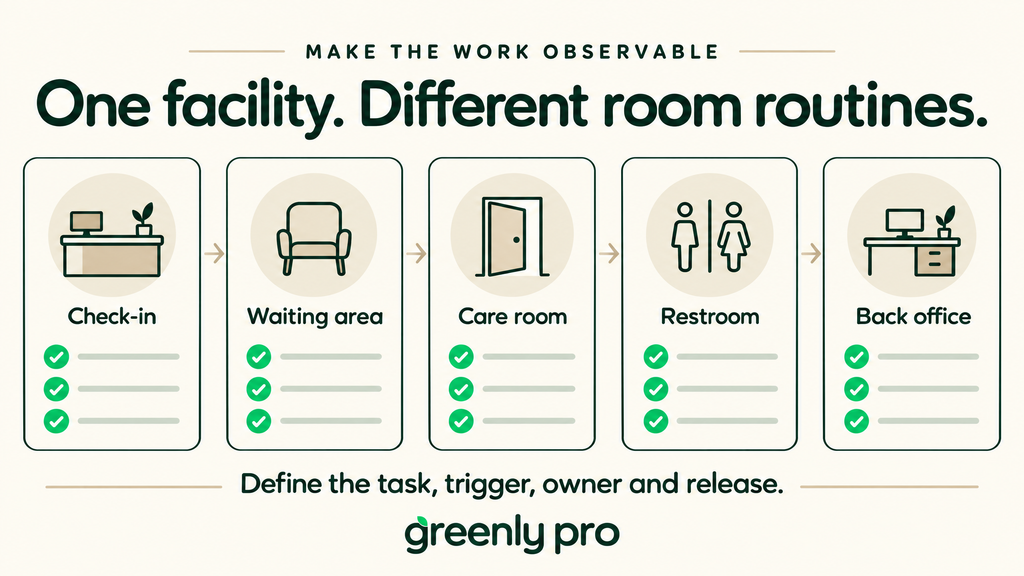
A facility does not need an enormous binder to establish a usable routine. It needs a short, observable standard for each room type.
For a waiting room, that might include chairs and arms, tables, reception-counter touchpoints, kiosk surfaces, door hardware, waste, floors, and an end-of-shift reset. For a care room, the process should be written with the facility’s approved turnover and equipment-boundary instructions. For restrooms, it should include a dedicated tool path and an inspection point before release.
Each routine should answer five questions:
- What surfaces or tasks are included?
- What triggers the reset? Scheduled interval, patient turnover, end of day, spill, or another defined event.
- Who performs it? Cleaning provider, clinical team, facility team, or another assigned role.
- Which approved product and method apply?
- What is the release or escalation step?
The CDC recommends detailed SOPs and checklists that identify responsibility, frequency and method for patient-care areas and noncritical equipment. A scope becomes easier to manage when the facility’s policy, the provider’s work instructions, and the actual room all tell the same story.
Use a deliberate sequence to prevent missed surfaces
A dependable method is usually quieter than people expect.
Before work starts, staff should visually assess the space: Is there clutter? A damaged surface? A spill? A patient or staff condition that requires different PPE or a different process? The point is not to make clinical decisions. It is to recognize when the normal route no longer applies.
For routine environmental surfaces, the CDC describes practical sequencing principles: work from cleaner to dirtier, high to low, and in a systematic pattern so surfaces are not skipped. In a patient-care area, the exact workflow must still be aligned to the facility’s policy, the room’s use, and any precautions in force.
Good sequence protects quality. A team that wipes a counter, touches a contaminated bin, then returns to the counter with the same cloth may complete tasks quickly but has not executed a controlled process.
The method should also describe tool changes, cloth handling, cart organization and floor finishing. Color coding alone is not a program; the team needs training, placement rules and accountability for keeping tools in their intended zones.
Treat product labels, SDSs and contact time as part of the scope
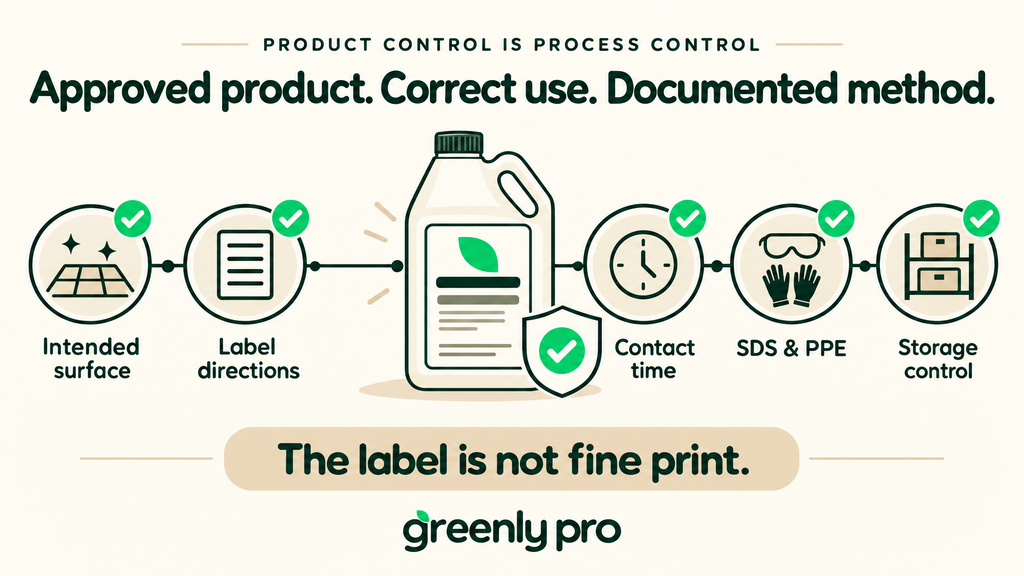
The product label is not fine print. It is the work instruction.
The EPA explains that the label specifies where a product can be used, how it should be applied, and how long it must remain on the surface. The surface needs to stay visibly wet for the full contact time. A product’s EPA registration number is a more dependable way to identify it than brand name alone.
For a facility manager, that means the provider should be able to show:
- The approved product list and the relevant EPA registration number
- The intended surfaces and use sites
- The label-directed dilution, application, and contact time
- Safety Data Sheets and staff access to them
- Required PPE and ventilation considerations
- Storage, dating and replacement controls
- The process for changing products when a facility’s infection-prevention team directs it
The Toxics Use Reduction Institute at UMass Lowell also warns against mixing cleaning chemicals and reinforces that cleaning comes before disinfection. That is particularly important in occupied spaces where staff, patients and visitors may be sensitive to odors or chemical exposure.
Draw a firm line around escalation work
A quality cleaning partnership does not claim to handle every condition in a healthcare setting.
The scope should make clear that sharps, regulated medical waste, device reprocessing, medication areas, sterile processing, clinical equipment, isolation precautions and blood or body-fluid incidents are governed by facility policy, qualified staff and applicable regulatory requirements. A cleaning provider may have a defined response role only when the facility’s written program, training and supervision support it.
OSHA’s Bloodborne Pathogens standard requires employers with occupational exposure to maintain a written Exposure Control Plan. It also requires a written cleaning and decontamination schedule suited to the location, surface, soil, and tasks performed, and states that contaminated environmental and work surfaces must be cleaned and decontaminated after contact with blood or other potentially infectious material.
In practice, the handoff needs to be simple:
- Secure or avoid the area according to site policy.
- Notify the designated facility contact.
- Follow only the trained, authorized response path.
- Document the handoff and release decision.
That protects patients, staff, and the cleaning team. It also prevents a routine-cleaning checklist from being used for an event it was never designed to manage.
Verify quality with evidence, not only appearance
A room can look polished and still be incomplete. Visual inspection is useful, especially for clutter, dust, spills, waste, and obvious missed tasks. But it should not be the whole quality program. The right measurement matches the service being managed.
For a medical office, that may mean a daily completion log plus manager checks of the agreed touchpoint list. For a larger site, it may include objective environmental-cleaning monitoring selected by the infection-prevention team. The CDC provides tools for hospitals to develop, implement, and evaluate objective monitoring programs for high-touch surface cleaning and terminal room cleaning.
The feedback loop matters more than the format:
| Step | What to capture |
| Scope | Room, task, approved method, owner and trigger |
| Completion | Time, initials or digital record, exceptions |
| Inspection | What was reviewed and against which standard |
| Correction | Missed work, retraining or scope revision |
| Review | Trends, recurring issues and next changes |
A provider who welcomes a concise review does not create extra work. It reduces repeat complaints and makes the next service better defined.
Ask these questions before you sign a healthcare cleaning agreement
The lowest monthly number does not tell you whether the scope fits the facility.
Ask a prospective provider:
- How will you map public, patient-facing, restroom, staff and restricted zones?
- What work stays with the provider, and what is escalated to the facility’s clinical or infection-prevention team?
- Which product information, labels, SDSs and training records can you provide?
- How will contact time be protected in the workflow?
- How are cloths, tools and carts managed between zones?
- What is the response process for a spill, safety concern, damaged surface or other exception?
- What gets documented each visit?
- Who reviews quality, and how quickly are missed items corrected?
- How will the scope be updated when rooms, patient flow or facility policy change?
For Massachusetts long-term-care settings, the Department of Public Health maintains infection-prevention resources and links to environmental-cleaning evaluation materials. For any regulated care setting, use those resources alongside your organization’s specific policies and oversight requirements.
The onboarding period is where the scope becomes real
Do not judge a new provider only by the first polished walkthrough.
Use the first 30 days to test the operating system. Walk the site together. Confirm the room list and access plan. Revisit the high-touch map. Verify approved products and location-specific procedures. Check the handoff process with the administrator and the clinical or infection-prevention lead. Then review the first service records for patterns.
This is also when many scope gaps become visible: a counter that belongs to the clinical team, a room that turns over more often than expected, a restroom that needs a different schedule, an access restriction, or a product incompatible with a surface. The solution is not to blame the cleaning team or write a longer contract. It is to clarify the decision and update the documented process.
A Healthcare Facility cleaning starts with a clearer operating system
Healthcare environments carry more responsibility than ordinary commercial spaces. The answer is not more vague language about sanitation. It is a scope that reflects the room, the workflow, the product label, the people responsible and the conditions that require escalation.
For healthcare facilities across Boston, Waltham, Burlington, Woburn and Braintree, Greenly PRO can develop a documented cleaning scope around your property’s access plan, room types and operational handoffs. Start at greenlypro.com/estimate. You will receive a site-specific conversation, not a one-size-fits-all promise.