HOA cleaning budget planning can make cleaning look like a small line item compared with insurance, utilities, staffing or capital repairs. Until it is not.
A dim lobby, overflowing trash room, streaked elevator, neglected stairwell, or clubhouse restroom becomes visible to every resident and guest. It also becomes the place where a board hears, “What are our fees paying for?”
The answer should not be a vague monthly number.
A good HOA cleaning budget explains what the association is choosing to maintain, how often the work happens, what falls outside the routine scope, and how the board will know whether the standard is being met.
The planning principle: Set the common-area standard first. Then build the cleaning line that supports it.
This guide is written for Massachusetts condominium boards, HOA trustees, community-association managers and volunteer finance committees. It is not legal advice. The association’s master deed, declaration, bylaws, management agreement and counsel should guide its own approval process and expense allocation.
Keep operating cleaning separate from reserves
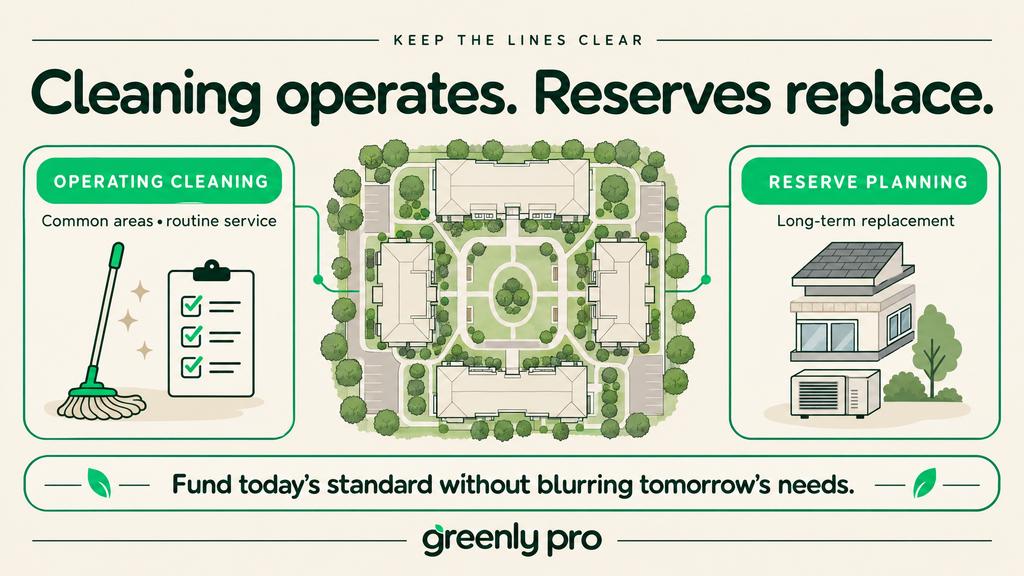
The first decision is conceptual: what belongs in the operating plan, and what belongs in a replacement reserve or capital plan?
Routine cleaning is generally an operating expense. It supports the day-to-day condition of common spaces: lobbies, corridors, elevator cabs, restrooms, laundry rooms, amenity spaces, waste areas and entry points.
Periodic work such as carpet extraction, hard-floor maintenance, interior glass, high dusting, or post-event recovery usually belongs in the operating budget too, provided it is planned as a service rather than treated as a capital replacement.
Replacement reserves are different. They prepare the association for the long-term maintenance or replacement of shared components. In Massachusetts, condominium common-expense assessments must be made at least annually from a budget adopted in accordance with the governing documents. The state also requires condominiums to maintain an adequate replacement reserve fund, separate from operating funds, subject to specific statutory modification provisions.
That distinction matters during budget season. Reducing routine cleaning to make the operating budget look better does not strengthen the association. It simply shifts the visible effect to the common areas—and risks turning predictable upkeep into reactive requests.
Use separate lines for:
| Budget line | What it covers | Board question |
| Routine common-area cleaning | Recurring service for shared interior areas, restrooms, waste rooms and entries | What standard should residents experience each week? |
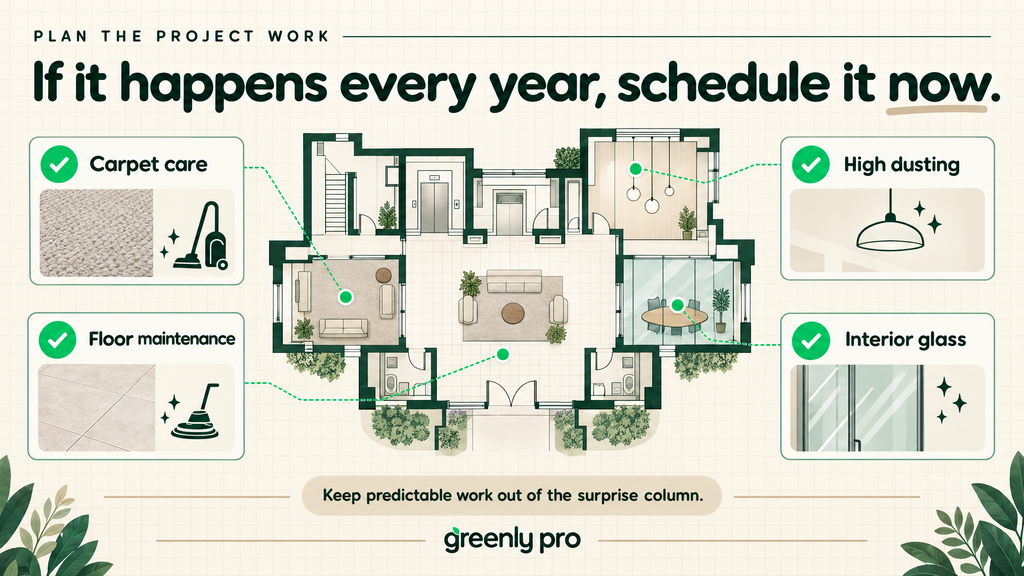
| Planned project cleaning | Carpet care, floor maintenance, interior glass, high dusting and seasonal deep work | Which projects happen predictably enough to schedule now? |
| Operating contingency | Approved response for an event, spill, turnover, access issue or temporary demand change | What flexibility does management need without eroding the base scope? |
| Replacement reserve / capital plan | Long-lived shared components and replacements, based on governing documents and professional guidance | Are we keeping operating service distinct from long-term replacement funding? |
For broader community-association context, the Community Associations Institute’s reserve guidance describes reserve studies as tools to plan for the maintenance and replacement of the components an association is responsible for. The cleaning budget should complement that planning—not compete with it.
Start with a common-area walk, not last year’s invoice
The most common budget mistake is carrying last year’s number forward without confirming last year’s work.
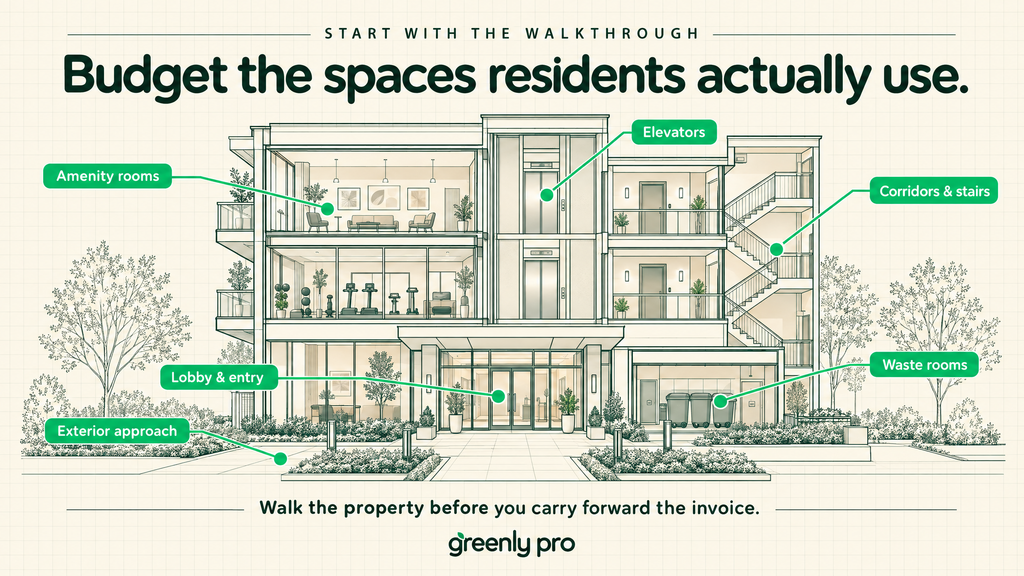
Start with a short walkthrough. Bring the current scope, any recurring resident complaints, extra invoices, incident notes and a simple map of the property. Look at the common areas at the times residents actually use them—not just midmorning, after a cleaning visit.
For most associations, the walk should include:
- Main entry, vestibule, mail/package area and lobby
- Hallways, landings, stairs, handrails and elevator cabs
- Laundry rooms, fitness areas, clubrooms and shared restrooms
- Waste, recycling and loading areas
- Amenity rooms, leasing offices or management spaces where applicable
- Entry glass, mats, exterior approach and any accessible route that accumulates debris
The point is not to turn the board into a cleaning inspector. It is to give the board and provider the same picture of the work.
ISSA’s workloading guidance follows a similar sequence: inventory the space that is actually cleaned, define tasks and frequencies, then connect the scope to labor and cost. That is useful for a board even when all cleaning is contracted out.
Match frequency to use, not to tradition
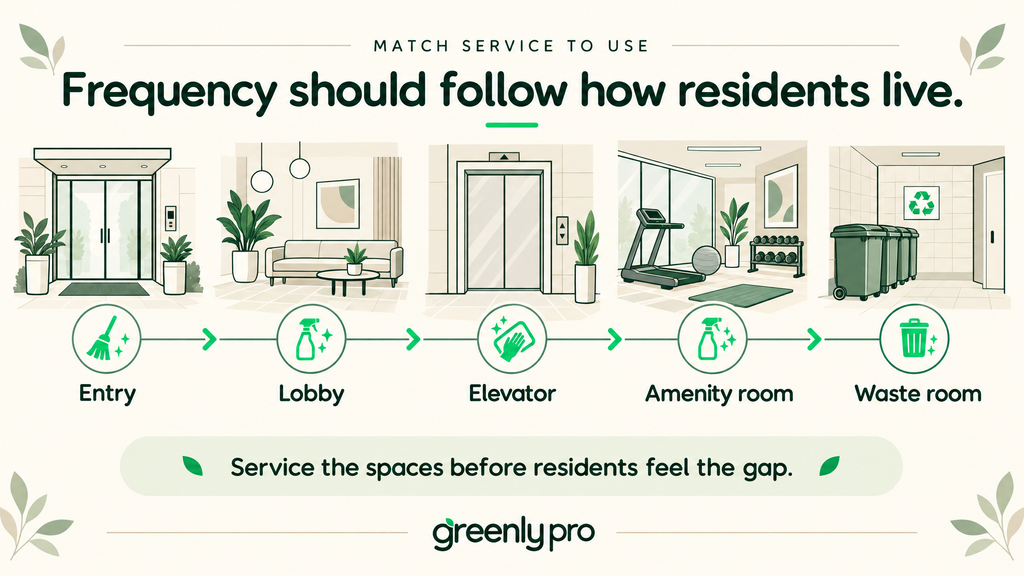
A community with a quiet two-building lobby does not have the same needs as a high-traffic condo with package deliveries, dogs, children, guest activity and an amenity floor.
That sounds obvious. Yet cleaning frequency is often inherited from a contract written years earlier.
Instead of asking, “How many visits do we buy?” ask, “What needs attention before residents see it?”
An entry mat might need frequent service during wet or snowy periods. A mailroom may need a reliable reset after daily package traffic. An elevator cab may be small but highly visible. A clubhouse may need to be cleaned after events, not on a fixed schedule that ignores actual bookings.
Build a frequency map around use:
| Area | Routine question | Practical scope detail |
| Entry and lobby | When does visible debris become a resident experience issue? | Mats, glass, floors, touchpoints and waste removal |
| Corridors and stairs | What is the expected standard between visits? | Vacuuming or mopping, spot cleaning, railings and corners |
| Elevators | What do residents see several times a day? | Cab floor, walls, doors, controls and reporting of damage |
| Amenity/club rooms | Is service scheduled around reservations and events? | Reset, restroom check, waste, floor condition and post-event recovery |
| Waste and recycling rooms | What must happen before odor, overflow or spills become a complaint? | Floors, touchpoints, liners, spill response and escalation path |
The goal is not to increase every frequency. It is to stop paying for a schedule that no longer matches how the community lives.
Define what is inside the cleaning line and what is not
A flat monthly quote is only useful if the board understands its boundaries.
Routine cleaning commonly includes a defined set of tasks at a defined cadence. It may include common-area vacuuming, mopping, restroom cleaning, waste removal, touchpoint wiping and visible-detail work. It does not automatically include everything that happens in a building.
The scope should separate four categories:
- Included routine service —> the recurring work in named locations.
- Planned periodic work —> recurring projects placed on an annual or seasonal calendar.
- Approved exceptions —> event recovery, unusual spill response, turnover support or temporary access changes, priced or authorized through a stated process.
- Specialist work —> restoration, post-construction cleaning, exterior-height work, mold concerns, pest remediation or another task requiring different expertise, equipment or insurance.
This is not about creating exclusions to avoid responsibility. It is about giving the association a clean way to make a decision when something outside the normal plan happens.
Without that boundary, boards are forced to choose between two poor options: approve a surprise charge without context or expect a routine crew to absorb work that was never planned.
Plan projects before they become “extras”
Every association has cleaning work that shows up repeatedly but never seems to make the budget.
Maybe it is carpet extraction before a busy season. Maybe it is hard-floor maintenance after winter salt. Maybe it is high dusting in a lobby with tall ceilings, a community-room reset after repeated events or interior glass before a board event.
If it happens every year, it is not a surprise.
Create a simple project calendar with the provider. Name the project, location, expected timing, access needs, approval owner and whether it is included in the operating budget or held as a pre-approved allowance.
| Project type | Budget planning question |
| Carpet care | Which corridors, rugs or amenity rooms need scheduled extraction versus spot treatment? |
| Hard-floor maintenance | Are winter residue, finish condition and foot traffic addressed before the surface looks neglected? |
| Interior glass | Which entry glass, mirrors or community-room partitions are not covered by routine service? |
| High dusting | Which ledges, vents, fixtures or ceiling-adjacent areas need a planned access method? |
| Event recovery | Does the reservation process trigger a cleaning reset, and who authorizes it? |
A planned project line gives the treasurer a cleaner forecast. It also makes it easier to explain why the monthly cleaning invoice and the total annual care of the property are not the same thing.
Compare proposals by scope, not just the monthly total
The lowest monthly number may be the right choice. But only after the board verifies that the proposals describe the same work. Place competing proposals into a one-page comparison with these rows:
| Compare this | What “clear” looks like |
| Covered locations | Named common areas, not “all common areas” |
| Frequency | Days, service windows and event-triggered work stated |
| Routine tasks | Floors, restrooms, waste, glass, touchpoints and visible-detail work listed |
| Periodic projects | Included calendar, allowance or separate price process stated |
| Supplies and equipment | Ownership of chemicals, consumables, machines and liners is clear |
| Quality control | Site contact, inspection cadence, correction process and reporting are defined |
| Exclusions | Specialist, restoration and non-routine work are identified before a need arises |
Give every vendor the same building information and same target standard. If one proposal is lower because it assumes fewer visits, omits the waste room or leaves projects unplanned, that is not necessarily wrong. It is simply a different service decision.
Put quality control in the HOA cleaning budget conversation
A board does not need to inspect every stairwell every week. It does need a reasonable feedback loop.
Ask the provider how an issue moves from observation to correction. Who is the site contact? How are missed tasks reported? What happens if a resident-facing area needs attention between regular visits? How does the board or manager see patterns instead of isolated complaints?
A simple loop is enough:
- Observe: manager, concierge, board liaison or provider notices the condition.
- Document: record the location, issue and date with a short note or photo where appropriate.
- Correct: resolve the issue under the routine scope or flag it as an exception requiring approval.
- Review: look for recurring friction at the monthly or quarterly management review.
That data becomes valuable next budget season. Instead of debating impressions, the board can see whether the lobby needed more attention, the waste room created repeated calls or an amenity room required a cleaner post-event process.
Include product and supply expectations before renewal
Common-area cleaning affects many people, often in enclosed spaces. If the association has product standards—fragrance preferences, a sustainability policy, concentration controls or a need to avoid certain products—write those expectations into the scope.
The EPA Safer Choice product search lets purchasers filter for business-use products across categories such as all-purpose, carpet, floor, glass and restroom cleaning. It can be a practical reference when a board or manager wants a defined procurement standard without naming a single manufacturer.
Also clarify who owns consumables and equipment. Paper goods, liners, floor pads, dispensers, machines, batteries and replacement items can become quiet budget leakage when no one has defined the handoff.
A board-ready timeline for next year’s cleaning line
- 8–12 weeks before the draft budget: Walk the property, gather the current scope, pull extra invoices and list resident-facing friction points.
- 6–8 weeks before the draft budget: Update the location list, routine frequencies, project calendar, supply ownership and exception process. Ask the current provider or bidders to respond to the same scope.
- 3–6 weeks before the draft budget: Compare proposals line by line. Confirm what belongs in operations versus reserves with the association’s governing documents, manager and appropriate advisers.
Before the board approves: Record the selected standard, annual project plan, reporting path and the person authorized to approve exceptions.
After communication to owners: Explain the decision in service terms, not just assessment terms. Residents can understand “weekly lobby and hallway attention, scheduled floor care and an event-reset process” more easily than a line labelled “janitorial.”
The cleaning line is a promise residents can see
A strong HOA cleaning budget does not chase the lowest number or assume the prior year is automatically right.
It gives the board a standard, a scope, a project plan and a way to monitor the result. It keeps routine operating work distinct from long-term replacement planning. And it gives residents a practical answer when they ask what the budget provides.
For condominium and community-association properties in Boston, Waltham, Burlington, Woburn and Braintree, Greenly PRO can build a scope-based common-area cleaning estimate around how your property is actually used. Start at greenlypro.com/estimate. You will receive a defined service plan, not just a monthly figure.