Veterinary clinic cleaning in Boston teams need a different operating plan when canine parvovirus is suspected or confirmed. A polished exam room is not the standard. A room that has been cleaned, disinfected with the right product for the right length of time, kept out of circulation until released by the appropriate clinical lead, and documented is the standard.
That distinction matters because canine parvovirus is a hardy non-enveloped virus. The Massachusetts parvovirus cleaning guidance notes that CPV can survive in the environment for months to years and makes the core sequence explicit: clean first, then disinfect.
The phrase “kill parvo” is common shorthand. Technically, the goal is to inactivate the virus on a clean, compatible surface using a product with the appropriate label claim and a process your veterinary leadership has approved.
This is an operational cleaning guide for Boston veterinary practices, animal hospitals, urgent-care clinics, boarding operations, and facility teams. It does not replace a veterinarian’s clinical judgment, your hospital’s infection-control plan, product labels, local regulations, or your designated infection-control lead.
Veterinary Clinic Cleaning: Starts with Five Parvo Disinfection Protocol Decisions
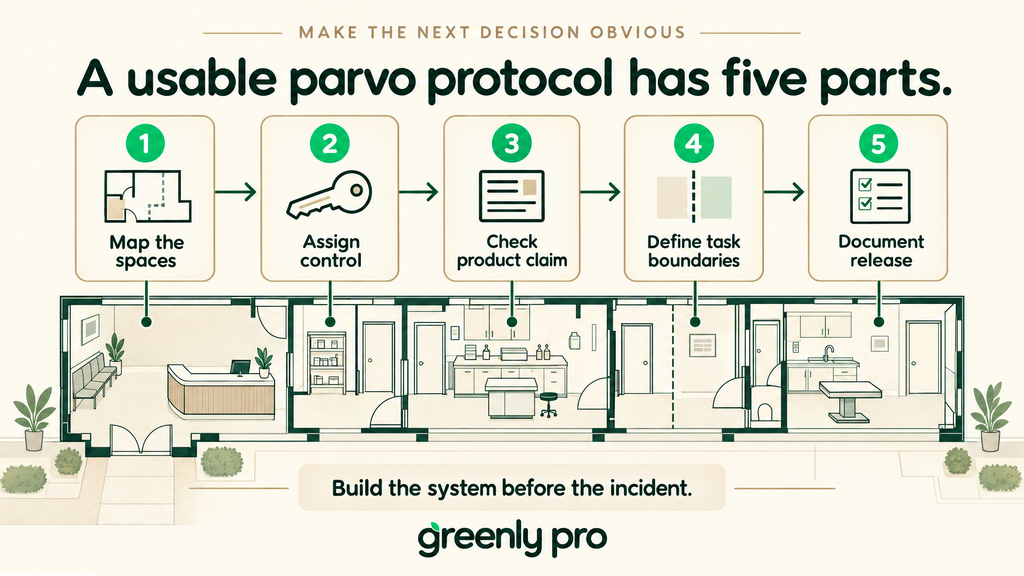
Parvo response can feel chaotic because the animal, the owner, the waiting area, the clinical team and the cleaning team all have to move quickly. A useful protocol makes the next decision obvious.
Before the cleaning route begins, confirm five things:
- Which spaces may be involved? Think beyond the exam room: entry path, carrier, scale, floor route, reception touchpoints, treatment or isolation area, kennel, laundry and waste-handling zone.
- Who controls the space? A veterinary leader or designated infection-control owner should determine the clinical response, patient routing and room-release decision.
- What is the approved disinfectant for this use? The product must be suitable for the surface and have label directions that support the intended parvovirus use.
- What work belongs to the cleaning team? Routine environmental cleaning may be assigned. Clinical equipment, medical waste, patient care decisions and exposure-specific tasks should follow the hospital’s written boundaries.
- How is completion verified? A room is not “done” because the cart left. It needs a documented clean, disinfect, dry and release path.
The AAHA infection-control guidance recommends an infection control, prevention and biosecurity plan with protocols, checklists, training, surveillance and compliance evaluation. That is the right frame: not a heroic cleanup, but a repeatable system. For a broader explanation of why routine contracts miss specialty work, see Greenly PRO’s guide to the janitorial scope gap in Massachusetts.
Control the patient route before you clean the room
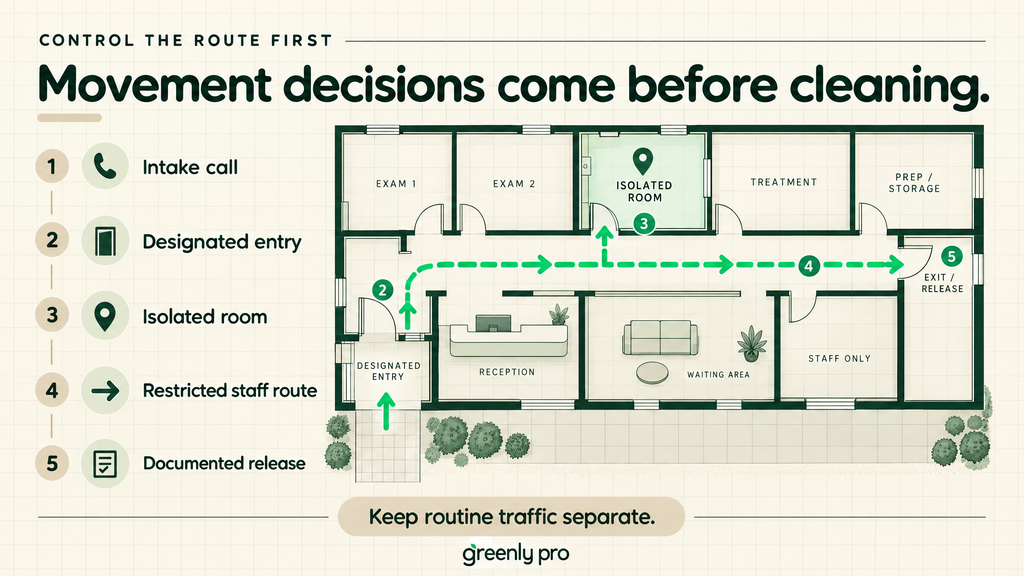
The cleaning protocol starts before a mop or wipe appears. A practice needs a pre-planned approach for high-risk patients: who receives the initial call, what information triggers a different route, where the animal waits, which entrance or exam room is used, and how the clinical team limits unnecessary movement. The AAHA’s example of a suspected-parvo puppy includes keeping the patient out of a common waiting room, using an isolated assessment route where appropriate, and limiting staff movement through other patient areas.
That is not a cleaning company’s decision to make. It is a clinical and operational decision the cleaning partner needs to understand.
For the facilities team, the useful output is a simple map:
| Zone | Operational question |
| Arrival / exterior approach | Where can an animal arrive without crossing routine patient traffic? |
| Reception and waiting | Which touchpoints require assessment if the route was used? |
| Exam or isolation room | Who posts the room status and authorizes entry and release? |
| Treatment/kennel support | Which surfaces, equipment exteriors and tool paths are governed by clinical direction? |
| Laundry, waste and staff route | How are contaminated items and personnel kept from crossing into clean areas? |
When everyone knows the route, cleaning stops being a reaction to an incident and becomes part of the containment plan.
Remove organic material before the disinfectant does its job
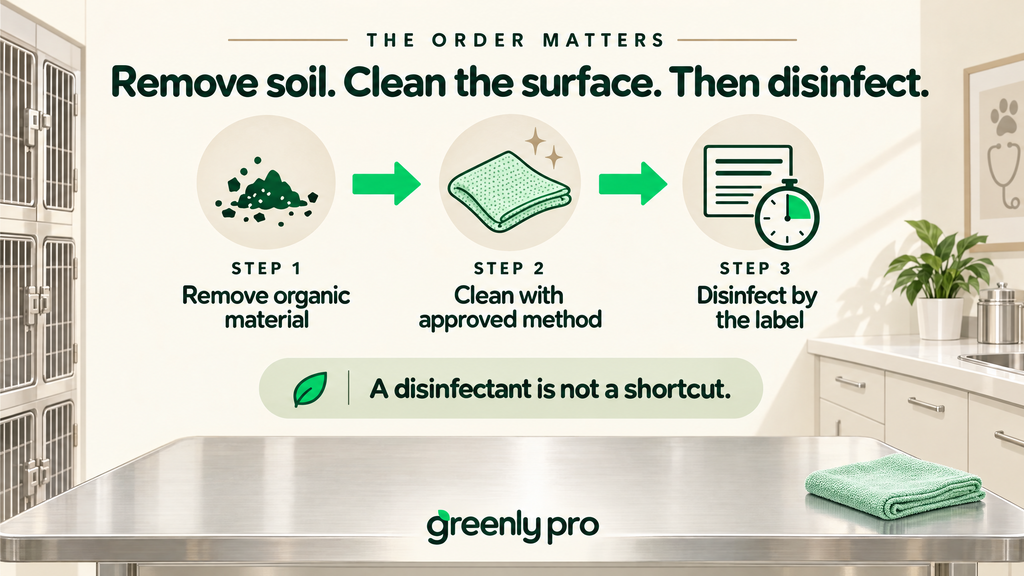
The most important step is also the least glamorous: remove the soil first.
Feces, urine, vomit, fur and other organic material can prevent a disinfectant from reaching the surface as intended. Massachusetts guidance directs teams to remove organic material, then use soap and hot water to clean the area and equipment before disinfection. The Merck Veterinary Manual likewise advises removing gross organic material before applying a suitable disinfectant.
A more effective room turnover uses separate, deliberate stages:
- Restrict access and follow the facility’s PPE and clinical instructions.
- Remove visible organic material and dispose of it through the hospital’s established process.
- Clean the surface with the approved detergent or soap-and-water method.
- Apply the selected disinfectant according to its label.
- Allow the required wet contact time, then rinse or dry only as the label and facility policy direct.
The order matters. Spraying a disinfectant over a visibly soiled floor, kennel or tabletop may create the appearance of a response without creating a dependable one.
Choose for the parvovirus claim, the surface and the workflow
A product is not appropriate just because it says “disinfectant.”
The EPA explains that a disinfectant label defines where a product may be used, how it should be applied, and how long it must remain on a surface. The EPA registration number is the most reliable identifier when the same formulation appears under different brands or distributor labels.
For parvo exposure, the facility should work from an approved list—not a shelf of assumptions. Confirm:
- The label identifies canine parvovirus or supports the facility’s approved organism claim.
- The surface is within the product’s approved use directions.
- The concentration and application method are correct.
- The required contact time can be maintained in the actual workflow.
- The product is compatible with flooring, sealed and unsealed materials, stainless steel, plastic, upholstery, and equipment exteriors.
- Staff have access to the Safety Data Sheet, required PPE, ventilation guidance and storage instructions.
Massachusetts guidance identifies accelerated hydrogen peroxide and bleach-family products as options that can inactivate CPV when used correctly, while also noting meaningful limitations. Bleach can be corrosive, irritating and ineffective when organic material is present; it is not a good choice for porous surfaces. The same guidance cautions against quaternary ammonium compounds for parvovirus control.
This is why there is no universal “best bottle.” Product selection belongs in the hospital’s written protocol, not in a last-minute purchasing decision. The same discipline matters when comparing providers: Greenly PRO’s commercial cleaning service selection guide outlines useful questions about technical competence, accountability and documented scope
Protect the contact time instead of racing the turnover
A disinfectant only works according to its label directions.
The EPA calls this the contact time: the surface must remain visibly wet for the full time stated for the relevant use. If the surface dries early, the product may need to be reapplied. Massachusetts guidance notes that the parvovirus label time is often 10 minutes, but your team should use the exact time on the product label—not a remembered number from another product or another room.
That has practical implications for busy clinics:
- Start the contact-time clock only after the surface is fully cleaned and coated as directed.
- Do not dry, wipe, seat a patient, return equipment or reopen the area early.
- Choose products whose label instructions are realistic for the room’s turnover pressure.
- Build the time into the room-status board, cleaning log or digital workflow.
Speed is useful only when it does not erase the purpose of the step.
Use one-way movement, dedicated tools and an explicit release signal
A well-chosen product can still fail if the tools and people move contamination back through the clinic.
The AAHA guidance emphasizes controlling staff and patient movement, using PPE correctly and not allowing gloved hands to touch surfaces that will later be touched by ungloved hands. For facility operations, translate that into a simple movement plan:
- Use the facility’s defined clean-to-dirty path.
- Assign dedicated or clearly managed tools to the affected area.
- Keep carts, cloths, mop heads and equipment from moving into routine patient areas until they have been handled under the approved process.
- Follow the hospital’s process for laundry, waste and reusable equipment.
- Make the room status visible: in use, pending clean, disinfecting, pending release or released.
The purpose is not to create extra steps. It is to make it harder for a rushed person to guess.
Porous materials and damaged surfaces need an honest plan
Not every contaminated item can be handled the same way.
A smooth, sealed, nonporous surface is easier to clean and disinfect reliably than scratched plastic, unsealed concrete, fabric, or a damaged kennel panel. Massachusetts guidance specifically notes that accelerated hydrogen peroxide can be effective on porous and nonporous surfaces, while bleach is not a good choice for porous materials and does not work if organic material remains.
That does not mean a cleaning provider should make product or disposal decisions alone. It means the facility should decide ahead of time:
- Which surfaces can be cleaned and disinfected in place
- Which reusable items need a separate process
- Which porous or damaged materials should be removed, laundered, replaced or handled under a different approved procedure
- Who signs off when an item is ready to return to service
This is one reason a site walk matters. A protocol written for sealed vinyl flooring may not translate to scratched acrylic, carpeted reception areas or older utility-room finishes.
Verify completion with a log that helps the next shift
The purpose of a log is not to prove that someone was busy. It is to give the next person enough information to act safely.
A practical parvo-response record can capture:
| Record item | Why it matters |
| Area and time | Identifies the affected room, route or item |
| Status | Shows whether the space is restricted, disinfecting or released |
| Cleaning and disinfectant method | Confirms the approved process was used |
| Product and contact time | Makes the key label-controlled step visible |
| Exception or escalation | Flags damaged surfaces, unclear ownership or clinical follow-up |
| Release owner | Confirms who authorized return to service |
AAHA’s guidance calls for surveillance and compliance evaluation as part of a broader infection-control program. The best version is modest and usable: short enough for a busy shift, detailed enough to uncover the gaps before the next incident.
What an outside cleaning partner should and should not own
A specialist cleaning partner can bring disciplined environmental-cleaning routines, documented checklists, tool control and an objective facility review.
It should not replace the veterinary team’s role in triage, diagnosis, patient handling, clinical equipment decisions, medical-waste management, isolation policy, exposure assessment or room release. Those decisions belong to the practice’s veterinarian and designated infection-control leadership.
The value of the partner is clarity:
- Turn the clinic’s approved policies into workable environmental-cleaning steps.
- Train cleaning staff on site access, zone boundaries, product directions and escalation contacts.
- Maintain a consistent service record.
- Raise a flag when a surface, process or condition does not match the agreed protocol.
- Review the plan after a real event, not only when the contract renews.
In a multi-room practice, operational consistency is often the difference between a protocol on paper and one the evening team can follow.
A calmer parvo response begins before the incident
The right question is not, “Which product kills parvo fastest?”
It is, “Can our team reliably isolate the route, remove organic material, use the correct product as directed, protect contact time, manage tools, and release the space with evidence?”
If the answer is not clear today, the protocol will be harder to assemble when a high-risk animal is already at the door.
Greenly PRO supports Boston-area veterinary and animal-care facilities with site-specific environmental-cleaning scopes, documented room routines and operational handoffs. For veterinary clinic cleaning, Boston leaders who want a practical walk-through of common areas, support spaces and cleaning workflow, start at greenlypro.com/estimate.