Dental office cleaning cost in Boston is usually a monthly scope decision, not a simple price per square foot. For 2026 planning, an active small practice with a defined nonclinical after-hours route can budget roughly $750 to $1,450 per month. A mid-sized practice often falls around $1,350 to $2,800 per month. A larger or near-daily program can reach $4,000 to $7,000 or more each month.
Those are planning bands, not quotes. They assume recurring facility care, normal after-hours access, and a written division between the practice’s clinical work and the cleaning partner’s nonclinical route. They do not include patient turnover, instrument reprocessing, regulated medical waste, a contamination response, post-construction work, or periodic carpet and hard floor projects unless the proposal says so.
That last point matters more than the low number on a proposal. Two Boston practices can have the same square footage and very different costs because their frequency, operatories, restrooms, access rules, and service boundaries are different.
Dental Office Cleaning Cost: Planning Bands
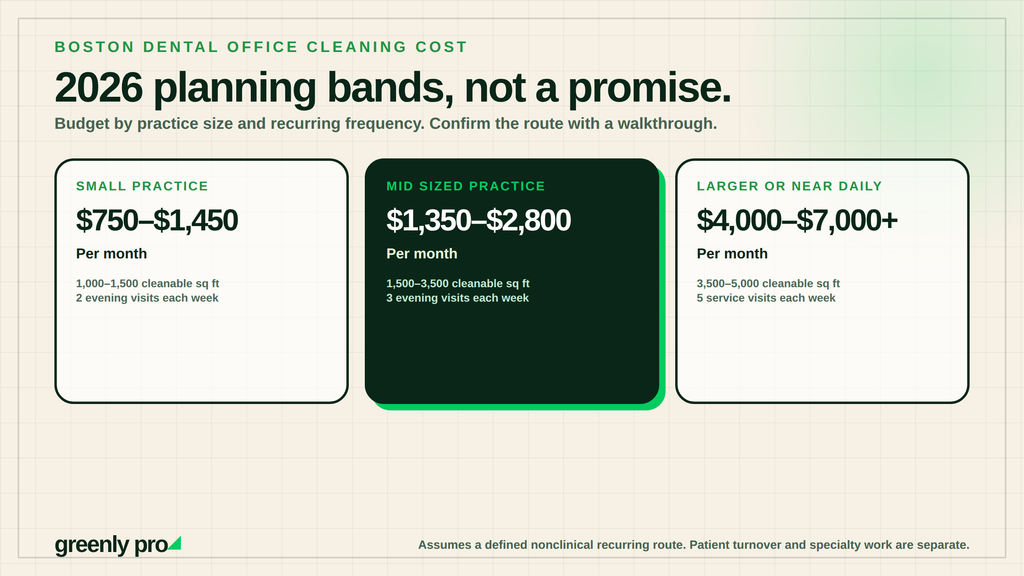
Use the following bands to set a budget before a walkthrough, not to accept or reject a bid in isolation.
- Small practice: roughly 1,000 to 1,500 cleanable square feet, two recurring evening visits each week, $750 to $1,450 per month.
- Mid-sized practice: roughly 1,500 to 3,500 cleanable square feet, three recurring evening visits each week, $1,350 to $2,800 per month.
- Larger or near-daily program: roughly 3,500 to 5,000 cleanable square feet, five service visits each week, $4,000 to $7,000 or more per month.
These bands reflect Greater Boston labor, building access and a dental scope that needs more control than a conventional office. They do not turn clinical work into a generic janitorial line item.
ISSA’s commercial cleaning guidance puts general office work at $0.09 to $0.17 per square foot and medical or healthcare facilities at $0.14 to $0.29. ISSA also cautions that a square foot rate is less useful when a facility has work that varies sharply by room. A dental office is exactly that kind of facility.
Use the dental office cleaning cost bands as a reason to ask better questions, not as a substitute for a site visit. If a proposal falls far below the band, check whether it assumes fewer visits, leaves out a restroom, excludes after-hours access or treats a specialty room as ordinary office space. If it lands above the band, ask which operating condition or included work explains the difference. A sound proposal makes either answer visible.
What a Boston Dental Cleaning Quote Is Actually Buying
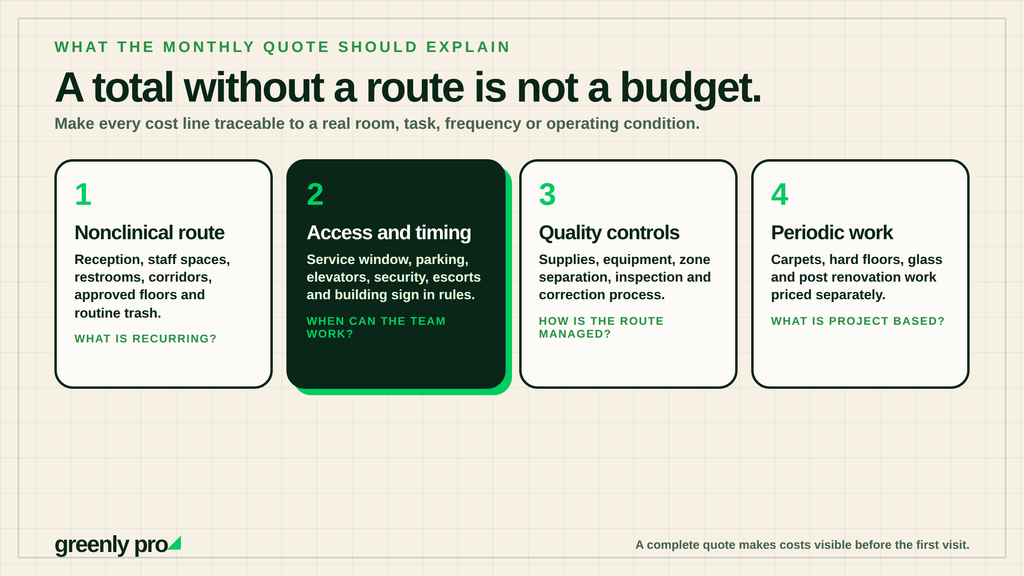
A good quote describes the work, not just the monthly total. The recurring number normally pays for a defined nonclinical route: waiting areas, reception, administrative offices, staff rooms, restrooms, corridors, approved floor care, dust control and trash from approved locations.
The next part is time and access. A practice that ends patient care at 5:30 p.m., requires escorted entry or has a narrow cleaning window has a different cost structure from a ground floor suite that can be serviced without delay. Downtown Boston, Cambridge and Seaport logistics can change a proposal even when the floor plan is similar.
Then there are supplies, equipment and quality controls. A professional quote accounts for site-appropriate products, equipment, zone separation, supervision and a correction path when a visit misses the standard. The Greenly PRO Massachusetts cleaning cost guide explains why building type, frequency, scope and access move the price more than square footage alone.
Finally, periodic work should be separate. Carpet extraction, hard floor refinishing, interior glass and post-renovation cleanup should not be hidden inside a recurring number that cannot actually support them.
For a practice manager, the useful dental office cleaning cost question is, “What route does this rate fund every time the team arrives?” The answer should tie the total to rooms, tasks, frequency, access and the recovery process when something goes wrong.
Dental Janitorial Pricing in Massachusetts
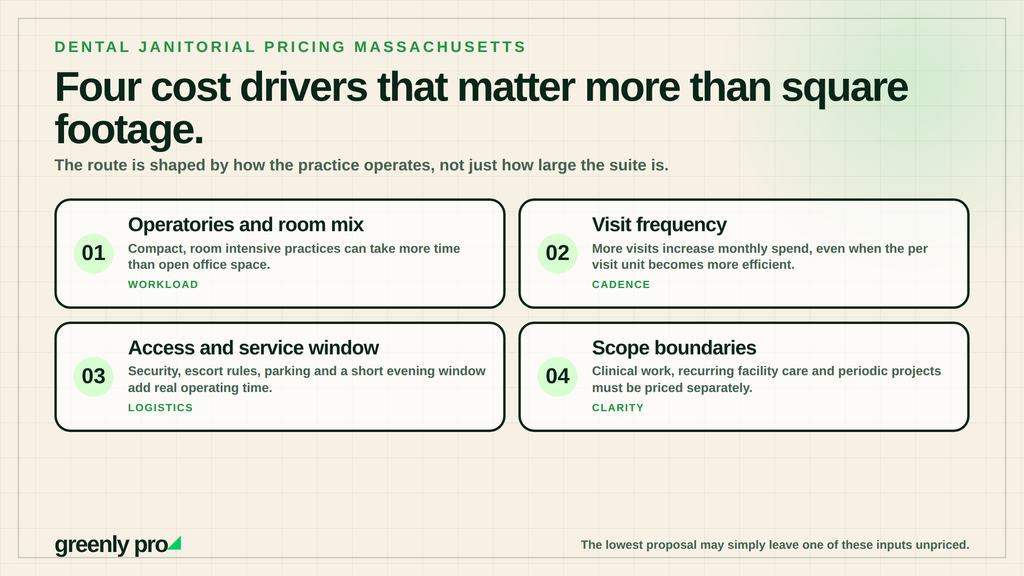
Dental janitorial pricing in Massachusetts is higher than a standard office route when the work requires extra time, tighter separation of zones or more demanding access conditions. The reason is not that every surface must be treated the same way. It is that the proposal must recognize which spaces are operationally different.
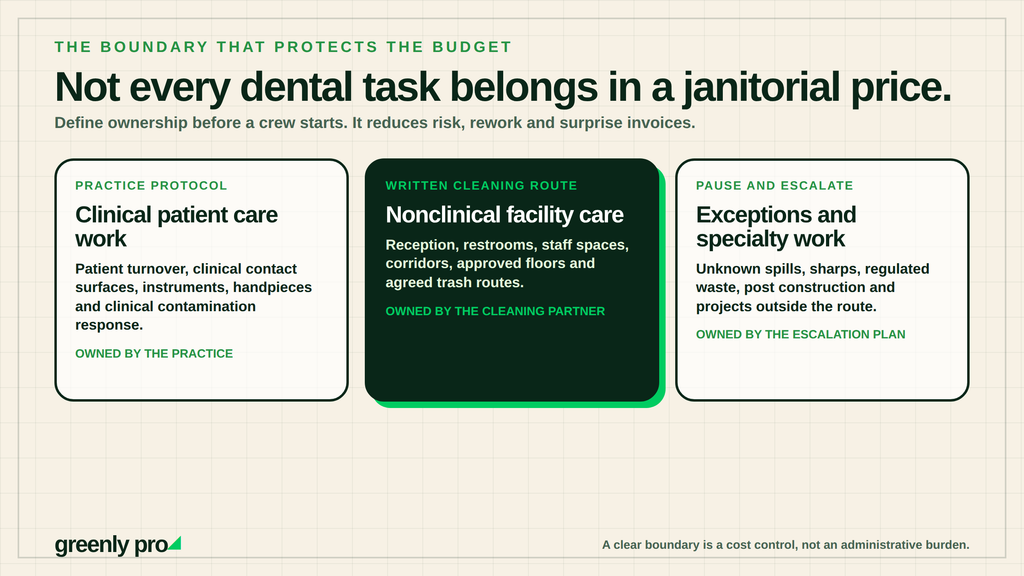
Operatories change the workload. A compact office with six operatories can take longer to service than a larger space with open desks. But a vendor should not assume ownership of patient turnover or equipment handling. The written scope must state where the clinical team’s protocol ends and the cleaning route begins.
Restrooms and high-touch areas change the time. Restrooms, staff areas and patient-facing spaces need recurring detail. They consume more labor than open administrative square footage.
Frequency changes the monthly budget. More visits raise the monthly total, even if the cost of each visit becomes more efficient. The right frequency matches operating days, patient traffic and the standard the practice wants to maintain when doors open each morning.
Access changes the quote. Security, elevators, loading rules, parking, building sign-in procedures and short after-hours windows create labor that cannot be seen on a floor plan.
The clinical boundary changes risk. CDC distinguishes between clinical contact surfaces and housekeeping surfaces. CDC dental guidance identifies clinical contact surfaces as likely to be contaminated by patient care. Floors, walls and sinks are housekeeping surfaces with a different risk profile. Pricing should reflect the route a cleaning partner actually owns, not a vague promise to “sanitize everything.”
This is why two sites with the same square footage can have a different dental office cleaning cost. One might have a predictable nonclinical route and unrestricted evening entry. The other might have a short access window, multiple restrooms, a higher room count and several spaces the cleaning team must not enter without direction. Square footage is useful for the first estimate. The operating map finishes the estimate.
Do Not Let “Dental Cleaning” Hide a Scope Gap
The lowest quote may simply be missing work. In a dental office, the expensive surprise is usually not the initial bill. It is a task discovered later that both teams believed the other team owned.
The dental practice owns its infection prevention program. It owns patient turnover, clinical contact surfaces, instruments, handpieces, clinical contamination response and the determination that an operatory is ready for the next patient. CDC recommends written infection prevention policies, a trained coordinator, and job-specific training. That guidance also applies to contracted personnel where relevant.
A cleaning partner can own nonclinical facility work when it is written into the scope, and the team has clear access, product and escalation instructions. For a detailed responsibility map, read Greenly PRO’s guide to dental office cleaning responsibilities.
Massachusetts adds a reason to be precise. 234 CMR 5.05 requires dental practices to operate in compliance with CDC infection control guidance and OSHA standards. OSHA requires a written cleaning and decontamination schedule that considers location, surface type, soil and the work performed in the area. A vague quote cannot substitute for that system.
The OSHA housekeeping standard is useful here because it asks the same questions a careful scope asks: where is the work, what surface is involved, what soil is present and what procedure takes place in the area? Those details should clarify a dental office cleaning cost proposal rather than complicate it.
How to Compare Two Dental Cleaning Quotes
Start with a simple question: What does this price exclude? Ask every bidder to answer it in writing.
Then compare the proposals using the same categories. Confirm the rooms and surfaces on the recurring route. Check visit frequency by area, not just the number of nights per week. Ask who provides equipment and supplies, how a missed visit is corrected and who the team contacts when it sees an exception.
Ask how regulated waste, sharps and unknown spills are handled. A commercial cleaner should not quietly take on a task outside the defined scope. OSHA requires employers to define cleaning and decontamination methods based on the location, surface and likely soil. The correct response to an exception is an escalation path, not improvisation.
Also separate periodic projects from monthly care. A proposal that includes everything in one flat total may be convenient, but it makes it harder to see what was actually priced and what will appear later as an add on. Greenly PRO’s commercial cleaning pricing guide for Massachusetts explains why labor, equipment, supplies, insurance and supervision all belong in a transparent proposal.
If two bids are close, ask each vendor to restate its dental office cleaning cost as a scope comparison. The recurring work and exclusions should be comparable before anyone signs.
How to Control Cost Without Cutting the Wrong Work
Cost control begins with scope discipline, not with removing the work that protects the practice. Match the recurring route to operating days and actual traffic. If the office closes on Fridays, do not pay for a routine Friday evening visit unless the condition of the space justifies it.
Keep patient turnover separate from after hours facility care. That avoids asking a cleaning crew to make clinical decisions and avoids paying twice for the same task. Give the vendor a current floor plan, operatory count, restroom count, service window, building access rules and a list of restricted areas before the walkthrough.
Schedule periodic work on a calendar. Carpets, hard floors and glass usually budget better as planned projects than as urgent requests. Finally, review the scope after a new operatory, a schedule change or a building move. A good contract changes when the facility changes.
The goal is not to force every practice into the same dental office cleaning cost model. A compact practice with a consistent evening route may need a simple agreement. A larger group with several operatories and strict access controls needs a more detailed one. Both benefit from the same discipline: price the work that is really being performed, then review it when operations change.
The Practical Next Step
The useful number is not the cheapest figure in an email. A reliable dental office cleaning cost is attached to a route your staff, cleaning partner and practice manager all understand.
Bring your floor plan and operating schedule to a walkthrough. Define the nonclinical route, record access constraints and identify the work that belongs in a separate project quote. For a Boston dental office cleaning estimate with a defined scope, start at greenlypro.com/estimate.