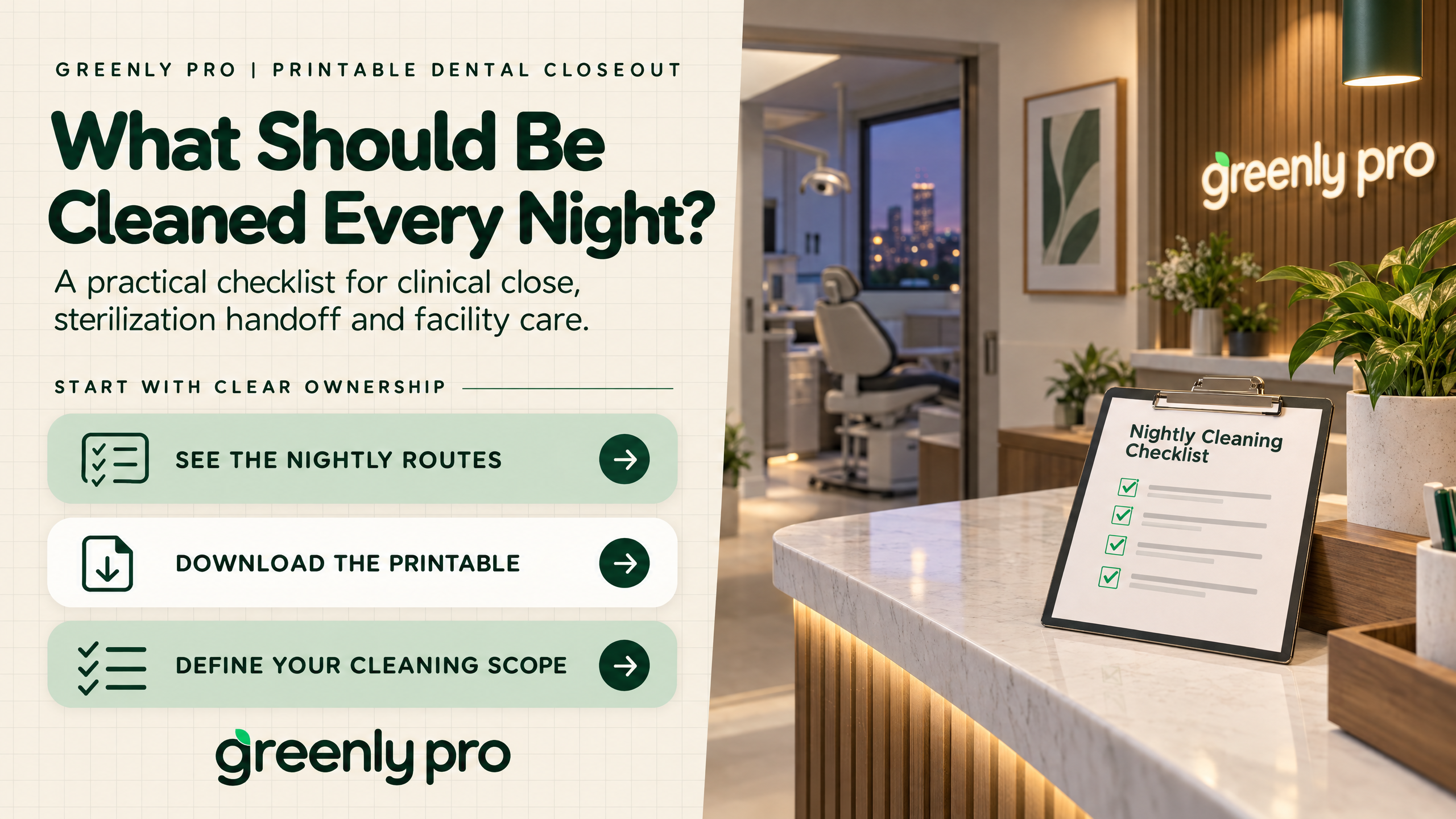
A dental office cleaning checklist works when it separates the work by owner. The clinical team closes and verifies patient care areas under the practice’s infection prevention plan. Trained dental health care personnel handle instruments and the sterilization area. The after-hours cleaning route covers the approved nonclinical spaces, such as reception, restrooms, staff areas, administrative offices, corridors, and floors.
That may sound like an administrative detail. It is not. Most missed work in a dental office starts with an unclear handoff. The clinical team assumes a cleaner will take care of a surface. The cleaning team assumes it was part of patient turnover. The next morning begins with a question nobody should have to answer under pressure.
This guide explains what should be confirmed each night, who should own it, and how to use the printable checklist without turning it into a substitute for your written infection prevention plan.
A Dental Office Cleaning Checklist Starts With Two Routes
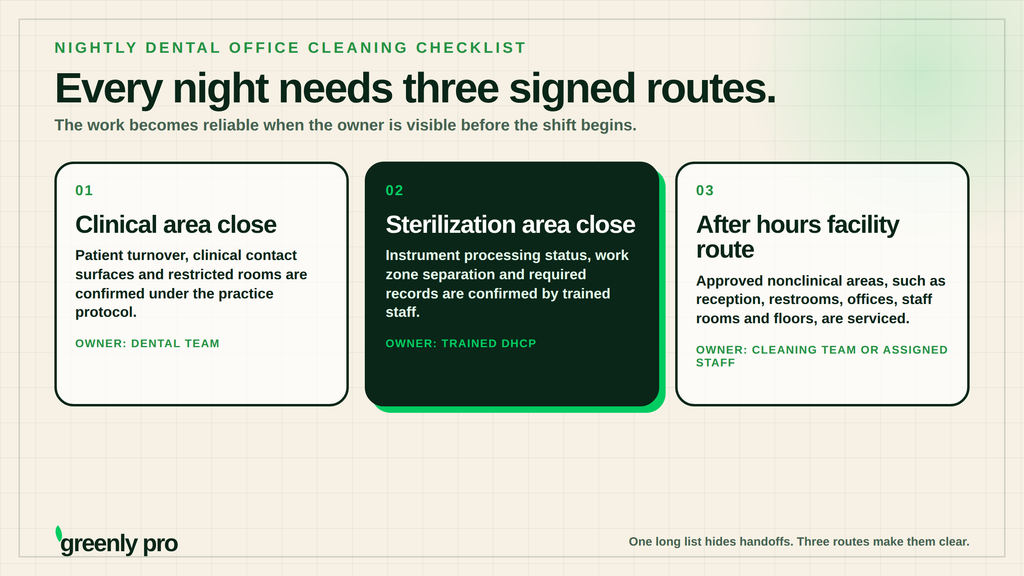
The first route is clinical. It happens during patient flow and at the end of the day under the practice’s established policies. It includes patient turnover, clinical contact surfaces, barriers, patient care items, equipment reprocessing, and any contamination response. The practice owns this route, even if it receives support from people who have been trained and authorized within that program.
The second route is facility care. It normally begins after the clinical close is complete. It includes repeatable work in approved nonclinical spaces: reception, waiting rooms, restrooms, staff areas, administrative spaces, corridors, entry points, floors, and trash from approved locations. A commercial cleaning partner can own that route when the work and access boundaries are written down.
The distinction prevents two common failures. It keeps a cleaning crew from guessing at clinical work. It also keeps the clinical team from discovering that the nonclinical route was never fully defined. Greenly PRO’s guide to dental office cleaning responsibilities shows how one room can contain clinical contact surfaces and housekeeping surfaces with different owners.
Use the dental office cleaning checklist at the same time every evening and keep the three closeout sections together. That makes it easier for the opening team to see whether a task was completed, restricted or escalated before the next day starts.
Operatory Cleaning: Verify the Close, Do Not Blur the Handoff
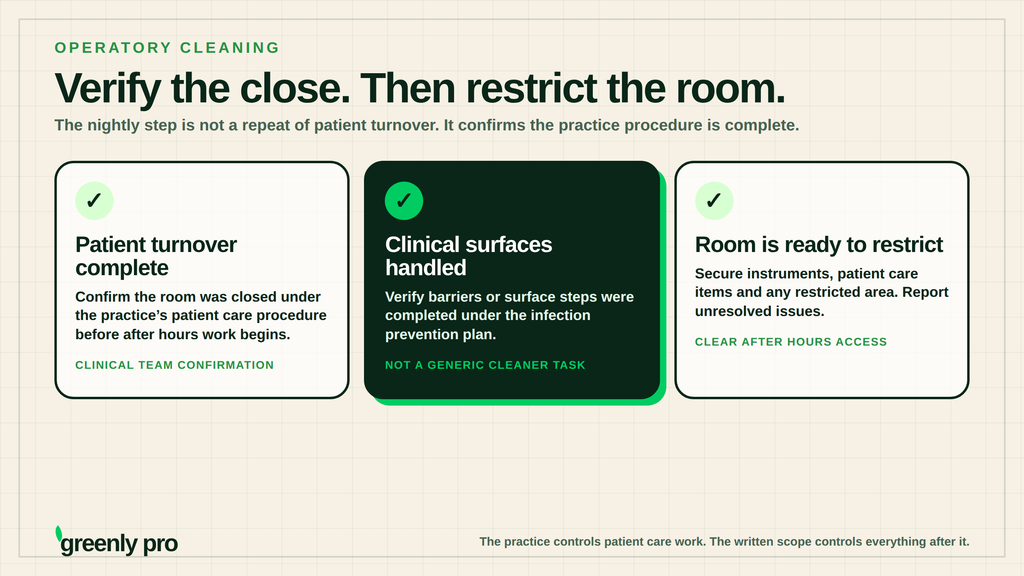
Operatory cleaning needs a simple rule: patient care work should be complete before an after-hours facility route begins. CDC identifies light handles, bracket trays, dental unit switches and computer equipment in patient care areas as examples of clinical contact surfaces. Those surfaces may be exposed to spray, spatter or contaminated gloves. They belong in the practice’s turnover and infection prevention process, not in a vague instruction to “wipe down the operatory.”
The CDC recommends using barriers where appropriate and changing them between patients. If a clinical contact surface is not barrier protected, it should be cleaned and then disinfected between patients under the practice protocol. If visibly contaminated with blood or other potentially infectious material, the CDC calls for an EPA-registered intermediate-level hospital disinfectant with a tuberculocidal claim. The product label and the practice’s policy control the exact method, including amount, dilution and contact time. Read the CDC’s dental environmental surface guidance before building or changing that policy.
The nightly close is the time to verify, not casually repeat, this clinical work. The dental team should confirm that the operatory is closed according to its own procedure, that restricted rooms are identified, and that no instruments or patient care items are left for a nonclinical cleaner to interpret. If a cleaner is assigned any work inside an operatory, the practice should define the exact approved surfaces, products, access conditions and escalation instructions in writing.
Sterilization Area Cleaning Requires a Trained Owner
Sterilization area cleaning is often where a general checklist becomes unsafe. The sterilization area is not simply a back room to be cleaned after hours. It supports a controlled process for contaminated instruments, cleaning, packaging, sterilization, monitoring and storage.
CDC says cleaning, disinfection and sterilization of dental equipment should be assigned to dental health care personnel who are trained in the required reprocessing steps. It also calls for manufacturer instructions to be available near the reprocessing area, for instruments to move through the process in the correct sequence and for monitoring records to be maintained. That means a nightly checklist should ask trained staff to confirm the close. It should not instruct a nonclinical crew to reprocess instruments, move packs or decide whether an item is ready for use.
A good closeout asks whether instrument flow is complete under the practice procedure, whether contaminated and clean or sterile areas remain separated, whether required records are current, and whether any processing issue has been reported before the team leaves. The CDC’s sterilization and disinfection guidance is the proper reference for the actual reprocessing process.
After Hours Facility Route: What a Cleaning Partner Can Own
Once the clinical team has closed restricted spaces, the facility route should be straightforward. This is the portion of the dental office cleaning checklist where an evening cleaning crew can add the most predictable value.
Start at the reception and waiting area. Empty approved nonregulated waste, reset visible guest areas, clean approved nonclinical touchpoints under the site’s product instructions, care for floors and report damage or a safety concern. Do not remove patient files, paperwork or items that have not been designated as trash.
Then move to restrooms. Clean and service fixtures, replenish supplies according to the agreement, clean approved touchpoints and maintain floors. A routine restroom should have a clear route, dedicated tools and a clear stop rule for a problem that falls outside the scope.
Staff rooms and administrative offices are another common blind spot. The route can include approved trash, dust control, approved shared touchpoints and floor care. It should not involve moving documents, food, equipment or personal items without permission. Corridors, entrance areas and approved hard floors complete the route. Reusable cloths and mops must be cleaned and dried before reuse, or the site can use single use options, as noted in the CDC environmental guidance.
Use an Exception Rule Instead of Asking People to Improvise
A reliable dental office cleaning checklist does not assume every issue fits the normal route. It gives the team a visible exception rule.
Sharps, regulated medical waste, unknown spills, visibly contaminated materials, compromised instrument packs and equipment failures should not be handled by guesswork. The practice’s written policy and trained clinical personnel control the response. OSHA requires a cleaning and decontamination schedule that considers location, surface type, soil and the work performed in the area. It requires contaminated work surfaces to be decontaminated after procedures, as soon as feasible after visible contamination or a spill, and at the end of the shift if they may have become contaminated since the last cleaning. See OSHA’s Bloodborne Pathogens Standard for the full requirement.
For the after-hours team, the instruction should be short: pause, do not touch the task if it is outside scope or training, secure the area if safe to do so, and call the named escalation contact. Clear stop rules are more useful than a broad claim that a team can handle any situation.
Make the Checklist Easy to Use at the End of a Long Day
The printable version is designed for a practical handoff. It has three owner sections: clinical close, sterilization area close and nonclinical facility route. Each section has its own sign-off so a checkmark does not hide who completed the work.
Use it with the practice’s current floor plan and written policies. Add the escalation phone number, restricted rooms and service window. If your cleaning partner works after hours, give the team a route that names what it owns. A phrase such as “clean the entire dental office” does not set a standard. A list of rooms, tasks, frequency, approved products, access limits and stop rules does.
The printable dental office cleaning checklist is most useful after a small trial. Have the clinical lead, the sterilization lead and the cleaning lead use it for a week. Then revise unclear wording before it becomes the permanent closeout record.
CDC recommends that dental practices have a trained infection prevention coordinator who maintains written policies suited to the setting and ensures task-specific education. That coordinator is the person who should approve the checklist and revise it when the office adds a new operatory, changes equipment or changes its workflow. The CDC administrative guidance also notes that job-specific training can apply to relevant personnel working through outside agencies or contracts.
When You Use an After Hours Cleaning Partner
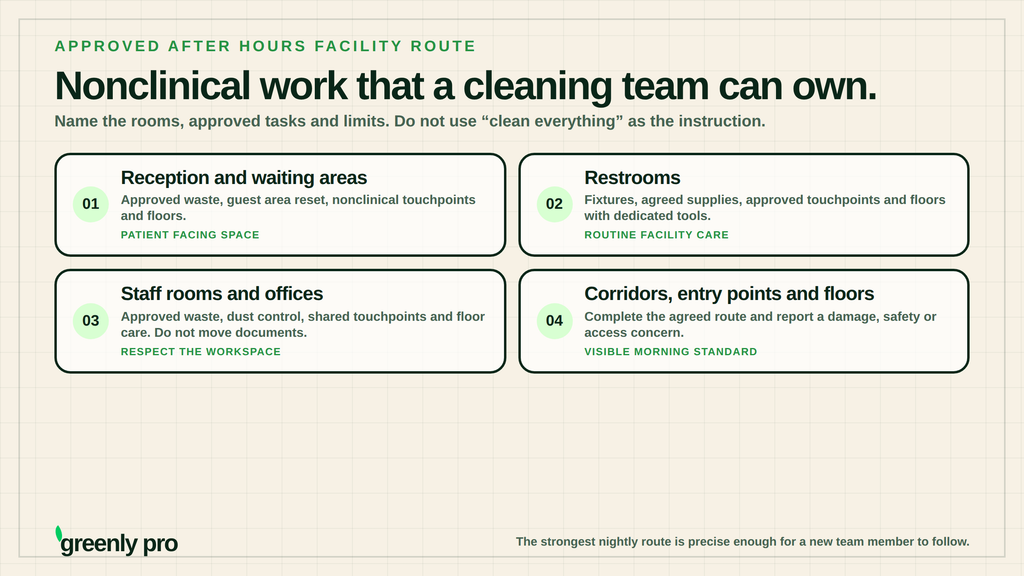
A commercial cleaning partner should make the nonclinical route easier to manage. The team should know when it can enter, which rooms are restricted, which surfaces are approved, which tools stay in each zone, and who to contact when something is wrong. It should never have to decide whether a patient care surface was turned over correctly or whether an instrument pack is ready for the next day.
This kind of clarity is not extra process. It is how a practice protects its staff, avoids avoidable rework, and starts the morning with fewer questions. If your current cleaning agreement still says “clean all areas,” compare it against Greenly PRO’s guide to the janitorial scope gap in Massachusetts.
For a Greater Boston walkthrough and a written nonclinical cleaning route that fits your practice, start at greenlypro.com/estimate.