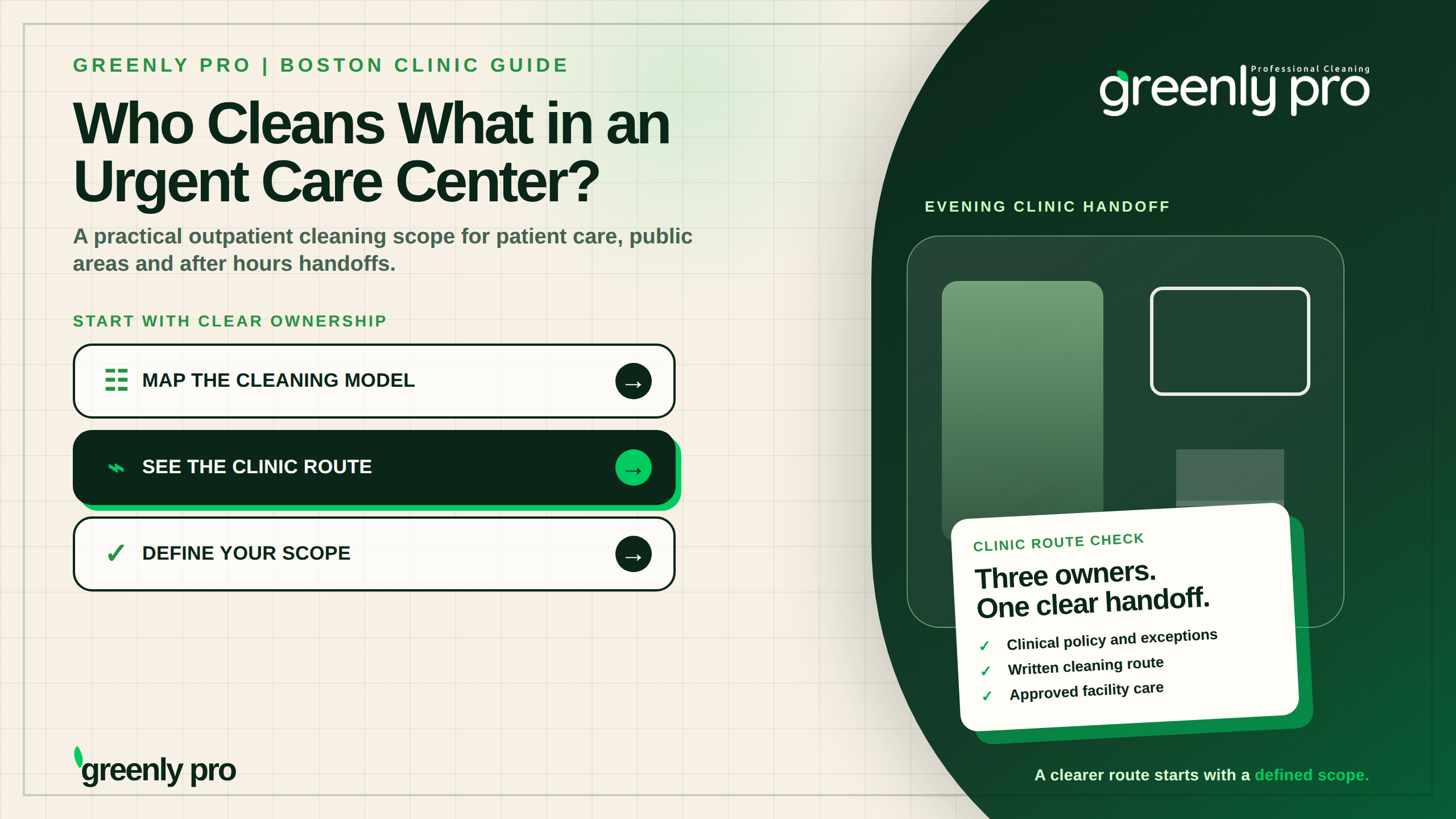
Urgent care cleaning in Boston works best when a clinic stops treating every surface as one cleaning problem. An urgent care center has patient care rooms, public waiting areas, restrooms, staff spaces, medical equipment and moments when normal work must pause. Those spaces do not have the same risk, owner or cleaning method.
The useful question is not, “Who cleans the urgent care center?” It is, “Who owns this task, at this moment, under which procedure?”
In a sound operating model, clinical leadership owns the infection prevention plan and clinical exceptions. Trained environmental cleaning staff complete the documented patient care route. An after-hours provider can care for approved public and back-of-house spaces. The clinic still owns the policy, training verification and quality review, whether that work is done by employees or a contracted team.
That distinction is what makes urgent care cleaning Boston safer to run and easier to manage. It also prevents an after-hours cleaner from being asked to make a clinical decision at the end of a busy shift.
Urgent Care Cleaning Boston Needs a Role-Based Model
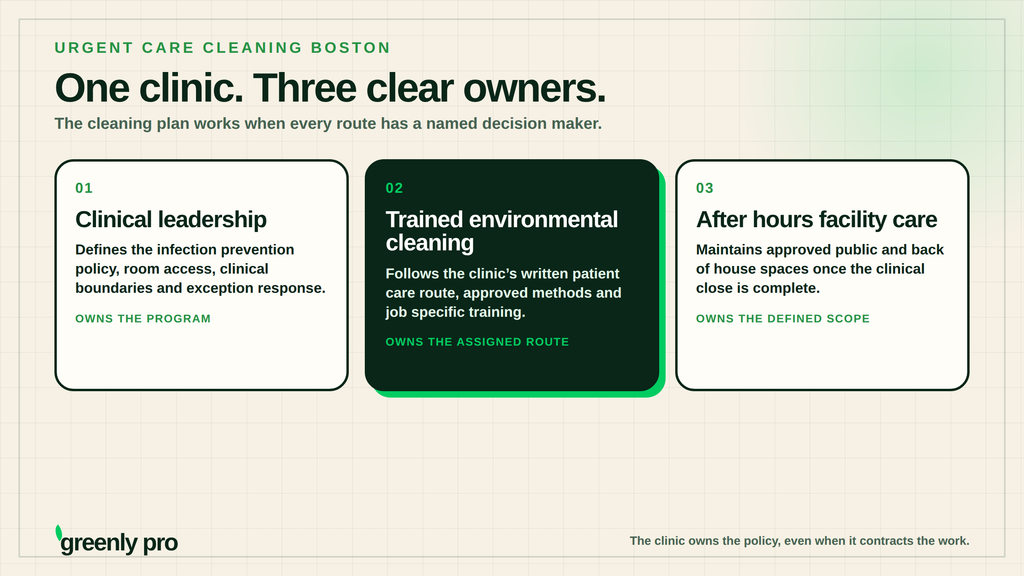
So, who cleans urgent care centers in Boston? The practical answer is a coordinated team. The urgent care center’s leadership and infection prevention program define the policy, patient flow boundaries, escalation steps and final standard. Trained environmental cleaning personnel may carry out the facility’s written route in patient care spaces. A commercial cleaning provider can handle defined nonclinical work and, where assigned, defined environmental cleaning tasks after the clinic verifies the arrangement supports its own policy.
CDC’s outpatient checklist expects the facility to have written policies for routine environmental cleaning and disinfection that identify responsible personnel. It calls for staff who clean patient care areas to receive job-specific training before independent work, annually and when the facility introduces new equipment or protocols. If contract staff perform environmental cleaning, the facility should verify that the contracting company provides that training. Read the CDC outpatient checklist as a planning tool, not as a one-page replacement for your clinical policies.
The owner lines should be visible before service starts. Clinical leadership should decide which rooms are restricted, what happens during a spill or exposure concern, who manages medical equipment and which surfaces require patient care procedures. The cleaning lead should know the approved areas, route, products, tools, PPE rules, access window and escalation contact. Facility leadership should know what gets checked and how a missed item is reported.
For urgent care cleaning Boston, that shared ownership is the operating standard. It replaces a broad promise to clean the clinic with a route that people can use when the building is busy and the day is ending.
Start With Risk Zones, Not Square Footage
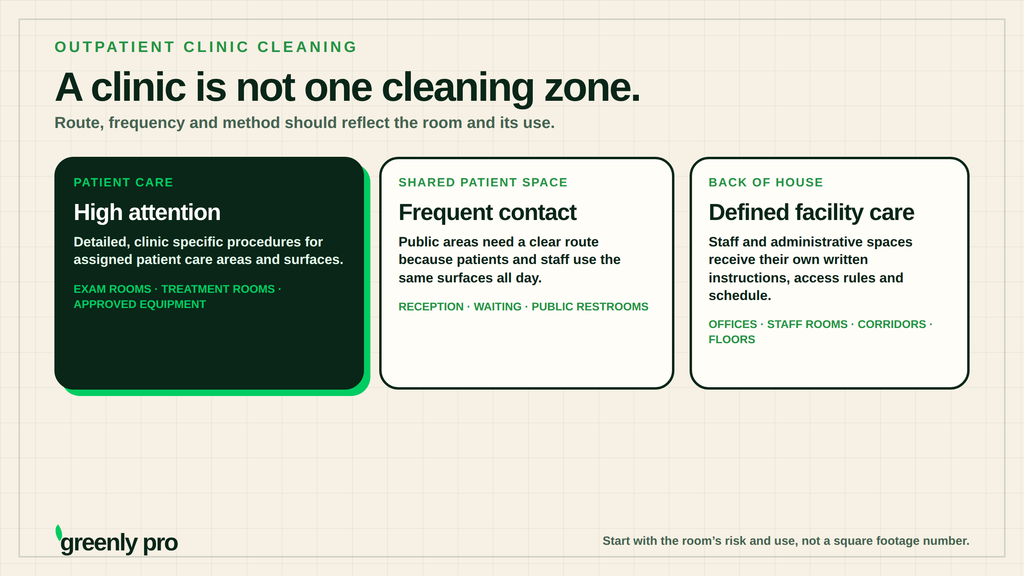
A clinic may look like a small office from the lobby. It is not maintained like one. Outpatient clinic cleaning needs to reflect patient contact, hand contact, visible soil and the services delivered in the room.
Patient care spaces include exam rooms, treatment rooms and the surfaces or noncritical equipment that the facility policy assigns to its environmental route. These areas need a detailed room-specific procedure. A shared patient space, such as reception, a waiting room or a public restroom, has a different route but can still require frequent attention because many people touch the same surfaces. Staff areas, administrative offices, utility spaces and corridors should have their own instructions rather than being treated as leftover work at the end of the night.
CDC’s core practices say cleaning and disinfection should be routine and targeted according to the level of patient contact and degree of soil. Surfaces close to patients and frequently touched surfaces in patient care environments need a more frequent schedule than other surfaces. That is why a good scope names zones and tasks. A quote based only on square footage cannot tell a team what to do in each room.
Build the Route Around the Clinic’s Actual Day
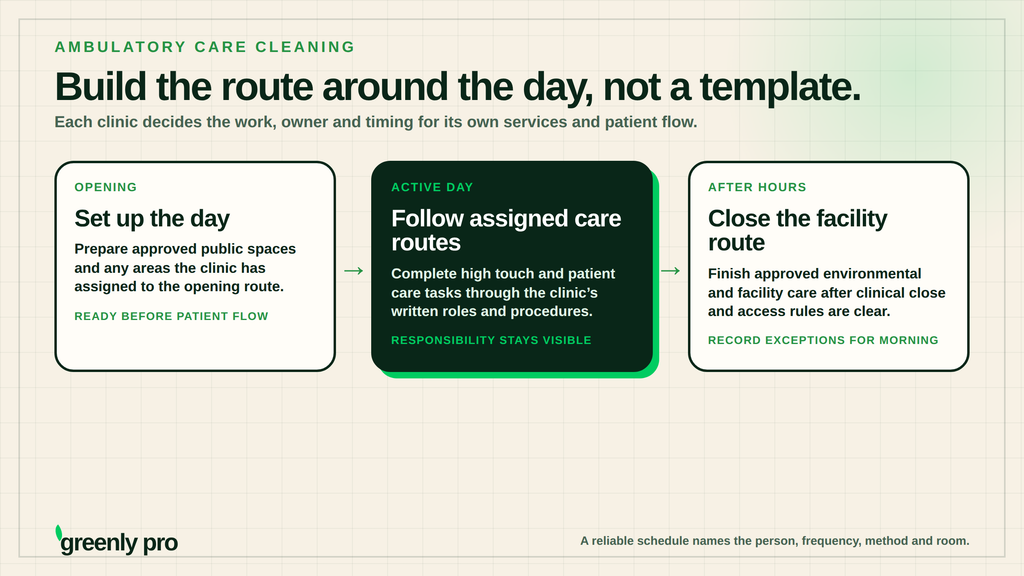
Ambulatory care moves quickly. The same room can be used by several patients in a day, while the waiting area stays active long after the first appointment. That is why ambulatory care cleaning should be connected to the way people actually enter, receive care, and leave.
There are usually three windows to define. The opening route makes public areas and approved rooms ready for the day. The active day route addresses the high-touch and patient care tasks the clinic has assigned to specific personnel. The after-hours route completes the agreed environmental and facility work once the clinical day is closed and access rules are clear.
Do not copy a schedule from another facility. CDC guidance says every facility should develop schedules that identify the responsible person, frequency, method and detailed procedures for each type of patient care area. A clinic that offers different services, sees a higher volume of walk-ins, or operates extended hours may need a different route. The document should explain the work, not merely say “daily cleaning.”
Every urgent care cleaning Boston schedule should also account for the handoff between clinical staff and the after-hours team. If a room is unavailable or a task is not assigned, the route should make that clear before work begins.
Clean First, Then Follow the Product Label
Cleaning and disinfecting are connected steps, not interchangeable words. For an approved surface, cleaning removes soil and organic material. Then the selected product must be used exactly as its label and the clinic policy require. CDC describes systematic work from cleaner to dirtier areas, high to low, with floors cleaned last. It also recommends a preliminary assessment for spills, transmission-based precautions, missing supplies, clutter or damage before the work begins.
EPA-registered disinfectant labels establish where a product may be used, how it should be applied and the contact time required for the stated claim. The surface must remain visibly wet for the entire label contact time. A quick spray and wipe may not meet the label directions. See the EPA’s disinfectant guidance for the reason product names and shortcuts do not belong in a generic scope.
The cleaning provider should have the current approved product procedure for the work it has been assigned. If a new product, surface or equipment enters the clinic, revise the procedure before the next shift. Do not ask a night crew to decide whether a medical device is compatible with a product or whether a clinical surface has been released for service.
Contracted Urgent Care Cleaning Boston: Put the Real Work in Writing
A contracted provider can make a clinic’s routine more dependable. The contract cannot carry the safety program on its own. The clinic needs a named point of contact who can approve the facility-specific policy, answer questions and review issues. CDC says this focal person is important whether environmental cleaning is handled internally or by an external company.
For urgent care cleaning in Boston, write down five things before the first service. Name the areas and responsible roles. Define the cleaning schedule and method for each area. Document the training expected for the assigned work. Identify approved equipment and supplies. Set a routine monitoring and feedback process.
Those are not arbitrary contract details. They reflect the elements CDC includes in a service level agreement for contracted environmental cleaning. The CDC cleaning program guidance also calls for reporting lines and contingency staffing. If a service proposal says “medical cleaning” but cannot explain those details, it is not yet a usable clinic cleaning plan.
Greenly PRO’s guide to the Massachusetts janitorial scope gap can help a clinic spot where a general scope ends and a specialty assignment needs definition.
Give the Team a Clear Stop Rule
A well-written scope tells people when not to continue. Sharps, regulated waste, unknown spills, visibly contaminated materials, damaged equipment and a restricted clinical area need an explicit response plan. The correct response depends on the clinic’s policies, training, protective equipment and the facts of the event.
OSHA requires employers to implement a written cleaning and decontamination schedule based on the facility location, surface, soil and tasks performed. It requires contaminated work surfaces to be decontaminated after procedures, promptly after visible contamination or a spill, and at the end of the shift if contamination may have occurred. The OSHA Bloodborne Pathogens Standard contains the full requirements.
For an after-hours team, the instruction should be simple: stop work outside the written scope or training, secure the area only if it is safe to do so, and contact the clinic’s named escalation lead. A good cleaning agreement does not turn a crew into an on call clinical response team.
Measure the Route, Then Improve It
The strongest cleaning program is not a binder left in a closet. It is a shared routine that the clinic revisits. Use room-specific checklists for high-touch work, opening and closeout logs for recurring routes, and a short issue report for missed work, supply gaps, damage or access barriers. The aim is not to create paperwork. It is to let the clinic see whether the route happened as intended.
CDC’s outpatient checklist includes competency assessment, routine monitoring, documentation and feedback for cleaning and disinfection procedures. Massachusetts clinics can also use the Massachusetts Infection Prevention and Control Resource Hub and the Massachusetts Department of Public Health HAI resources to support infection prevention planning.
For a clinic manager, one useful review question is: if the evening team finds something unusual, do they know who to contact and what not to touch? If the answer is unclear, the urgent care cleaning Boston route needs work before it needs another reminder.
Choosing an Outpatient Clinic Cleaning Partner in Boston
A capable partner does not arrive with a generic healthcare promise. It asks how the clinic uses rooms, when patient care ends, where access is restricted, who owns urgent exceptions, and how it reviews quality. It should be comfortable writing down what it does not handle by default.
Start with a walkthrough. Map the patient care areas, public spaces, staff areas, storage and access points. Then define the after-hours route in plain language. If the work includes any patient-care environmental cleaning, keep the clinic’s infection prevention lead involved in the scope, training verification, and review.
Greenly PRO provides after-hours commercial and healthcare facility care in Greater Boston, with scopes built around the space and service window. See our healthcare facility cleaning guidance and our practical guide to choosing a commercial cleaning service in Massachusetts before comparing proposals.
If you want a written urgent care cleaning Boston scope and a clearer handoff, start with a short walkthrough at greenlypro.com/estimate.