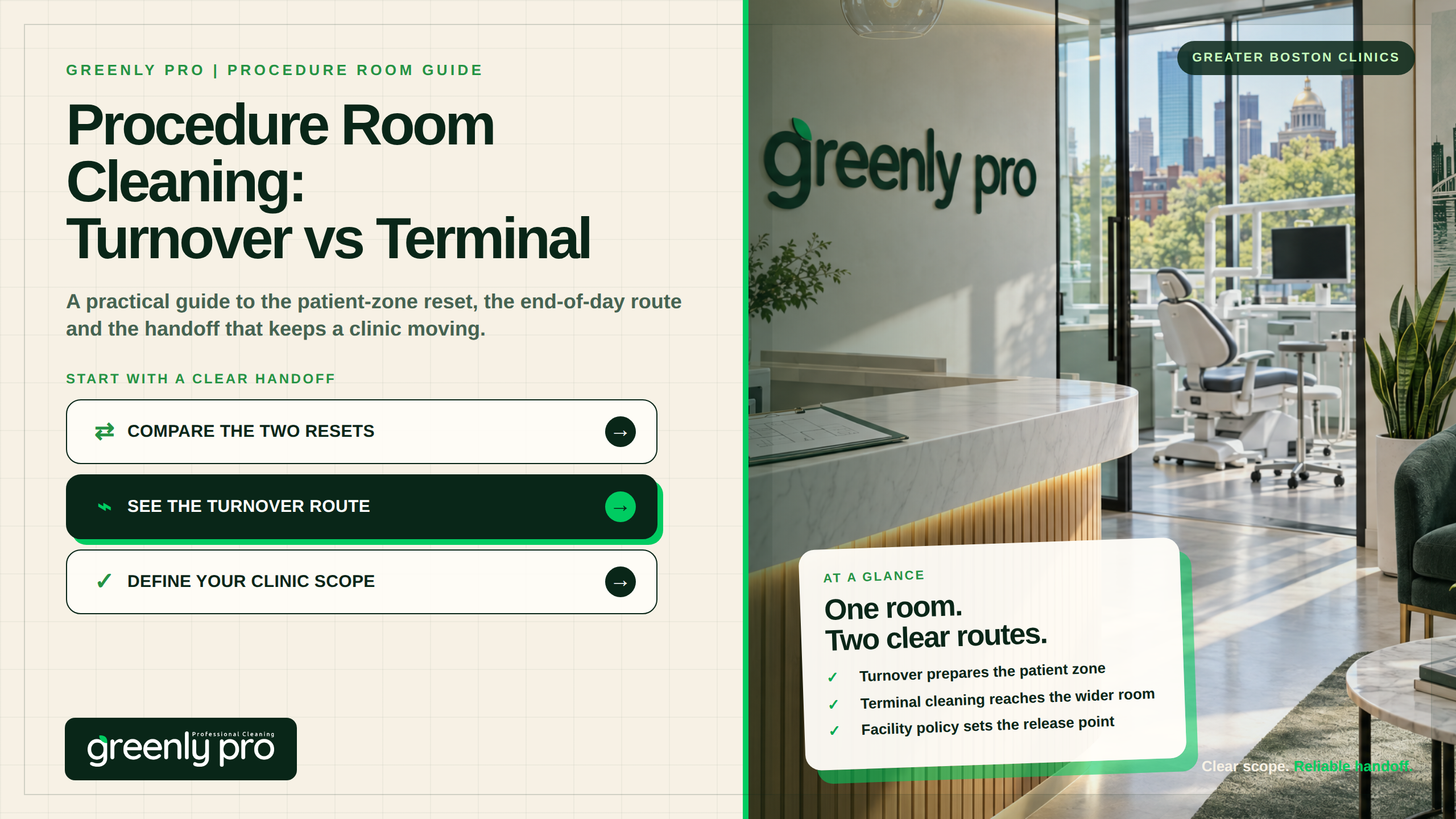
A procedure room cleaning protocol should not give the same instructions for every reset. The room that is ready for the next patient and the room that is being closed for the day have different jobs to accomplish.
Between patients, the priority is to reset the patient zone safely and predictably. At the end of the day, the work expands across the room. That is the practical difference between room turnover cleaning and terminal cleaning that outpatient teams need to understand.
Direct answer: In a general procedure room, terminal cleaning is the more comprehensive clean and disinfection after the last patient. The CDC’s general procedure-room table describes it as completing the between-patient work, then adding high-touch surfaces beyond the patient zone, the entire floor with portable equipment moved, and low-touch surfaces. The exact procedure room cleaning protocol still belongs to the facility’s infection-prevention plan, room classification, approved products, equipment instructions, and staff training.
That distinction matters on a busy schedule. “Clean the room” is not a usable handoff. A dependable plan identifies what happens after each patient, what waits for end of day, which role owns each task, and when the room is ready to return to service.
Procedure Room Cleaning Protocol: Two Different Resets
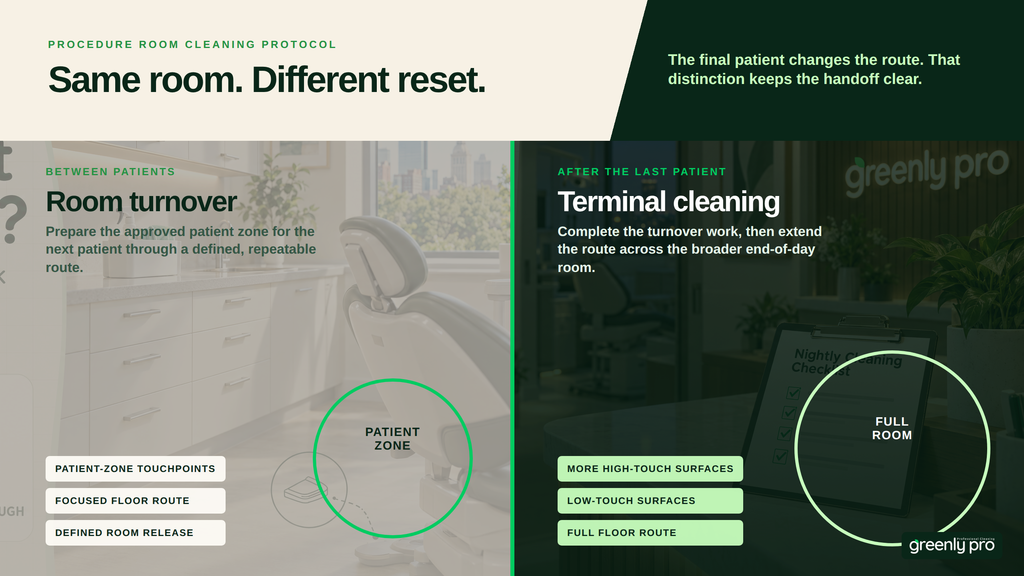
The easiest mistake is to treat terminal cleaning as a longer version of a turnover. It is more accurate to see them as two planned resets with different reach.
For a general procedure room, CDC guidance describes room turnover cleaning before and after every patient as removing disposable equipment, moving reusable noncritical patient-care equipment into its approved reprocessing path, and cleaning and disinfecting high-touch surfaces. Those include the procedure table, countertops and fixed-equipment exteriors. The floor is addressed with a focus on the patient zone, and any surface visibly soiled with blood or body fluids requires attention.
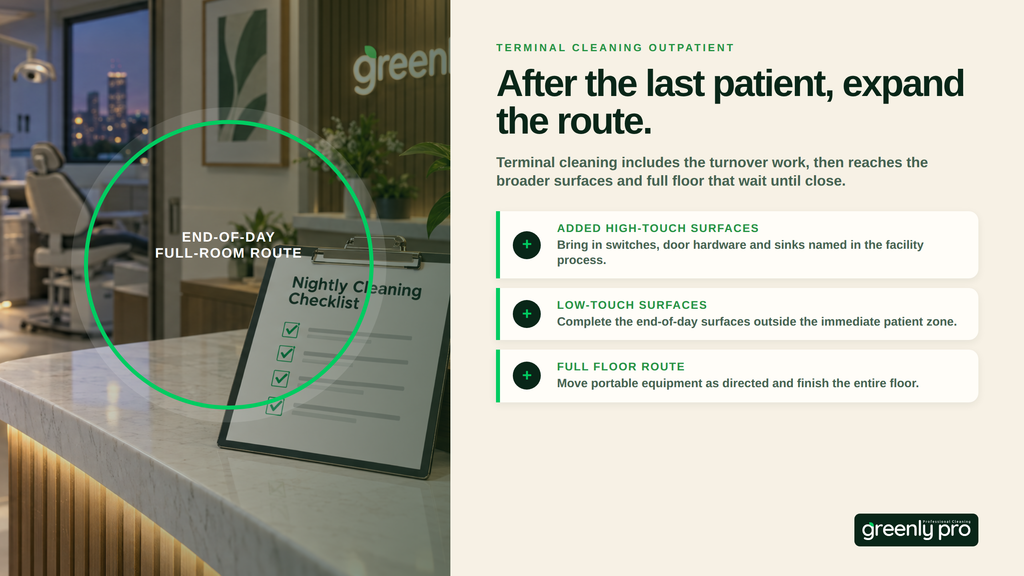
After the last patient, terminal cleaning outpatient workflows build on those tasks. The terminal clean adds high-touch surfaces such as light switches, door handles and handwashing sinks, the full floor with portable equipment moved, and low-touch surfaces.
Those labels do not allow shortcuts. Procedure rooms can differ in classification and use. Operating rooms have a more specialized workflow. Qualified facility leadership must set the room type, clinical boundaries, release criteria and applicable instructions.
Between-Patient Room Turnover: Reset the Patient Zone
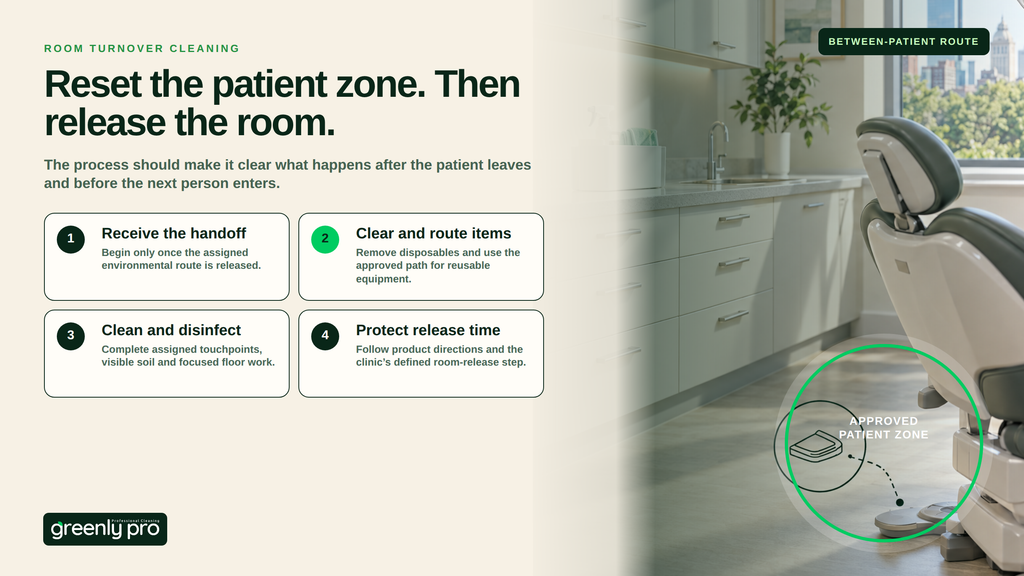
Turnover pressure is real. Use a concise, room-specific route the assigned team can complete without guessing.
A sound procedure room cleaning protocol begins with a clear handoff. Clinical staff complete the patient-care and equipment actions assigned to them. The environmental route starts only when the room is released for cleaning and the scope is clear. Reusable medical devices and critical or semi-critical equipment follow their manufacturer instructions and the facility’s reprocessing system. They are not routine environmental-cleaning tasks.
Assigned staff then follow the facility-approved route: remove disposables, address visible soil, handle assigned noncritical equipment surfaces and clean/disinfect patient-zone touchpoints. Leave enough time for the approved product to work. An empty room is not necessarily released.
The CDC outpatient checklist expects high-touch surfaces in rooms where surgical or other invasive procedures occur to be cleaned and then disinfected with an EPA-registered disinfectant after each procedure. This is why a general commercial scope must never imply that an evening crew can decide the patient-turnover process on its own.
Terminal Cleaning Outpatient Teams
What is terminal cleaning in a clinic? In plain language, it is the final, more complete room clean after the last patient or procedure. In CDC’s general procedure-room table, it includes the between-patient work plus a broader sweep of the room.
That broader sweep matters because some surfaces sit outside the immediate patient zone. They may not be the priority during a fast turnover, but they still need a planned end-of-day reset. The terminal route reaches low-touch surfaces, switches, door hardware, handwashing sinks, the full floor and the space under or around portable equipment as the facility’s process directs.
A terminal cleaning outpatient plan should name the room owner, the order of work, the approved supplies, the access conditions and the completion record. It should not simply use “terminal” as a label for a deeper-looking clean. The plan is only reliable when the team can explain what was added beyond the turnover route.
For operating rooms, CDC describes three distinct intervals: before the first procedure, between procedures and after the last procedure. A procedure room may need different details. The facility’s policy should make that distinction visible rather than borrowing an OR checklist without confirming that it fits.
Build a Room Turnover Cleaning Route That Holds Up Under Pressure
A patient schedule can create pressure to make the room look finished before it is actually ready. The route must protect the non-negotiable steps without asking staff to remember them from memory.
Start with the handoff. The facility should state who releases the room, who removes or reprocesses reusable patient-care equipment, who manages waste and who performs the approved environmental route. Then define the surfaces, sequence and room-release signal. This structure turns a general instruction into an observable process.
AORN identifies familiar turnover failures: missing high-touch items used during care, using the same cloth across spaces, applying a disinfectant without keeping the surface wet for the full contact time, moving from dirtier areas back to cleaner surfaces, or returning clean and sterile supplies before the environmental process is complete. These are workflow failures, not simply effort failures.
Use a route that supports the team. Work from cleaner to dirtier areas and high to low, as facility policy directs. Change materials through the approved process. Keep clean supplies outside the active sequence until release. If the schedule conflicts with the process, the clinic needs an operational decision.
Product Labels Set the Pace of the Procedure Room Cleaning Protocol
The product label is not an administrative detail. It determines where a disinfectant may be used, how it is applied, which organisms support a claim and how long the surface must remain wet. The EPA says the Directions for Use specify intended use sites, application directions and contact time. If the label calls for a surface to stay visibly wet, staff may need to reapply product to maintain that condition.
That has a direct effect on room turnover cleaning. A team cannot promise a fixed turnaround time without knowing the facility-approved product, the required wet time, surface compatibility and the room’s policy. A quick spray and wipe may appear efficient while failing to follow the actual instructions.
Keep the approved product list, relevant label directions, Safety Data Sheets and equipment compatibility information available where the team needs them. When the facility changes a product or room workflow, the procedure room cleaning protocol should change with it, followed by training and competency verification.
Keep Equipment Reprocessing and Environmental Cleaning Separate
The most important boundary in a procedure room is often not visible on a checklist. It is the line between environmental cleaning and clinical or device reprocessing work.
CDC states that critical and semi-critical equipment requires specialized reprocessing and is never the responsibility of environmental cleaning staff. Its general procedure-room guidance says reusable noncritical patient-care equipment should be reprocessed according to the approved route. In other words, a room turnover plan has to tell each person where their work starts and ends.
The same principle applies to sharps, regulated waste, blood or body-fluid spills, medication areas, sterile processing and any restricted clinical task. OSHA requires an employer to implement a written cleaning and decontamination schedule based on location, surface type, soil and procedures performed. It also requires contaminated work surfaces to be decontaminated after procedures, promptly after visible contamination or a spill, and at the end of the shift if contamination may have occurred.
For a cleaning partner, the correct response to a task outside the agreed scope is not improvisation. It is a defined stop rule and escalation contact.
Assign Ownership Before You Contract the Work
A contracted team can make a procedure-room cleaning schedule more dependable. It cannot replace the clinic’s infection-prevention program.
CDC’s outpatient checklist expects written environmental-cleaning policies that identify responsible personnel. It also calls for job-specific training before independent work, at least annually and when new equipment or procedures are introduced. The facility should verify training when it contracts environmental services, assess competency, monitor adherence and give feedback.
For procedure room cleaning protocol work, ownership is part of the quality standard. A provider can complete only the scope the clinic has assigned, trained and made observable.
For a service agreement, the CDC recommends documenting responsibilities, staffing, training, schedules and methods, monitoring and feedback, and the supplies and equipment used. That creates a much better starting point than “medical cleaning after hours.”
Greenly PRO’s healthcare facility cleaning guide explains why a room’s risk, workflow and escalation path should shape the scope. Its guide to the Massachusetts janitorial scope gap helps facility managers see where a general commercial proposal stops being specific enough for patient care spaces.
Verify the Handoff, Not Just the Appearance
A room can look orderly and still have an incomplete handoff. The review should confirm the right work, by the right role, at the right time.
Use a short completion record that fits the clinic’s workflow. It can capture the room, turnover or terminal clean, assigned person, completion time, exception and release contact. Then review a small sample of rooms routinely with the facility’s designated lead. The CDC core practices call for monitoring adherence to infection-prevention requirements and giving regular feedback to healthcare personnel and facility leadership.
A procedure room cleaning protocol should make that review simple: compare the completed route to the approved scope, then correct the process before the next procedure day.
Massachusetts clinics can use the Massachusetts Infection Prevention and Control Resource Hub for education and MDPH assessment resources. It makes weak handoffs visible before the next day.
A Clear Scope Makes Procedure Rooms Easier to Manage
A well-run procedure room does not rely on people remembering what “terminal clean” meant in a prior job. It creates a site-specific process that separates between-patient turnover from end-of-day work, protects equipment and clinical boundaries, and gives every team member a clear route.
For Boston clinics and outpatient facilities, Greenly PRO helps define after-hours facility care around the clinic’s written procedures, access plan and operational handoffs. Review our guide to urgent care cleaning in Boston and our practical resource on choosing a commercial cleaning service in Massachusetts before comparing proposals.
If you want a clearer procedure room cleaning protocol for your facility’s approved nonclinical and after-hours scope, start with a short walkthrough at greenlypro.com/estimate.