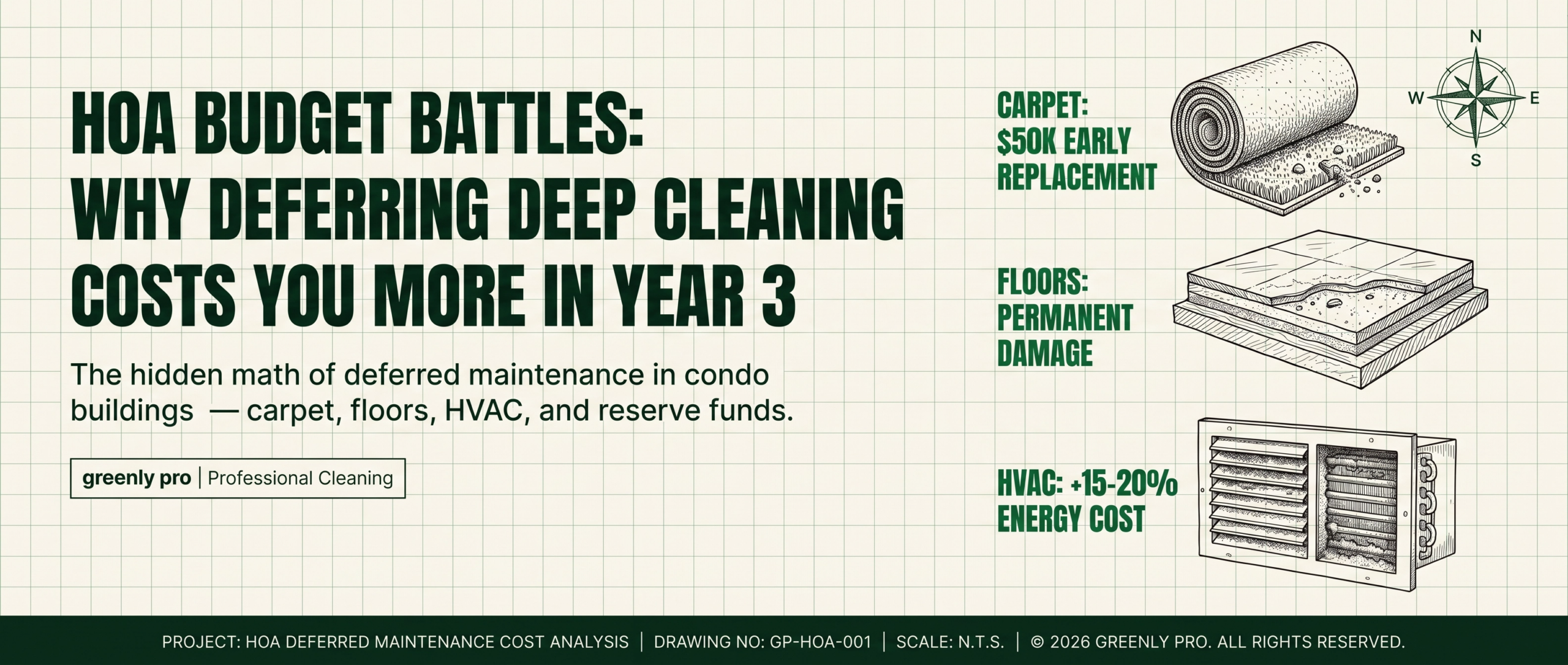
Every HOA board meeting eventually reaches the same standoff. The operating HOA budget is tight, inflation is driving up vendor costs, and the board needs to find ways to keep monthly dues from spiking. The treasurer presents the spreadsheets, the property manager reviews the contracts, and inevitably, someone looks at the maintenance line item and suggests a cut.
“Do we really need to extract the hallway carpets this year? Can we push the hard floor stripping to next spring? The lobby still looks fine. Let’s just stick to the daily janitorial contract and save the deep cleaning money for when we really need it.”
It sounds like a prudent financial decision. In reality, it is a mathematical trap.
When a condo association decides to skip restorative deep cleaning, they are not saving money. They are simply shifting a manageable operational expense into a massive capital expenditure. This practice directly accelerates HOA deferred maintenance costs and guarantees that the association will pay significantly more in Year 3 than they “saved” in Year 1.
The belief that “we can skip the deep clean to save money” is one of the most destructive financial myths in property management. Deferred maintenance does not pause the wear and tear on your building; it accelerates it.
Here is the exact math behind the false economy of deferred maintenance, how it silently destroys your interior assets, and why routine deep cleaning is your most effective tool for protecting your reserve fund.
Cost of Deferred Maintenance
Deferred maintenance is defined as the postponement of scheduled repairs or upkeep due to budget, staffing, or resource constraints. While it often starts as a temporary measure to balance an annual budget, it quickly compounds into a financial crisis.
The financial reality of deferring maintenance is severe, and the multiplier effect is well-documented in the property management industry. According to reserve study analysts at PropFusion, for every dollar saved today by deferring maintenance, multiple dollars will be spent tomorrow. Their industry data indicates that a roof replacement deferred three to five years beyond its useful life can cost 40% to 60% more due to underlying structural damage.
The same compounding multiplier applies to the interior assets of a condo building.
When you defer maintenance, you do not pause the wear and tear on your building. You accelerate it. The dirt, grit, and environmental pressure that professional cleaning removes will continue to degrade your assets, moving them closer to premature failure.
The Psychology of the “Visual Standard”
The primary reason HOA boards fall into the deferred maintenance trap is their reliance on a “visual standard” of cleanliness. If the lobby looks acceptable to the naked eye, the board assumes the building is in good condition.
However, the forces that destroy commercial assets are rarely visible until the damage is irreversible. The microscopic grit at the base of a carpet fiber, the slow erosion of a floor finish, and the accumulation of dust inside HVAC returns do not look like emergencies. By the time these issues become visually obvious—frayed carpets, scratched tiles, or failing mechanical components—the asset is already destroyed.
At that point, cleaning is no longer an option. Replacement is the only remedy.
Carpet Replacement Trap: How $3,000 Turns Into $50,000
Nowhere is the cost of deferred maintenance more obvious, or more expensive, than in common area carpeting.
Condo building hallways endure relentless foot traffic. Residents track in abrasive grit, salt, moisture, and biological contaminants from the outside. Standard daily janitorial vacuuming removes the surface debris, but it cannot extract the heavy, abrasive particles that settle at the base of the carpet fibers.
Every time a resident walks down the hall, their body weight grinds that embedded grit against the synthetic fibers. It acts exactly like sandpaper, slicing the carpet fibers from the bottom up.
If an HOA board decides to skip annual hot water extraction to save a few thousand dollars, that abrasive grit is left to destroy the carpet. By Year 3, the carpet will show irreversible traffic laning, fraying, and matting. It will look ten years old, even if it was installed three years ago.
Cleaning vs. Replacing
The cost of commercial carpet replacement ranges from $2 to $12 per square foot installed, depending on the material and labor complexity. For a mid-sized condo building with 10,000 square feet of common area carpeting, a replacement project will cost between $20,000 and $120,000.
According to the Carpet and Rug Institute, professional cleaning can double or triple the lifespan of commercial flooring.
Let’s look at the financial impact of deferring this maintenance over five years:
•Scenario A (Deferred Maintenance): The HOA saves $3,000 a year by skipping annual hot water extraction. By Year 5, the carpet is structurally destroyed by embedded grit. The HOA must pull $50,000 from the reserve fund for an early replacement. Total 5-year cost: $50,000.
•Scenario B (Proactive Maintenance): The HOA spends $3,000 annually on professional extraction. The carpet lasts its full 15-year life expectancy. The reserve fund remains intact and growing. Total 5-year cost: $15,000.
Saving $9,000 over three years only to trigger a $50,000 capital expense is the definition of a budget failure. The board did not optimize the budget; they simply forced a massive, premature withdrawal from the reserve fund.
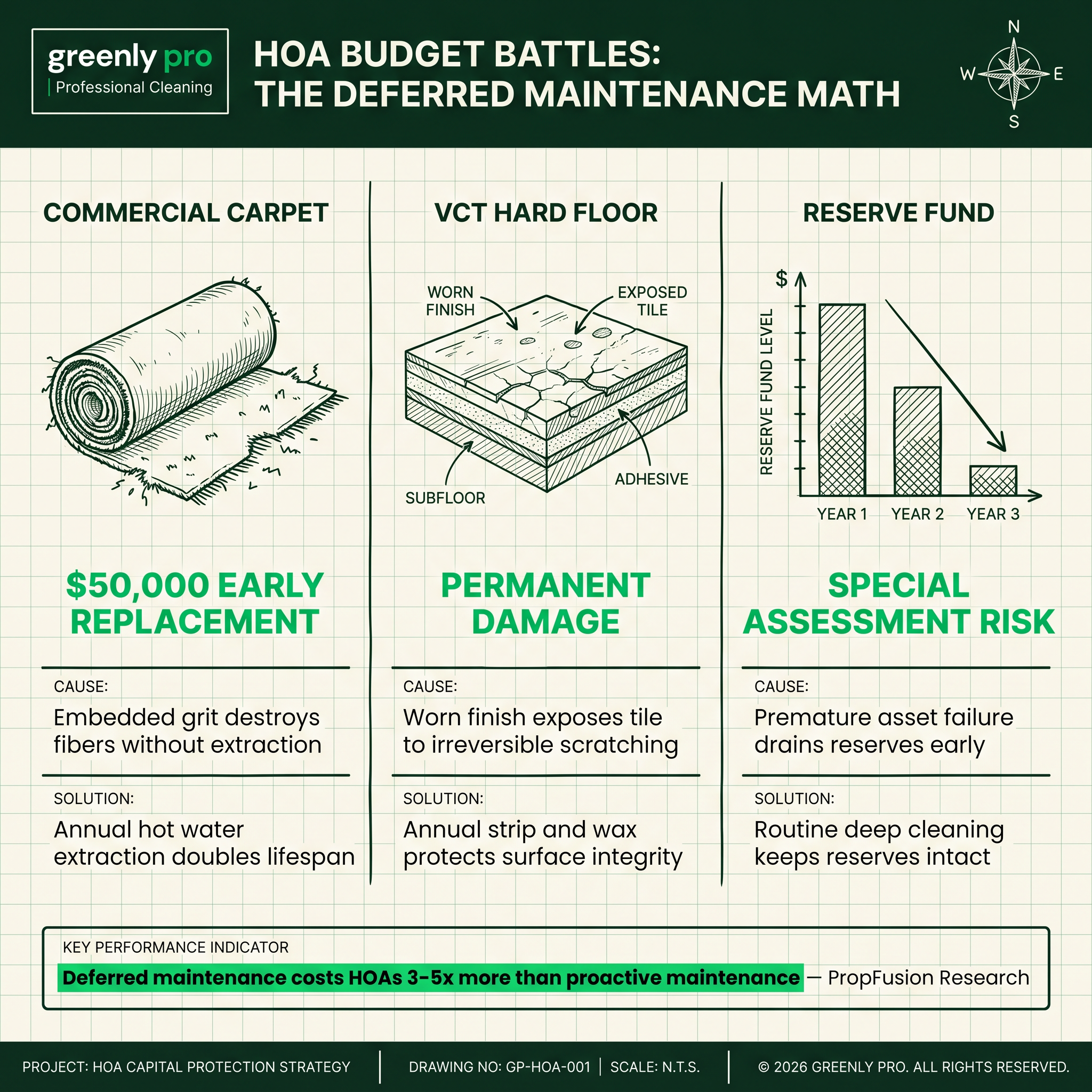
Deferred maintenance shifts costs from the operational budget directly into capital expenditures, draining reserve funds prematurely.
Hard Floors and Permanent Damage
The same deferred maintenance trap applies to hard flooring, particularly VCT (Vinyl Composition Tile) and luxury vinyl plank found in lobbies, mailrooms, and utility areas.
These floors rely on a protective finish (wax or sealant) to shield the actual flooring material from scratches, scuffs, and stains. Over time, foot traffic, cleaning chemicals, and environmental debris wear this finish down. An annual strip and wax protocol removes the degraded finish, cleans the raw tile, and applies a fresh, protective barrier.
When an HOA defers this maintenance to save money, the protective finish eventually wears away completely. Once the raw tile is exposed to foot traffic, it sustains permanent damage. Abrasive particles scratch the surface, and porous tiles absorb stains that can never be removed.
No amount of daily mopping or scrubbing can restore a scratched, porous tile. The only solution is a full floor replacement, another massive hit to the reserve fund that could have been entirely avoided with routine maintenance.
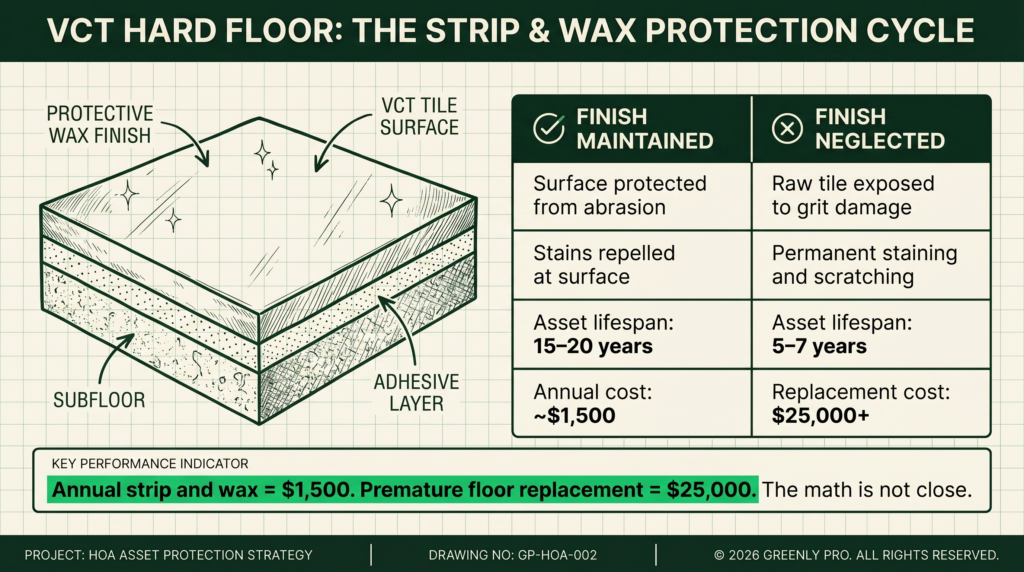
A $1,500 strip and wax cycle is an operational expense. A $25,000 floor replacement is a capital expenditure. When boards skip the former, they guarantee the latter.
HVAC Systems
While flooring is the most visible victim of deferred maintenance, the HVAC system is often the most expensive hidden casualty.
When deep cleaning tasks like high-dusting, carpet extraction, and vent cleaning are deferred, the ambient dust levels in the building rise significantly. The HVAC system pulls this dust-laden air through its returns.
Over time, this dust clogs the filters and cakes the evaporator coils. A clogged system has to run longer and work harder to maintain the desired temperature. This leads to two immediate financial consequences:
- Increased Energy Bills: A dirty HVAC system can consume 15% to 20% more energy than a clean system. The HOA’s monthly utility bills will slowly creep upward, erasing any “savings” generated by cutting the cleaning budget.
- Premature Mechanical Failure: The increased strain on the blower motor and compressor accelerates wear and tear. An HVAC system designed to last 20 years may fail at Year 12, forcing a catastrophic capital expenditure.
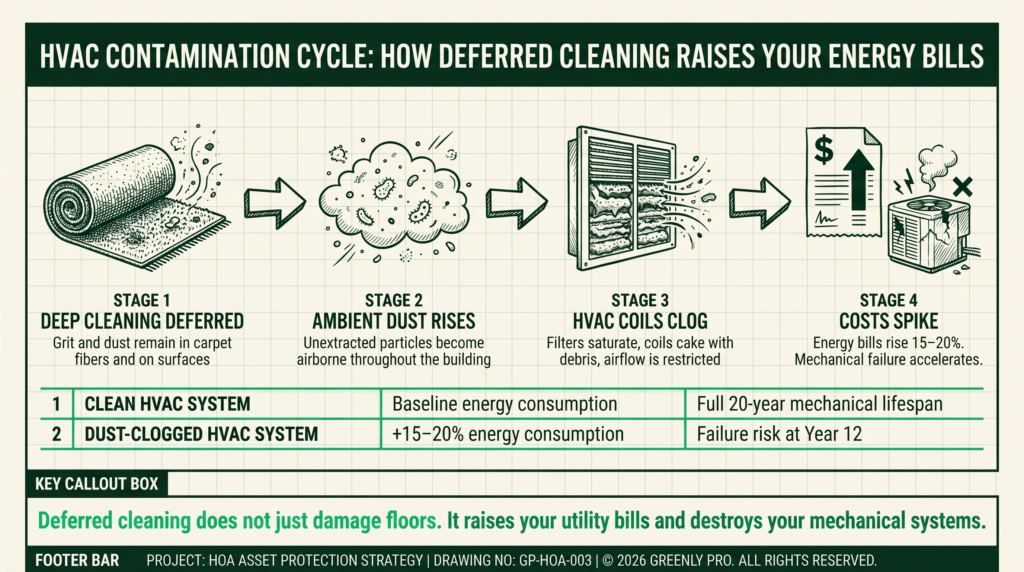
Routine deep cleaning reduces the ambient dust load on the building’s mechanical systems, protecting both the operational utility budget and the long-term capital replacement schedule.
Protecting the Reserve Fund
A healthy HOA reserve fund is typically considered to be between 70% and 100% funded, according to professional reserve studies. This fund is designed to cover the predictable, scheduled replacement of major assets at the end of their useful life.
When a board consistently defers maintenance, they artificially inflate the lifespan of their assets on paper, while actively destroying them in reality.
If the reserve study assumes the hallway carpets will last 15 years, but deferred maintenance destroys them in 7 years, the reserve fund will not have accumulated enough capital to cover the replacement. When those assets fail prematurely, the board is forced to drain the reserve fund faster than anticipated.
The Special Assessment Nightmare
If the reserves are insufficient to cover these premature replacements, the board has only two options: take out an expensive HOA loan, or levy a special assessment against the homeowners.
A special assessment is the fastest way to anger residents, create political turmoil within the association, and drive down property values. Potential buyers scrutinize HOA financials; a history of special assessments and underfunded reserves is a massive red flag that will deter premium buyers and lower the resale value of every unit in the building.
Professional condo building cleaning is not an aesthetic luxury. As we have discussed in our guide on Why Cleaning is Your Most Underutilized Facility Planning Strategy, it is a highly effective capital protection strategy. By shifting the perspective from “janitorial cost” to “asset preservation strategy,” HOA boards can ensure their assets reach their maximum life expectancy, keeping the reserve fund healthy, monthly dues stable, and property values high.
Furthermore, understanding the difference between daily maintenance and restorative care is crucial. In our article Deep Cleaning vs. Regular Cleaning in Boston: What’s the Difference?, we outline how regular cleaning maintains the baseline, while deep cleaning is the restorative “reset” that addresses long-term buildup and protects assets like commercial carpets and VCT flooring.
How to Shift the Board’s Mindset
If you are a property manager or a forward-thinking board member trying to convince a “frugal” board to approve the deep cleaning budget, you must shift the conversation away from aesthetics and toward asset protection.
Here is a simple framework for presenting the case:
- Stop talking about “clean.” Talk about “extraction” and “restoration.” Clean is subjective; extraction is a mechanical necessity.
- Present the replacement cost first. Before asking for $3,000 for carpet cleaning, remind the board that a full carpet replacement will cost $50,000.
- Frame the cleaning as an insurance policy. “We are spending $3,000 this year to insure our $50,000 asset reaches its 15-year lifespan.”
- Demand objective guarantees. Do not hire a vendor who promises a “good job.” Hire a partner who provides published checklists, transparent protocols, and objective guarantees.
Stop Depreciation with Greenly PRO
If your HOA board is debating whether to approve the annual deep cleaning budget, look past the immediate cost and consider the long-term liability. The cheapest cleaning contract is almost always the most expensive decision a board can make.
For 37 years, Greenly PRO has partnered with property managers and HOA boards across Greater Boston to implement restorative cleaning protocols that protect building assets and extend their lifespan. We understand the financial pressures condo associations face, which is why we focus on predictable execution, transparent reporting, and measurable ROI.
We provide the objective guarantees, published checklists, and reliable service required to keep your building defensible, your residents happy, and your budget intact.
Don’t let deferred maintenance drain your reserves and trigger a special assessment.
Contact Greenly PRO today to schedule a comprehensive facility assessment and protect your building’s most valuable assets. You can also review our Office Deep Cleaning Frequency Guide to understand how traffic and building size should dictate your restorative maintenance schedule. For more insights on protecting your property and optimizing your maintenance budget, visit the Greenly PRO Blog.