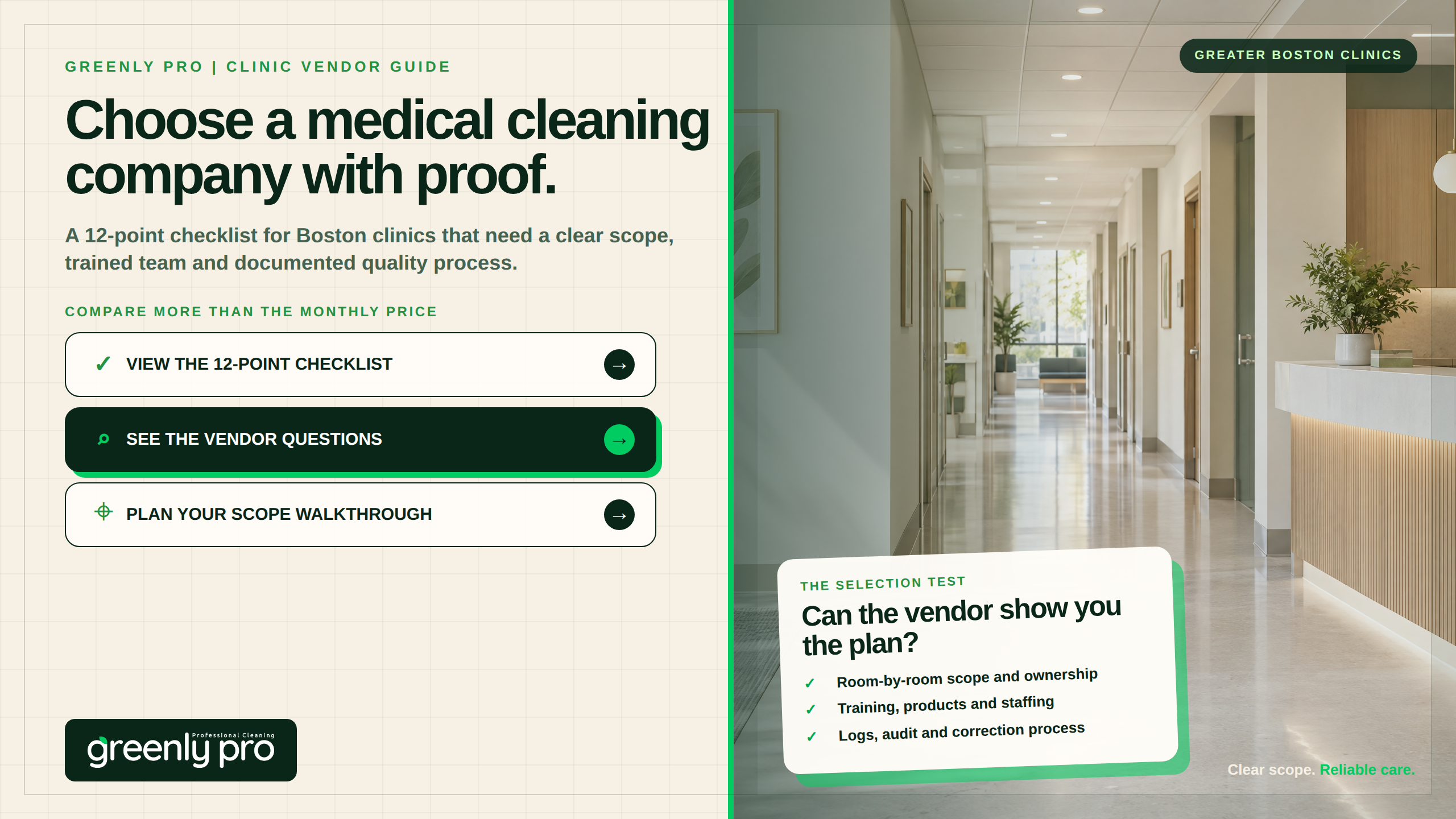
Medical cleaning company Boston searches should lead to a vendor your clinic can verify in the real world. The company should be able to map the rooms it will clean, identify who owns each task, show how its team is trained, name the products and methods used, document the work, and escalate anything outside its scope.
That standard is more useful than a long list of generalized healthcare claims. A strong vendor does not ask you to trust a brochure. It makes the cleaning plan visible enough for your facility leader to inspect.
This 12-point checklist helps Boston medical offices, outpatient clinics, dental practices, therapy centers and medical spas compare a healthcare janitorial vendor before service begins. It is not a substitute for your facility’s infection-prevention policies. It is a way to hire a partner that can work inside them.
Massachusetts DPH coordinates healthcare-associated infection prevention resources with federal, state and local partners. That is a useful reminder that cleaning is one part of a wider care and safety system, not a vendor claim that exists apart from the facility. Massachusetts HAI resources can help a practice find broader infection-prevention information for its setting.
Medical Cleaning Company in Boston: Start With the Care You Deliver
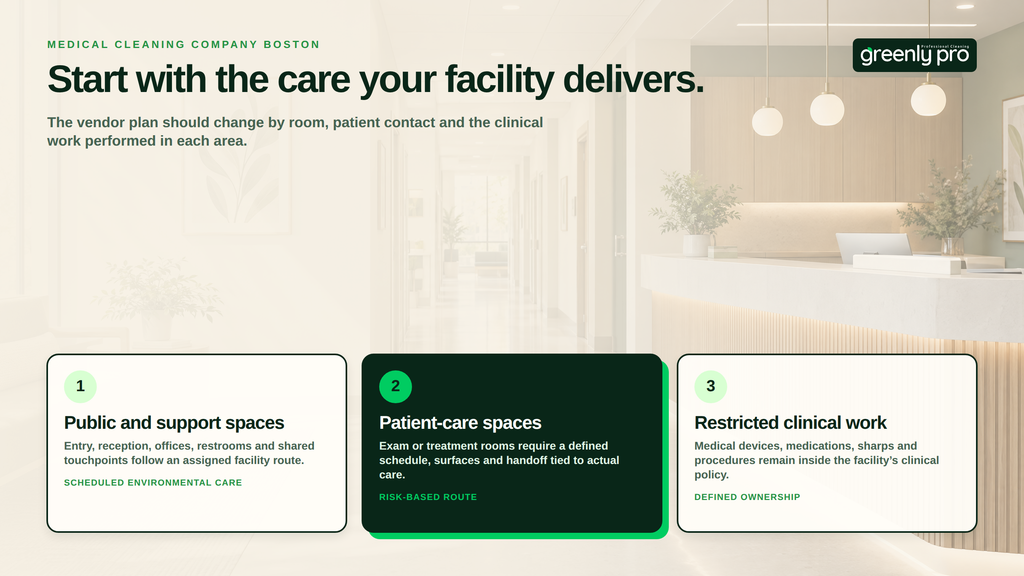
The wrong question is, “Do you clean medical offices?” Almost every clinic cleaning contractor will say yes.
The useful question is, “Can you show how your plan changes for our rooms, patient flow and services?” A medical office with reception, exam rooms and a staff restroom has different needs from an urgent care center, a dental practice with instrument processing, or a specialty clinic with procedure rooms.
The CDC’s outpatient checklist calls for written policies for routine cleaning and disinfection of environmental surfaces that identify responsible personnel. It also says the policies should be appropriate for the services provided by the facility.
Use that principle in the vendor selection process. Ask the medical cleaning company Boston teams you interview to walk the patient journey with you. Start at the entry, then move through reception, restrooms, patient-care areas, staff spaces, storage, and exit. The goal is not to turn every room into a procedure room. It is to understand what each room requires and who owns it.
A medical cleaning company Boston clinic managers can rely on will be comfortable slowing down at this stage. If a vendor cannot explain why one room has a different frequency, product or handoff from another, the scope is not ready for a price comparison.
The 12-Point Checklist for a Healthcare Janitorial Vendor
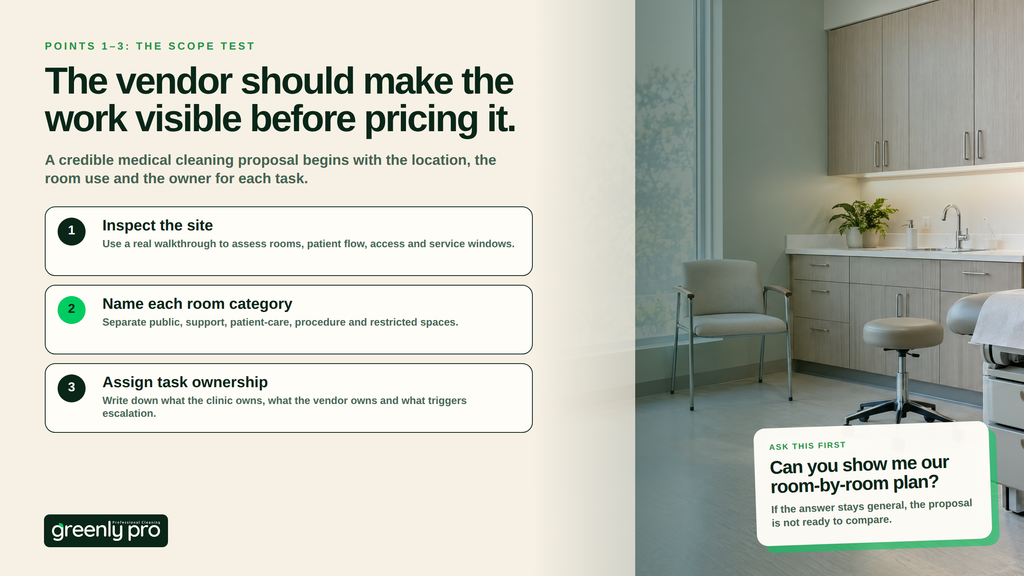
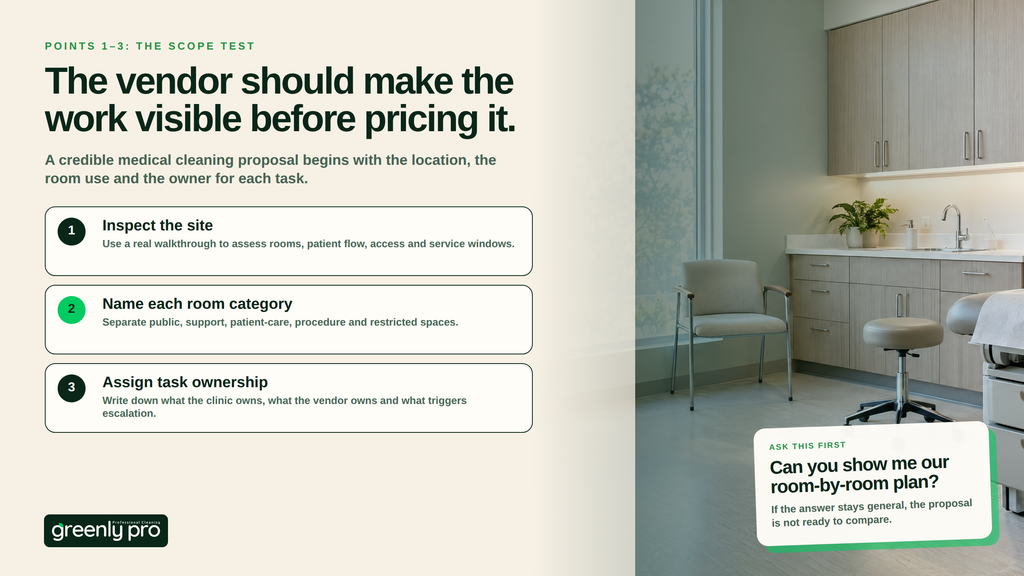
1. Does the vendor inspect the site before pricing?
A square-footage quote can be a starting point. It cannot explain patient flow, access windows, room turnover, waste streams, floor conditions or a clinic’s clinical boundaries. A serious site walkthrough should happen before the scope is finalized.
2. Does the proposal name each room category?
Ask the vendor to separate public spaces, offices, restrooms, patient-care spaces, procedure areas and restricted rooms. The CDC recommends identifying high-touch surfaces through workflow assessment with clinical staff, then putting them into checklists and job aids.
3. Does every task have an owner?
The agreement should state which work belongs to the clinic staff and which belongs to the cleaning team. It should not leave treatment tables, shared noncritical equipment, device reprocessing, medication areas, sharps or body-fluid response as implied responsibilities.
4. Can the vendor show job-specific training?
A general orientation is not enough. Ask what a new team member learns before working independently in your clinic, and what changes when equipment, products or clinic procedures change. CDC’s outpatient checklist expects training before independent environmental-cleaning work, annually and when new equipment or protocols are introduced.
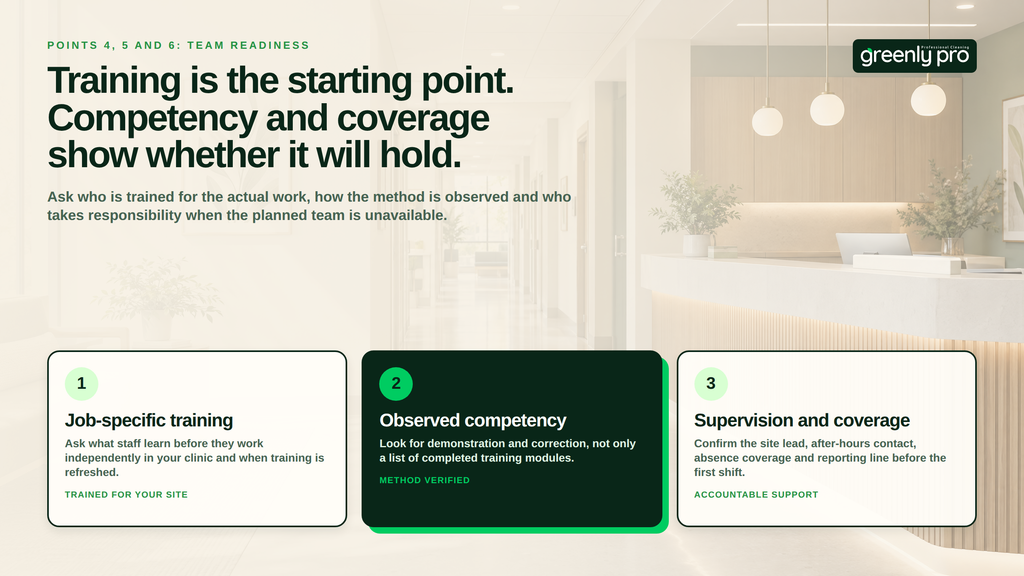
5. Is competency checked, not just attendance?
A training sign-in sheet confirms that someone attended. It does not confirm that the work was performed correctly. Ask how the healthcare janitorial vendor observes cleaning technique, documents competency and addresses a gap. The CDC checklist explicitly distinguishes training from a demonstrated competency check.
6. Who supervises the shift and covers absences?
Find out who performs the first site review, who receives a complaint after hours, and what happens when a scheduled cleaner is unavailable. An external cleaning agreement should name reporting lines, staffing plans and contingency coverage rather than treating them as afterthoughts. As an operational reference for contracted healthcare cleaning, the CDC’s cleaning-program framework identifies all three as core contract elements.
Also ask to meet or speak with the person who will supervise your site. A healthcare janitorial vendor with a clear account contact is easier to manage than one that sends every question through a sales representative who is absent once the agreement is signed.
7. Can they identify products by EPA registration number?
Do not accept “hospital-grade” as the whole answer. Ask for the product list, EPA registration numbers, intended use sites, safety information and the product directions relevant to your surfaces. The EPA explains that products can share a name family or branding, while the EPA registration number is the accurate way to identify the registered product.
8. Does the process include the label’s contact time and equipment compatibility?
A disinfectant only works as its label directs. EPA says the surface must stay visibly wet for the full contact time. A vendor should also know what the clinic’s treatment tables, devices and finishes can tolerate. This is not an abstract detail. It affects which product is used, how the shift is timed and when a surface can be returned to service.
Ask the clinic cleaning contractor to show the product-control sheet used on site. It should tell the team what product is approved, where it may be used, how it is applied and what the facility expects when a product, surface or piece of equipment is not on the list.
9. Does the proposal say what the vendor will not do?
This is a strength, not a limitation. A capable clinic cleaning contractor should set a clear boundary around clinical responsibilities. That usually includes sterile processing, reusable medical-device reprocessing, medication handling, injection turnover, sharps handling and other work that requires facility-specific clinical training or authorization.
Greenly PRO’s resource on the Massachusetts janitorial scope gap helps explain why a clean-looking agreement can still leave important work undefined.
10. Is there a written exception and spill-response path?
Ask who the cleaner contacts, what number they use, what they record and when they stop. The OSHA Bloodborne Pathogens Standard requires a written cleaning and decontamination schedule based on the location, surface, soil and tasks or procedures in the area. It also requires decontamination after contact with blood or other potentially infectious materials.
A vendor does not become safer by pretending every event fits routine cleaning. The reliable answer is an escalation path your clinic lead can understand before the event occurs.
11. Will the vendor document completion and exceptions?
A useful service log records the area, the type of session, date, person completing the work and any issue that requires follow-up. CDC cleaning-program guidance describes checklists and logs as tools for completing SOPs and creating accountability records.
The format can be simple. What matters is that the clinic can see whether the planned work happened and whether a problem was handed off.
12. How will performance be audited and corrected?
Ask to see the first 30-day quality-review process. Who inspects? What is measured? How quickly are missed items corrected? How does the clinic receive the report? CDC’s outpatient checklist calls for routine, documented audits of cleaning and disinfection procedures and feedback to personnel.
A medical cleaning company should welcome this conversation. A quality check is not an accusation. It is the practical way to keep standards aligned after the first week of service.
Ask for the correction pathway too. The strongest answer is specific: how the clinic reports an issue, who reviews it, when the correction is confirmed and how a repeated issue changes the work plan. This is where a medical cleaning company in Boston facilities separates itself from a vendor that simply promises to “make it right.”
Compare the Proposals Using the Same Evidence
Use the same 12 questions with every healthcare janitorial vendor. Otherwise, the polished proposal often wins simply because it is easier to read.
Bring the printable 12-point medical cleaning company checklist to every site walkthrough and proposal review. It gives your team one shared evaluation standard and makes missing information easier to spot.
Price still matters. It is just more useful after you know what the price includes. One proposal may cover scheduled public-area cleaning only. Another may include documented patient-care area routines, supervision, product controls and a correction process. Those are different services, even if both lines say “medical cleaning.”
When a medical cleaning company Boston quote looks lower, ask which of the 12 points were removed, assumed or assigned back to your staff. That question gives you a fairer basis for comparing cost without turning the process into a negotiation over slogans.
If the answers are vague, ask the vendor to revise the scope before you compare the monthly figure. A clear proposal protects both sides because it makes the expected result, handoff and response path easier to manage.
You can also review Greenly PRO’s guides to healthcare facility cleaning, urgent care cleaning and physical therapy clinic cleaning for examples of how the scope changes by clinical setting.
Bring This Checklist to the Walkthrough
The best selection process ends where service will actually happen: on site, with the people who understand the patient flow and the people accountable for the cleaning route.
Bring the checklist. Ask for examples. Make uncertain responsibilities visible. Then choose the team whose answers can be written into a usable plan.
For Greater Boston facilities that want to begin with a structured scope walkthrough, request an estimate at greenlypro.com/estimate. Greenly PRO will start with the facility, the schedule and the practical responsibilities that need to be clear before the first shift.