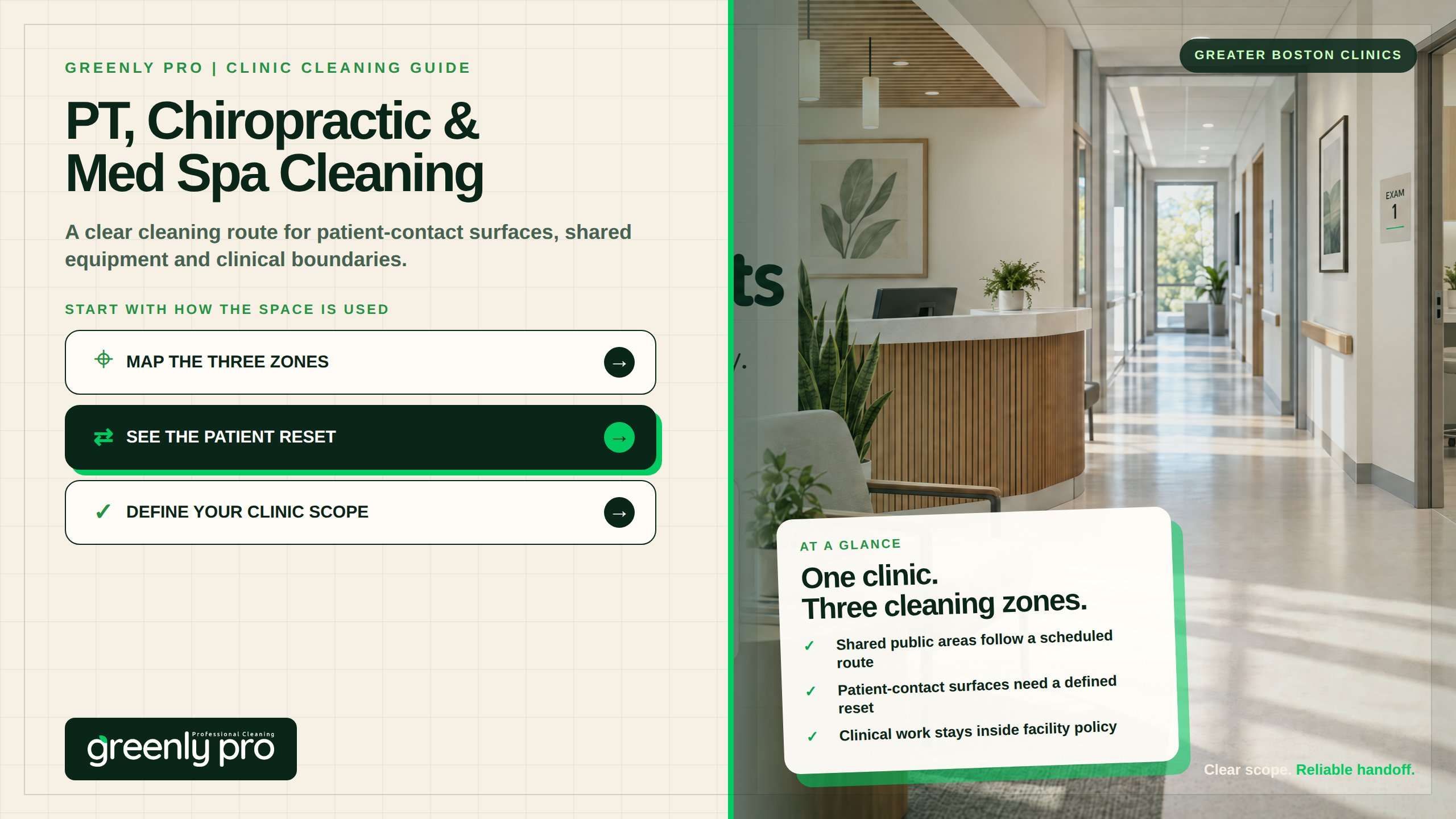
Physical therapy clinic cleaning should follow a written route based on patient contact, shared equipment, visible soil and the procedures performed in each room. In practice, that means defining the between-patient reset for treatment tables and shared rehab equipment, then expanding the route at close to cover lower-touch surfaces and floors. The facility’s policy, equipment instructions and product labels set the exact method.
That is more useful than asking a cleaning team to “sanitize the gym.” A therapy clinic has a reception flow, patient-contact surfaces, treatment rooms, exercise equipment, laundry or wet-area needs, and sometimes clinical services that do not belong in a standard after-hours scope.
The same logic applies to chiropractic office cleaning and med spa cleaning Boston operators may need. The service can look similar from the lobby. The cleaning scope should not be the same.
This guide treats physical therapy clinic cleaning as an operating system, not an after-hours task list.
Start With the Real Patient Journey, Not a Generic Checklist
A practical route starts where patients and staff actually move. A patient may touch the entry door, check in, sit in reception, use a treatment table, handle resistance bands or weights, use a restroom and leave through the same path. Each point has a different exposure pattern and a different owner.
The CDC’s core practices apply across healthcare settings, including physical therapy and rehabilitation centers. They call for routine and targeted cleaning based on patient contact and soil, with more frequent cleaning and disinfection for surfaces close to the patient and frequently touched surfaces.
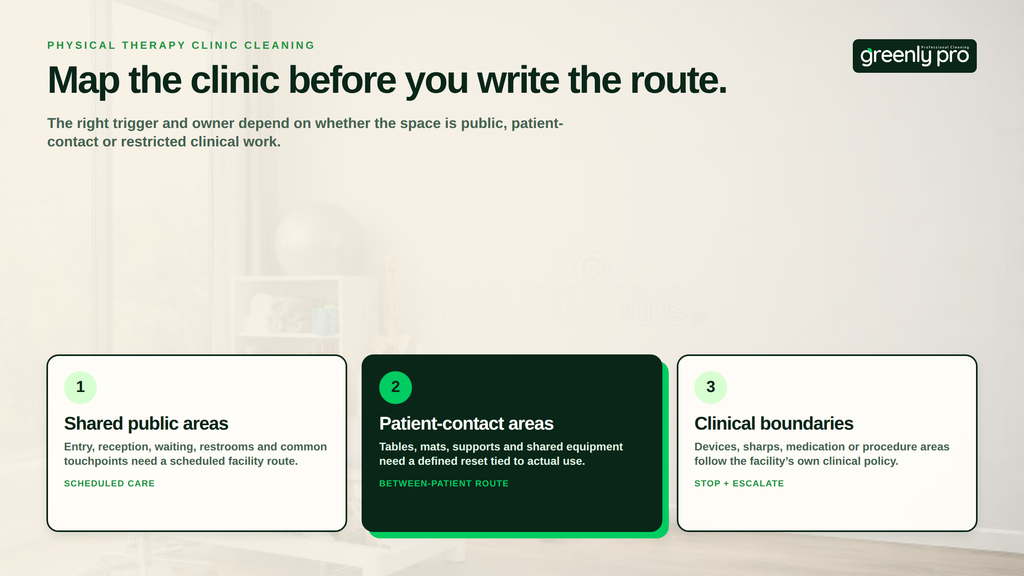
For an outpatient therapy or chiropractic office, group the site into three working zones:
- Shared public areas: entry points, reception, waiting chairs, restrooms and common touchpoints. These need a scheduled route and prompt attention when visibly soiled.
- Patient-care and active-treatment areas: treatment tables, supports, stools, therapy equipment handles, controls and the immediate floor area. These need a defined turnover process tied to actual use.
- Restricted clinical or specialty areas: medication preparation, sharps, reusable medical devices, injections, lasers or any invasive procedure. These require the facility’s own infection-prevention plan and trained, assigned personnel.
That physical therapy clinic cleaning map prevents the common scope gap: an excellent evening clean that never addresses the surfaces a patient touches between appointments, or a cleaning team being quietly expected to handle a task it was never trained or authorized to perform.
Physical Therapy Clinic Cleaning Between Patients
The critical moment in a busy PT practice is the reset between patients. It does not need to be elaborate. It does need to be specific.
A physical therapy clinic cleaning plan should list the patient-contact surfaces in each treatment space. That may include the treatment table or mat, face cradle or support, stool, treatment handles, shared equipment touchpoints and the floor area affected by the session. The facility should decide which of those tasks occur after every use, which occur on a scheduled cadence and which belong to the clinical team rather than an after-hours provider.
The CDC’s outpatient guidance says shared noncritical patient-care equipment should be cleaned and disinfected before and after each use with a compatible product. It also recommends cleaning and disinfection of patient-zone high-touch surfaces before and after every patient in general procedure rooms. The right clinic route adapts that principle to the real equipment and care model, rather than copying an operating-room checklist.
Use manufacturer instructions when cleaning equipment. Some treatment-table upholstery, electronic controls, tubing, mats and exercise equipment can be damaged by incompatible products. CDC similarly notes that compatible cleaning and disinfectant products should be identified through the manufacturer’s instructions or the manufacturer.
Chiropractic Office Cleaning
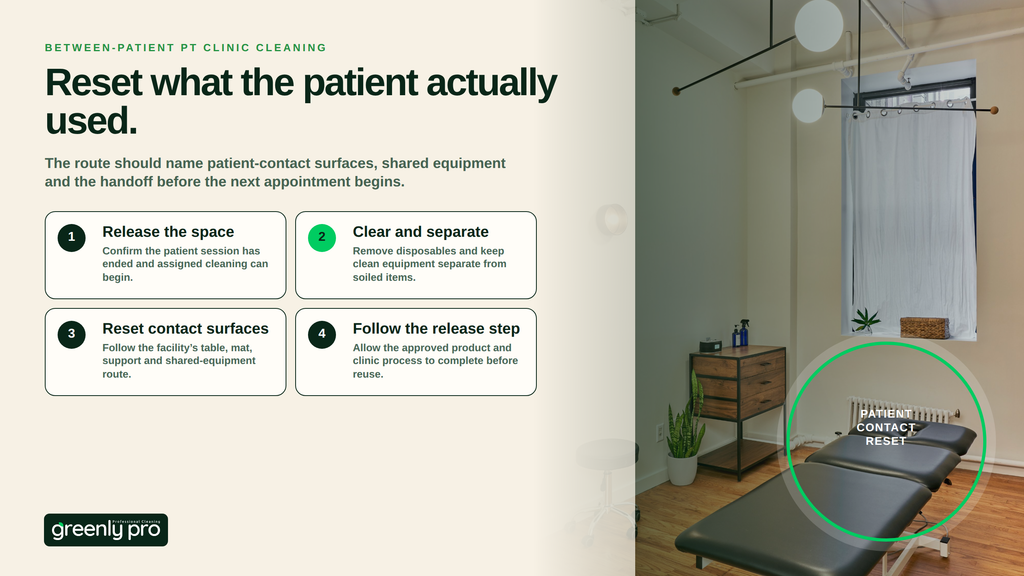
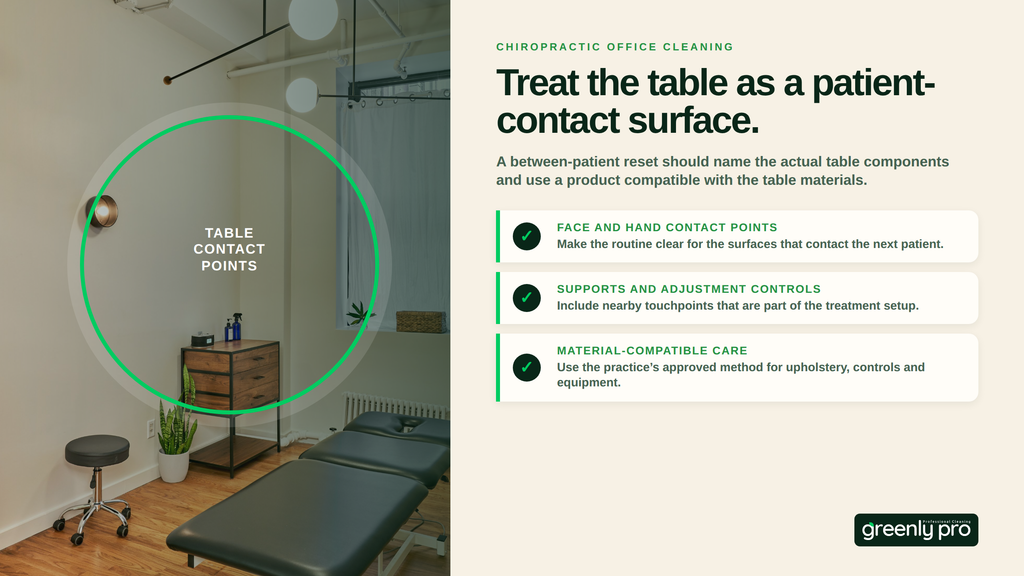
Chiropractic office cleaning has a simple priority: the treatment table needs an explicit between-patient routine. It is not just furniture. It is a contact surface where hands, face, chest and clothing may repeatedly meet the same vinyl, paper holder, adjustments and supports.
A peer-reviewed chiropractic paper noted frequent hand-to-patient contact and the need to consider treatment-table surfaces in routine infection-control practice. It also emphasizes manufacturer-compatible care for vinyl-covered treatment tables. The article is useful background, but a current facility policy and product directions should always control.
For the clinic manager, the useful question is not “Was the room cleaned?” It is: “Which table components are reset after every patient, who does it, and how do we know the material is protected?” That question brings the treatment table, face section, adjustment controls and nearby high-touch surfaces into a manageable route.
Med Spa Cleaning Boston: Separate Hospitality From Clinical Procedure Scope
A polished med spa can make every room look low risk. The operating question is not how polished the space feels. It is whether a room is used only for hospitality and nonmedical services, or whether it supports a medical procedure.
The Massachusetts DPH advisory says medical spas providing medical services may be subject to clinic licensure, unless an exemption applies. It identifies laser, light and radiofrequency devices, chemical peels, fillers, botulinum toxin and sclerotherapy as examples of medical procedures or treatments.
That makes med spa cleaning Boston a scope-design issue. The lobby, retail surfaces, restroom and general service areas can follow a clear hospitality and environmental-cleaning plan. A room where medical procedures occur needs the facility’s specific clinical policies, trained staff and appropriate oversight. A commercial cleaning provider should not infer responsibility for sharps, medication areas, reusable medical devices, injection turnover, body-fluid spills or procedure-room clinical work.
If the division is unclear, stop and map the room with the practice lead before a proposal is signed. The goal is not to make the scope complicated. It is to avoid an unsafe assumption at the end of the day.
Clean First, Then Follow the Product Label
Cleaning removes soil. Disinfection uses a product with a specific approved use and contact time. Those steps cannot be collapsed into a generic promise to “wipe everything down.”
The EPA says a disinfectant label identifies where a product may be used, how it is applied and how long it must remain on the surface to work. The surface must stay visibly wet for the full labeled contact time, which may require reapplication.
For a PT, chiropractic or med-spa environment, that affects both scheduling and materials. A product can be effective only when it is used on its approved surface, at the right dilution if relevant, for its stated contact time. It also has to be compatible with the equipment and upholstery the practice uses. The physical therapy clinic cleaning route has to make that timing visible.
Build a short product-control card for every location. It should identify the approved product, target surfaces, manufacturer compatibility notes, storage location and the role responsible for its use. Update it when products or equipment change.
Keep Clinical Responsibilities and Cleaning Responsibilities Visible
The safest scope is one that states both what the provider does and what the provider does not do.
The CDC outpatient checklist calls for written environmental-cleaning policies that identify responsible personnel. It expects training before independent work, annually and when equipment or protocols change, plus competency checks, monitoring and feedback. If environmental cleaning is contracted, the facility still needs to verify those requirements are met.
The OSHA standard adds a separate housekeeping obligation wherever occupational exposure may exist. Employers must implement a written cleaning and decontamination schedule based on the location, surface, soil and procedures performed. Contaminated equipment and surfaces must be decontaminated after a procedure, promptly after visible contamination or a spill, and at end of shift if contamination may have occurred.
This is why an after-hours scope needs an escalation rule. When the team finds a spill, an unfamiliar device, a sharps container, a medication station or an area outside the written plan, the right action is to stop and contact the designated facility lead. Not to improvise.
Greenly PRO’s guide to the Massachusetts janitorial scope gap explains why explicit handoffs matter wherever commercial cleaning meets patient care.
End-of-Day Physical Therapy Clinic Cleaning: Expand the Route
The closing route should not repeat the patient turnover. It should widen it.
CDC’s outpatient guidance uses a similar distinction for general procedure rooms. The between-patient route focuses on patient-zone high-touch surfaces, while end-of-day terminal cleaning adds high-touch surfaces beyond the patient zone, low-touch surfaces and the entire floor with portable equipment moved.
For a therapy clinic, that logic can guide the end-of-day plan without treating every room as a procedure room. Close out the surfaces that are not reached in a rapid between-patient reset. Include reception, door hardware, restroom touchpoints, treatment-room surfaces, staff areas assigned in the scope and the floor route. Address equipment only as the facility policy and manufacturer instructions allow.
A thoughtful end-of-day route protects more than appearance. It makes the morning opening simpler because each area has a known condition and an accountable handoff. That is the closing standard a physical therapy clinic cleaning scope should make visible.
What to Ask Before You Hire a PT, Chiropractic or Med Spa Cleaning Provider
Before comparing prices, walk the site with the questions that shape the actual scope:
- Which surfaces receive patient contact between appointments?
- Which shared equipment needs a facility-defined reset before another patient uses it?
- Are there wet areas, laundry, restrooms or staff spaces that change the route?
- Which rooms support medical procedures, injections, lasers or reusable devices?
- Who owns patient turnover, after-hours cleaning, spill response and quality review?
- How will exceptions be recorded and escalated?
Greenly PRO’s healthcare facility cleaning guide and urgent care cleaning resource show how a facility’s workflow should set the cleaning plan, not the other way around.
For Greater Boston clinics that need a clearly defined nonclinical and after-hours scope, request a walkthrough at greenlypro.com/estimate. The goal is a physical therapy clinic cleaning route that staff can follow, patients can trust and management can verify.