OSHA compliance in industrial cleaning is not just a checkbox for facility managers in Massachusetts—it is the foundation of operational continuity and risk management. Managing an industrial facility requires balancing relentless operational efficiency with strict adherence to safety regulations. For facility managers overseeing a warehouse, manufacturing plant, or distribution center, ensuring that commercial cleaning protocols align with OSHA standards is a legal and moral imperative.
When a facility manager hires an industrial cleaning vendor, they are not just outsourcing a task; they are extending their liability. If your cleaning contractor uses the wrong degreaser, fails to properly mark a wet floor, or mishandles a chemical spill, it is your facility that faces the OSHA citation, the workers’ compensation claim, and the operational downtime.
In the industrial sector, cleaning is fundamentally an act of risk management. This guide breaks down the specific OSHA compliance in industrial cleaning standards, focusing on the highest-risk areas: heavy-duty degreasing, spill response, and general warehouse safety standards.
Foundation of Compliance: Hazard Communication (29 CFR 1910.1200)
The backbone of OSHA compliance in any industrial setting is the Hazard Communication Standard (HazCom). This standard ensures that information about chemical and toxic substance hazards is disseminated to workers and that protective measures are clearly communicated .
Cleaning industrial spaces often requires heavy-duty degreasers, industrial solvents, and specialized floor strippers. These are not consumer-grade products; they are potent chemicals that present significant risks if improperly handled.
Safety Data Sheets (SDS) and Labeling
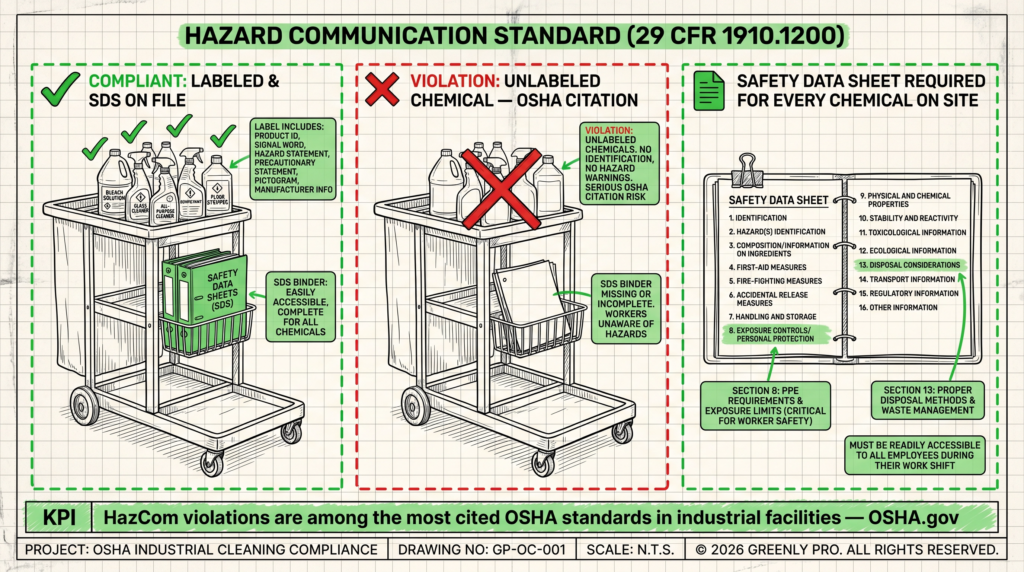
A compliant industrial cleaning partner must maintain accessible Safety Data Sheets (SDS) for every chemical brought onto your site. If an OSHA inspector walks your floor and finds an unlabeled spray bottle of degreaser on a janitorial cart, that is an immediate violation.
Furthermore, the cleaning contractor must document that their staff has undergone rigorous training on the safe handling, dilution, and disposal of these hazardous substances. As the facility manager, you have the right—and the responsibility—to request these training records and SDS binders at any time. This level of transparency is exactly what separates a true partner from a liability, a concept we explore deeply in our guide on How to Choose a Commercial Cleaning Service in Massachusetts.
Walking-Working Surfaces and Slip Prevention (29 CFR 1910.22)
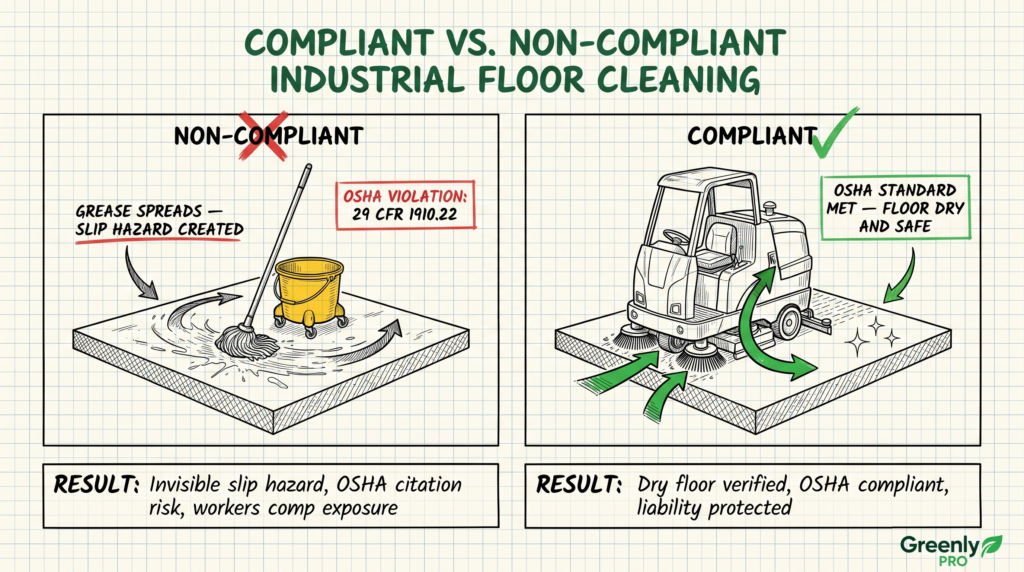
Slips, trips, and falls are consistently among the leading causes of workplace injuries and fatalities. OSHA’s Walking-Working Surfaces standard (29 CFR 1910.22) explicitly requires that all places of employment, passageways, storerooms, and walking-working surfaces are kept in a clean, orderly, and sanitary condition at all times .
In a manufacturing or warehouse setting, oil spills, forklift grease buildup, and debris are constant threats. A compliant cleaning program must include strategic floor care protocols executed with proper industrial equipment.
The Danger of Consumer Equipment in Industrial Spaces
One of the biggest red flags in industrial cleaning is a vendor attempting to clean a 50,000-square-foot warehouse with a standard mop and bucket.
When dealing with industrial grease, a traditional mop merely spreads the contaminant, creating a massive, invisible slip hazard. Compliant industrial floor care requires heavy-duty ride-on scrubbers equipped with the correct degreasing solutions and industrial squeegees that leave the floor immediately dry and safe for foot and forklift traffic. This is a classic example of the Janitorial Scope Gap, where standard contracts fail to address specific industrial facility needs.
Industrial Degreasing
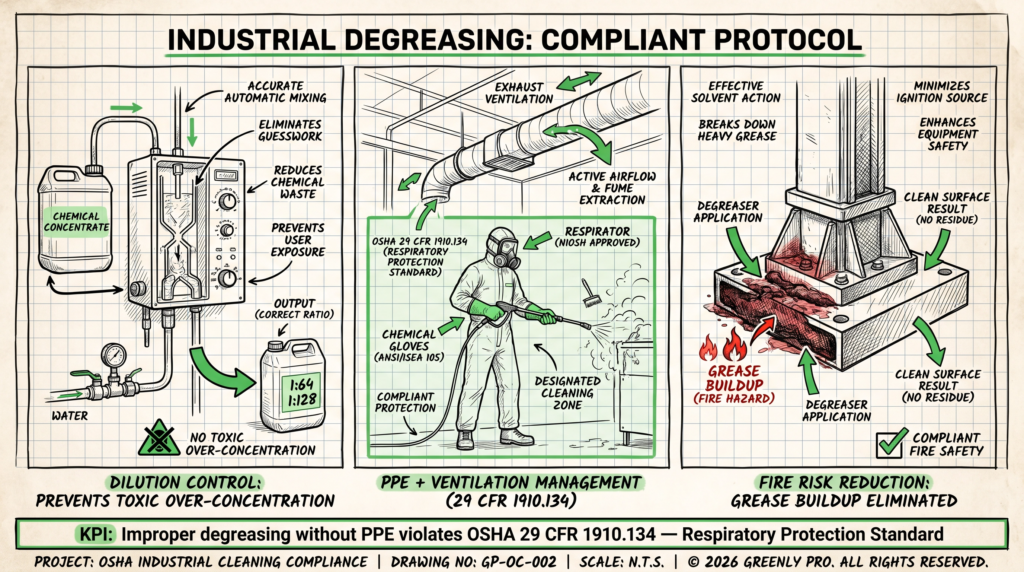
Degreasing is a critical component of industrial cleaning, but it is also one of the most hazardous. The buildup of oils and lubricants on machinery and floors not only creates slip hazards but also significant fire risks.
However, the solvents used to cut through heavy industrial grease often emit Volatile Organic Compounds (VOCs). If a cleaning crew applies heavy degreasers in a poorly ventilated warehouse aisle without proper respiratory protection, they are violating OSHA standards and endangering your workforce.
Compliant Degreasing Protocols
A professional industrial cleaning service mitigates these risks through strict protocols:
- Proper Dilution Control: Using automated dilution systems to ensure chemicals are mixed to the exact manufacturer specifications, preventing toxic over-concentration.
- Ventilation Management: Coordinating deep degreasing tasks during off-hours or ensuring localized exhaust ventilation is active.
- Appropriate PPE: Ensuring cleaning staff are equipped with heavy-duty chemical gloves, safety goggles, and, when necessary, OSHA-approved respirators (29 CFR 1910.134) .
Hazardous Waste Operations and Emergency Response (HAZWOPER)
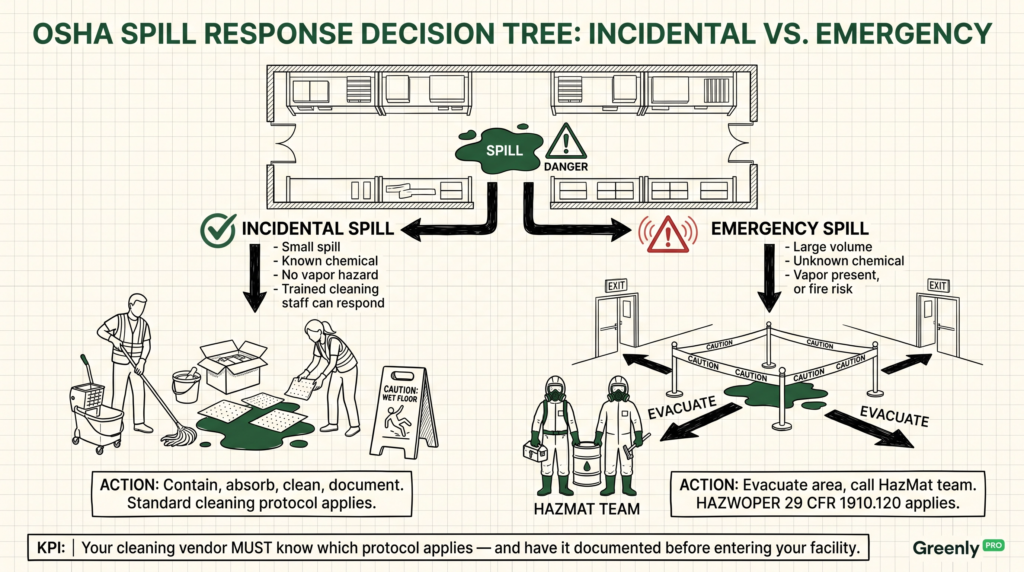
In an industrial facility, a spill is rarely just a spill. Whether it is a ruptured drum of hydraulic fluid or a leaked chemical solvent, the response must be immediate and strictly regulated.
OSHA’s Hazardous Waste Operations and Emergency Response (HAZWOPER) standard (29 CFR 1910.120) dictates exactly how chemical spills must be handled . Standard janitorial staff are generally not trained or legally permitted to handle significant hazardous material spills.
The Difference Between Incidental and Emergency Spills
OSHA distinguishes between “incidental” spills (which can be cleaned up by employees in the immediate area who understand the hazards) and “emergency” spills (which require a specialized HAZWOPER-trained response team).
Your commercial cleaning vendor must have a clearly documented protocol that defines their limits. A compliant vendor will properly contain and clean an incidental spill of standard cleaning chemicals or minor oil drips, but they must also know exactly when to secure the perimeter and escalate a major chemical spill to a certified HazMat team.
Combustible Dust: The Invisible Explosion Hazard
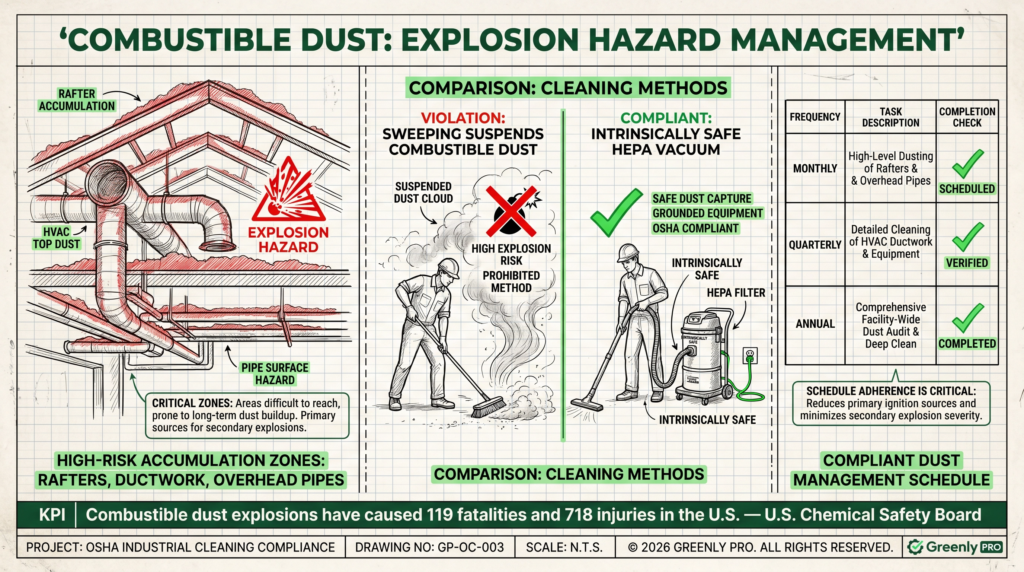
One of the most catastrophic hazards in industrial facilities is combustible dust. Materials like wood, metal, grain, and certain plastics generate dust that, when suspended in the air in the right concentration, can ignite and cause devastating explosions.
Standard sweeping or using compressed air to clean machinery is a severe OSHA violation in these environments because it kicks settled dust into the air, creating an explosive cloud.
Compliant Dust Management
Managing combustible dust requires specialized equipment and training:
- Intrinsically Safe Equipment: Using explosion-proof HEPA vacuums rated specifically for combustible dust environments.
- High-Level Dusting: Implementing a strict schedule for cleaning rafters, HVAC ductwork, and overhead pipes where dust accumulates unnoticed.
Aligning Your Cleaning Strategy with OSHA Compliance
Selecting the right commercial cleaning partner is one of the most consequential decisions a facility manager will make. The wrong vendor exposes your operation to OSHA fines, workplace injuries, and costly insurance claims.
If you are evaluating your current facility maintenance plan, consider how cleaning impacts your broader operational goals. For a deeper understanding of this dynamic, read our guide on Why Cleaning is Your Most Underutilized Facility Planning Strategy.
Furthermore, ensuring your facility receives the correct level of deep cleaning is vital for long-term compliance. Learn more about the necessary frequency in our Office Deep Cleaning Frequency Guide.
Is your industrial cleaning vendor protecting you from liability, or creating it?
Achieving true OSHA compliance in industrial cleaning requires more than good intentions; it demands specialized equipment, rigorous training, and unwavering operational discipline. Greenly PRO partners with industrial facility managers across Massachusetts to implement rigorous, OSHA-compliant cleaning protocols. We provide the industrial equipment, the documented training, and the safety-first approach your operation demands.
Don’t wait for an OSHA inspection to reveal the gaps in your cleaning program. Contact Greenly PRO today for a comprehensive facility compliance assessment.